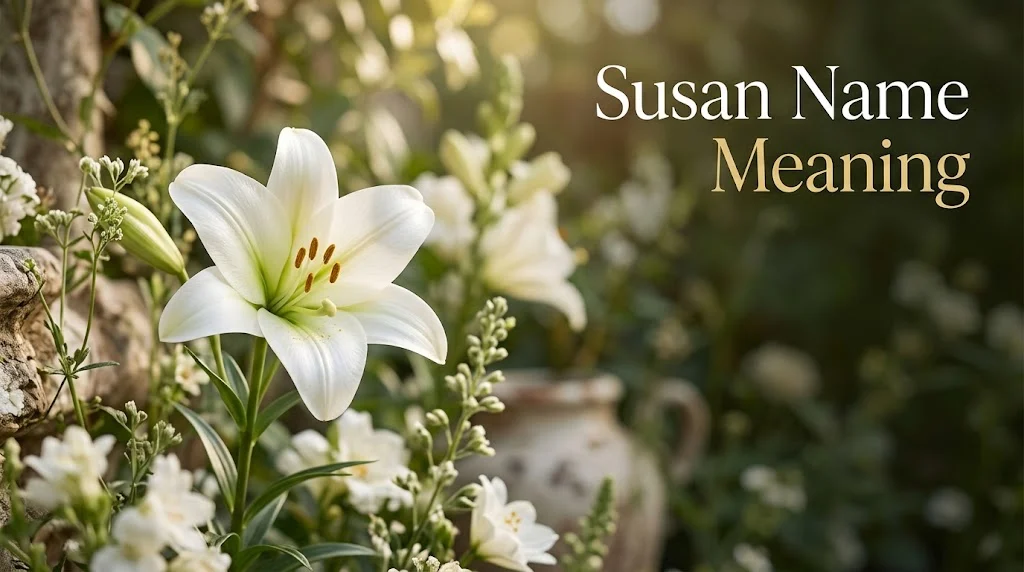
The Susan name meaning is traditionally connected with the Hebrew name Shoshannah, commonly interpreted as “lily” or “lily flower.” Susan is an English form related to Susanna and ultimately traces its linguistic roots to Hebrew. Because of its floral meaning and biblical history, the name is often associated with beauty, purity, grace, and natural elegance.
Susan has been used for centuries across different languages and cultures. It became particularly established in English-speaking countries, where it was once a highly familiar traditional girls’ name. Although its popularity has changed over time, Susan remains recognizable and carries a classic rather than newly invented feel.
This guide explores the meaning, Hebrew origin, biblical connection, pronunciation, history, symbolism, popularity, variations, related names, and common questions about Susan.
What Is the Susan Name?
Susan is a traditional feminine given name that developed through English usage from forms such as Susanna and Susanne. Its ultimate linguistic source is the Hebrew name Shoshannah.
The name is generally associated with the meaning “lily.” Some sources also connect the underlying Hebrew word with the broader idea of a flower, particularly the lily.
Susan became established in English alongside related forms found in other European languages. Its long history gives it a traditional character, while its floral meaning gives the name a softer natural association.
A concise definition is:
Susan is a feminine name of Hebrew origin, derived through forms such as Susanna, and traditionally associated with the meaning “lily” or “lily flower.”
The name should not be confused with every name that happens to sound similar. Susan, Susanna, Suzanne, and related forms share historical connections, while names with similar sounds may have completely different origins.
Susan Name Meaning
The traditional Susan name meaning is “lily.” The meaning comes from the Hebrew name Shoshannah, which is generally associated with the lily flower.
The lily has long carried symbolic associations in different cultural and religious traditions. As a result, the name Susan can evoke ideas such as:
- Beauty
- Purity
- Grace
- Gentleness
- Natural elegance
- Freshness
- Simplicity
- Spiritual symbolism
These qualities are symbolic associations rather than literal definitions of the name. Susan does not literally mean “pure” or “graceful”; its direct traditional meaning is connected with the lily.
The floral meaning gives Susan a distinctive quality among traditional names. It has a familiar sound and long history while retaining a connection with nature.
Susan Origin and Etymology
Susan ultimately comes from the Hebrew name Shoshannah, commonly represented in English transliteration as Shoshana or Shoshannah.
The Hebrew form is associated with the word for lily. Through historical transmission, the name appeared in Greek and Latin forms before developing into different forms in European languages.
One important form is Susanna, which appears in biblical and Christian traditions. From related forms, names such as Susan, Susanne, and Suzanne developed in different languages.
The basic historical pathway can be represented broadly as:
Hebrew Shoshannah → Greek Sousanna → Latin Susanna → European forms → English Susan
Historical transliteration can vary, so this should be viewed as a general linguistic development rather than a single perfectly uniform spelling chain.
The connection with the lily is the most important part of the name’s etymology. It explains why Susan has a floral meaning despite sounding quite different from the English word “lily.”
Susan Biblical Meaning and Connection
Susan has an important biblical connection through the related name Susanna.
Susanna appears in the Book of Luke in the New Testament as one of the women associated with Jesus and his disciples. The name is therefore part of the broader biblical naming tradition.
The underlying name is also connected with Shoshannah, a Hebrew floral term traditionally associated with the lily.
It is important to distinguish between Susan and Susanna when discussing biblical names. Susan is an English form related to Susanna, while Susanna is the form that appears directly in biblical and Christian textual traditions.
For families interested in biblical or Hebrew-derived baby names, Susan can therefore have significance beyond its floral meaning.
History and Cultural Context of Susan
Susan has a long history of use across Europe and became especially familiar in English-speaking communities.
The related form Susanna was used in Christian Europe because of its biblical association. Over time, different languages developed their own forms, including Susanne in some Germanic and Scandinavian contexts and Suzanne in French.
The English form Susan became particularly established in Britain and later in North America.
During the twentieth century, Susan became a very familiar girls’ name in the United States. It was especially prominent during the middle decades of the century. Its later decline in new-baby usage does not erase its historical importance; instead, it has contributed to Susan being perceived today as a distinctly classic or traditional name.
The name also became widely recognizable through literature, entertainment, historical records, and everyday use. Because of its long period of popularity, many people associate Susan with an established, familiar naming tradition rather than a contemporary naming trend.
How Do You Pronounce Susan?
Susan is generally pronounced:
SOO-zən
In many English-speaking varieties, the first syllable receives the main stress.
The name has two syllables:
Su-san
A simple phonetic approximation is SOO-zuhn.
The pronunciation is generally straightforward for English speakers, which is one reason the name has remained easily recognizable across generations.
Different languages may pronounce related forms differently. For example, the French Suzanne has a distinctly French pronunciation, while English Susan follows English pronunciation patterns.
Susan Name Symbolism
Because Susan is traditionally connected with the lily, its symbolism is strongly influenced by the flower.
Lilies have been associated with beauty and purity in various artistic and religious contexts. This has contributed to the symbolic interpretation of Susan as a name representing elegance and grace.
Some common symbolic associations include:
Purity: Lily imagery has historically been connected with purity in Christian art and symbolism.
Beauty: The lily is widely admired as a graceful flowering plant.
Grace: The flower’s appearance has encouraged associations with elegance and refinement.
Nature: Susan has a direct connection to a flower through its etymological meaning.
Tradition: The name’s long history gives it a classic and established character.
These interpretations depend on cultural context. The literal meaning of Susan remains connected with the lily rather than all of these symbolic qualities.
Susan as a Floral and Nature-Inspired Name
Susan can be considered a floral or nature-connected name because its traditional meaning refers to the lily.
However, it differs from names that are simply the English names of flowers. Susan developed from an ancient personal name and only reveals its floral meaning through its linguistic history.
This gives the name an interesting balance. It sounds like a traditional human name rather than a modern nature word, but its underlying meaning has a clear connection to the natural world.
Parents who like Susan may also appreciate other traditional names with nature-related meanings, including names associated with flowers, trees, gemstones, or natural landscapes.
Susan Name Variations
Susan belongs to a large family of related names that developed in different languages.
| Name | Language or Tradition | Relationship |
|---|---|---|
| Susan | English | Traditional English form |
| Susanna | Biblical and European | Closely related historical form |
| Susannah | English biblical form | Variant of Susanna |
| Suzanne | French | French form |
| Susanne | German and Scandinavian usage | Related European form |
| Susana | Spanish and Portuguese | Romance-language form |
| Shoshana | Hebrew | Modern Hebrew form |
| Shoshannah | Hebrew transliteration | Underlying historical form |
Although these names are related, pronunciation and usage vary by language and culture.
Susan vs. Susanna
Susan and Susanna are closely related, but they are not exactly the same name.
Susan is the shorter English form, while Susanna is an older and more elaborate form with direct biblical usage.
Both are connected with the traditional meaning “lily.”
| Feature | Susan | Susanna |
|---|---|---|
| Meaning | Lily | Lily |
| Origin | Hebrew through European forms | Hebrew through Greek and Latin forms |
| Biblical connection | Through related form | Directly appears in biblical tradition |
| Style | Short, classic | Traditional, formal |
| Common use | English | Biblical and international |
A family choosing between them may prefer Susan for its simplicity or Susanna for its more explicitly biblical character.
Susan Name Popularity
Susan has had a significant history of popularity, especially in the United States.
According to U.S. Social Security Administration data, Susan was among the country’s most frequently used girls’ names during parts of the twentieth century. Its popularity later declined as naming preferences changed and newer names became more fashionable.
This pattern is common with long-established names. A name can move from widespread popularity to a less frequently chosen status while remaining highly recognizable among the broader population.
Susan’s historical popularity is one reason it often has a classic or vintage feel today. It is familiar to multiple generations and has a long record of use.
Popularity rankings should always be tied to a specific year because baby-name preferences change over time. A historical ranking should not be presented as a current popularity measurement.
What Personality Does the Name Susan Suggest?
A name does not determine someone’s personality. However, people often develop symbolic impressions based on a name’s meaning, sound, cultural history, or popularity.
Because Susan is associated with the lily and has a long traditional history, it may symbolically suggest qualities such as:
- Graceful
- Kind
- Calm
- Elegant
- Traditional
- Dependable
- Gentle
- Thoughtful
These are subjective associations rather than scientifically established characteristics of people named Susan.
The name’s traditional character may also make it feel dependable and familiar. Someone looking for a classic name may appreciate Susan because it does not depend on a short-lived naming trend.
Is Susan a Biblical Name?
Susan is best described as a biblical-related name rather than saying that Susan itself is the primary biblical form.
The biblical form is Susanna, which appears in the New Testament. Susan developed as an English form related to this older name.
For parents looking for a name with Hebrew roots and a biblical connection, Susan can therefore fit that category. However, parents seeking the exact name found in biblical texts may prefer Susanna or Susannah.
Is Susan a Good Name for a Baby?
Susan can be a strong choice for parents who prefer traditional, familiar, and historically established names.
Its advantages include:
- A clear and attractive floral meaning
- Hebrew linguistic roots
- A biblical connection through Susanna
- Simple English pronunciation
- A long history of use
- Multiple international variants
- A classic rather than trend-dependent style
Susan may appeal particularly to families who prefer names with established histories rather than newly created or highly unusual names.
The name also has flexibility. Susan can stand on its own, while Susanna, Susannah, Suzanne, and related forms provide alternatives for families who want a similar historical foundation with a different style.
Names Similar to Susan
Parents interested in Susan may also consider names that share its sound, history, or classic style.
Some possibilities include:
- Susanna
- Susannah
- Suzanne
- Susanne
- Susana
- Shoshana
- Sharon
- Suzanne
- Sarah
- Anna
- Lily
- Rose
- Iris
Not all of these names have the same origin. Lily, Rose, and Iris are included because they share the floral or nature theme, while Susanna and Suzanne are linguistically related forms.
FAQs
What does Susan mean?
Susan traditionally means “lily” or “lily flower.” The name ultimately comes from the Hebrew Shoshannah and is related to the biblical name Susanna.
What is the origin of the name Susan?
Susan has Hebrew roots and developed through historical forms such as Susanna before becoming established as an English name.
Is Susan a Hebrew name?
Yes. Susan ultimately traces back to the Hebrew name Shoshannah, associated with the lily. The English form Susan developed through other historical language forms.
Is Susan a biblical name?
Susan is an English form related to the biblical name Susanna. Susanna appears in the New Testament, so Susan has a strong biblical connection even though the exact English form is not the principal biblical form.
What does Susan mean in Hebrew?
Susan ultimately derives from Hebrew Shoshannah, traditionally associated with the lily. Hebrew transliteration and interpretation can vary slightly among sources.
Conclusion
The Susan name meaning is traditionally connected with the lily, through the Hebrew name Shoshannah. This gives Susan a gentle floral meaning while its long history gives it a distinctly classic character. The name’s connection with Susanna also provides an important biblical and historical dimension.
Susan developed through several languages and naming traditions before becoming firmly established as an English feminine name. Its related forms, including Susanna, Susannah, Suzanne, Susanne, and Susana, demonstrate how one ancient name can develop differently across cultures and languages.
For parents considering Susan today, the name offers simplicity, history, and meaningful symbolism. It can appeal to families who appreciate Hebrew roots, biblical connections, floral meanings, and traditional names that have remained recognizable across generations. Susan may no longer have the same level of popularity it once had, but its established history and timeless meaning continue to give it a clear identity.
Discover More Related Articles:
- Alani Name Meaning | Origin, History, Pronunciation & More In 2026
- Jared Name Meaning | Origin, Biblical History & Symbolism In 2026

5 thoughts on “Susan Name Meaning | Origin, History & Symbolism In 2026”