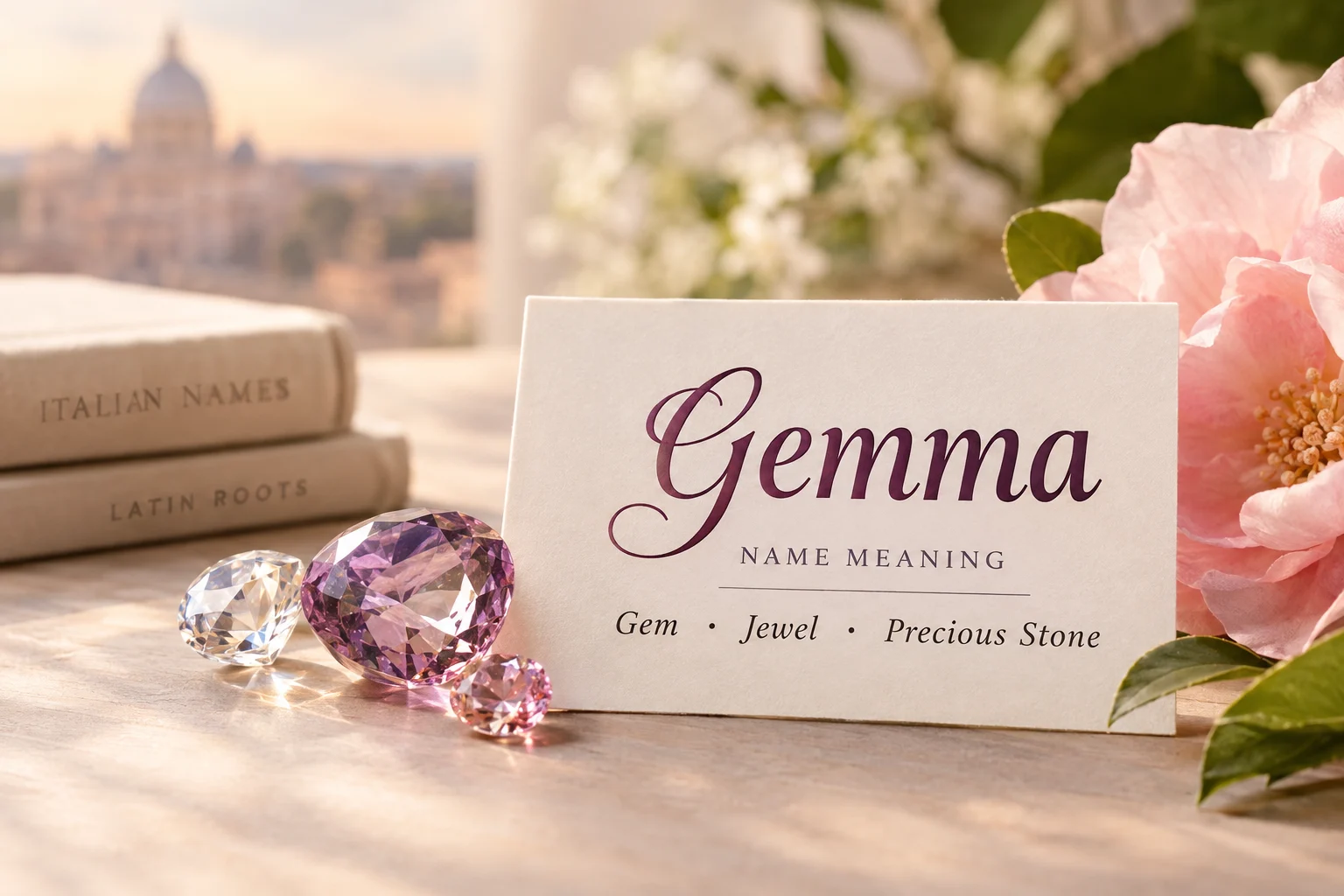
The Gemma name meaning is commonly understood as “gem” or “precious stone.” Gemma is a feminine given name with Italian and Latin roots and a long history of use in Europe. Because its meaning is connected with a valuable gemstone or jewel, the name often carries symbolic associations with beauty, rarity, value, and something precious.
Gemma has a classic yet approachable sound. It is especially familiar in Italy, Britain, Australia, and other English-speaking or European naming communities. The name also has historical and religious associations through notable women who have carried it, including the Italian Catholic saint Gemma Galgani.
In this guide, you will learn what Gemma means, where it comes from, how to pronounce it, its history, cultural background, symbolism, popularity, variants, related names, and questions parents often ask when considering Gemma for a baby.
What Is the Gemma Name?
Gemma is a feminine given name traditionally associated with the meaning “gem,” “jewel,” or “precious stone.”
The name comes from the Latin word gemma, which referred to a precious stone, jewel, bud, or something resembling a precious object. The word was adopted into Italian as gemma, meaning “gem” or “precious stone,” and eventually became established as a personal name.
As a given name, Gemma belongs to a group of names whose meanings are connected with valuable objects or natural beauty. It does not simply describe a gemstone as a common noun. As a personal name, it has developed its own cultural and historical identity.
A concise definition is:
Gemma is a feminine name of Italian and Latin origin meaning “gem,” “jewel,” or “precious stone,” symbolizing something beautiful, valuable, and treasured.
The literal meaning should be distinguished from the symbolic qualities often associated with gemstones. Ideas such as beauty, rarity, strength, and elegance are interpretations inspired by the name’s meaning rather than separate dictionary translations.
Gemma Name Meaning
The central Gemma name meaning is “gem” or “precious stone.”
The meaning comes from the Latin noun gemma, which was used for a precious stone or jewel. In Italian, gemma continues to mean “gem” or “jewel.”
Because gemstones are traditionally considered valuable and beautiful, Gemma naturally carries several symbolic associations.
The name may evoke ideas such as:
- Beauty
- Value
- Rarity
- Elegance
- Preciousness
- Brightness
- Strength
- Timelessness
- Something treasured
These qualities are symbolic rather than literal personality meanings.
A gemstone can be admired because of its color, clarity, durability, rarity, or cultural value. For this reason, parents who choose Gemma may appreciate the idea of giving their daughter a name that literally connects her with something precious.
The name also has a pleasant balance between softness and strength. Its two-syllable structure makes it short and easy to say, while the double m gives it a distinctive visual and rhythmic quality.
Gemma Origin and Etymology
Gemma has Latin roots and became strongly established as an Italian word and given name.
The Latin word gemma referred to a precious stone or jewel. It could also refer to a bud or something that was valuable or gem-like. The word is connected with the idea of something precious and beautiful.
The Italian form gemma means “gem” or “precious stone,” and this Italian usage is central to the modern understanding of the personal name.
Gemma is therefore often described as an Italian name of Latin origin. These two descriptions are not contradictory. The deeper linguistic root is Latin, while the form and naming tradition are strongly associated with Italian.
The name also has historical usage beyond Italy. Over time, Gemma became familiar in other European countries and later gained popularity in English-speaking countries.
Because of its clear lexical meaning, Gemma is sometimes grouped with jewel-inspired or precious-object names.
History and Cultural Context of Gemma
Gemma has a long European history as both a word and a personal name.
The Latin word gemma was associated with precious stones and valuable objects. During the medieval period, Gemma was used as a personal name, particularly in Italian contexts.
One important historical figure connected with the name is Gemma Donati, traditionally identified as the wife of the Italian poet Dante Alighieri. Her historical importance is primarily connected with Dante’s life rather than with the meaning of the name itself.
Another well-known figure is Saint Gemma Galgani, an Italian Catholic mystic who lived in the late nineteenth and early twentieth centuries. She was born in Tuscany and was canonized by the Catholic Church in 1940. Her association with the name helped reinforce Gemma’s place within Italian Catholic naming culture.
The name later became especially familiar in Britain and other English-speaking regions. Its modern popularity reflects a broader movement toward short, traditional European names that are recognizable across different languages.
Gemma’s history therefore combines classical linguistic roots, medieval European usage, Italian culture, religious history, and modern international naming.
How Do You Pronounce Gemma?
In common English usage, Gemma is usually pronounced:
JEM-uh
It has two syllables:
Gem-ma
The first syllable sounds like the word “gem.”
In Italian, the pronunciation follows Italian phonetic rules and is approximately JEM-ma, with a clear pronunciation of the doubled consonant.
For English-speaking families, JEM-uh is the pronunciation most people are likely to recognize.
The pronunciation is relatively straightforward, which is one reason the name travels well across English-speaking countries.
Is Gemma an Italian Name?
Yes. Gemma is strongly associated with Italian naming traditions, although its deeper linguistic origin is Latin.
The Italian word gemma means “gem” or “precious stone.” The name has a long history of use in Italy and has been carried by several notable Italian women.
It is therefore accurate to describe Gemma as an Italian name with Latin roots.
This distinction is useful because name origins can operate at multiple levels. A name may originate from an ancient language while becoming particularly established in another language or culture.
Gemma is a good example of this process: its etymological root is Latin, while its modern name identity is strongly connected with Italian and European usage.
Gemma Name Symbolism
The symbolism of Gemma comes directly from the imagery of a precious stone.
Gemstones have been valued across many cultures for their beauty, rarity, durability, and decorative qualities. As a result, the name Gemma can symbolically represent something considered precious and worthy of appreciation.
Common symbolic associations include:
Beauty: Gems are traditionally admired for their appearance and brilliance.
Value: A precious stone can represent something highly treasured.
Rarity: Rare gemstones are valued partly because they are not easily found.
Strength: Many gemstones are durable materials that withstand considerable wear.
Elegance: Jewelry and gemstones have long been associated with refinement and beauty.
Timelessness: Precious stones can survive for extremely long periods, giving them an association with permanence.
These are cultural associations rather than claims about the personality of someone named Gemma.
The name can therefore communicate a beautiful metaphor: something small but valuable, naturally formed yet capable of lasting for generations.
Gemma as a Baby Name
Gemma can be an appealing choice for parents looking for a classic European name with a clear and positive meaning.
Its greatest strength is that the meaning is easy to understand. Parents do not have to rely on an obscure interpretation to find significance in the name. A gem is something precious, and that makes the name’s symbolism immediately accessible.
Gemma also has a compact structure. It is short enough to work well with longer surnames and distinctive enough to stand apart from many common two-syllable names.
The name may appeal to parents who prefer:
- Italian names
- European names
- Classic girl names
- Short feminine names
- Names with nature-related meanings
- Jewel-inspired names
- Names with historical depth
- Names that symbolize something precious
Although Gemma has an established history, it does not have the same strongly traditional feel as some very old biblical or classical names. This allows it to feel both historic and contemporary.
Gemma Name Popularity
Gemma’s popularity varies significantly by country and by year.
The name has had particularly strong recognition in England and Wales, where it became especially popular during the late twentieth century. It has also been used in Australia, Ireland, Scotland, the United States, and other countries.
Popularity rankings should always be tied to a specific country and year. A name can be very familiar in one country while being less common in another.
In the United States, Gemma has become increasingly visible as parents have shown interest in short European names and traditional names with distinctive meanings. The U.S. Social Security Administration maintains annual baby-name data that can be used to track its ranking over time.
Rather than describing Gemma as universally “popular,” it is more accurate to say that it is an established international name whose popularity differs according to region.
Gemma Variations and Related Names
Gemma has relatively few direct spelling variants because the standard form is already short and distinctive.
Related forms and names include:
| Name | Relationship to Gemma |
|---|---|
| Gemma | Standard English and Italian form |
| Gem | Short English word-name related to the meaning |
| Gemina | A historically related Latin feminine form in some naming traditions |
| Gemina | Connected with the Latin naming tradition rather than being a direct modern variant |
| Jewel | English word-name with a similar symbolic meaning |
| Jewel | Related by meaning rather than etymology |
Some names may sound somewhat similar to Gemma but have unrelated origins. Similar pronunciation alone does not make two names etymological variants.
The strongest connection is between Gemma and names or words associated with gems, jewels, and precious stones.
Gemma vs. Jewel and Other Gem-Inspired Names
Gemma is one of several names that can evoke precious stones or valuable objects.
| Name | Meaning or Association | Main Difference |
|---|---|---|
| Gemma | Gem or precious stone | Italian form with Latin roots |
| Jewel | Precious ornament or gemstone | English word-name |
| Ruby | A red precious gemstone | Specific gemstone |
| Pearl | Precious gem formed in an oyster | Organic gemstone |
| Jade | A decorative gemstone/mineral | Specific stone name |
| Amber | Fossilized tree resin used as a gemstone | Nature and gemstone association |
| Crystal | Crystalline mineral or glass-like material | Broader mineral association |
Gemma is distinctive because it does not refer to one particular gemstone. Instead, it represents the broader concept of a gem or precious stone.
That makes the name more flexible symbolically than a name such as Ruby or Pearl.
Religious and Biblical Meaning of Gemma
Gemma is not a biblical name in the traditional sense, and its meaning does not originate from the Bible.
Its linguistic source is the Latin word gemma, meaning “gem” or “precious stone.”
However, gemstones and precious stones do appear throughout biblical texts as symbols and valuable objects. That broader religious imagery can make Gemma appealing to some families who appreciate the symbolism of precious stones.
The name also has a significant connection with Catholic history through Saint Gemma Galgani.
It is important to distinguish these facts. Gemma’s literal etymology is Latin and Italian, while any Christian symbolism associated with the name comes from later religious and cultural associations rather than a biblical name origin.
Famous People Named Gemma
Several notable people have carried the name Gemma.
Gemma Donati is traditionally known as the wife of Dante Alighieri, one of Italy’s most influential medieval poets.
Saint Gemma Galgani was an Italian Catholic mystic who became known for her religious devotion and was canonized in the twentieth century.
Gemma Chan is a British actress known for work in film and television, including major international productions.
Gemma Collins is an English television personality and businesswoman who became widely known through British reality television.
These examples demonstrate that Gemma has been used across different historical periods and professional fields.
What Personality Does the Name Gemma Suggest?
A name does not scientifically determine a person’s character. Personality develops through many influences, including family, environment, experiences, and individual choices.
Still, the meaning of Gemma can inspire certain symbolic personality associations.
Because a gem is valuable, durable, and admired, people may associate Gemma with qualities such as:
- Elegant
- Bright
- Valuable
- Strong
- Confident
- Refined
- Warm
- Resilient
- Unique
These should be understood as creative interpretations of the name’s symbolism rather than predictions about someone named Gemma.
For parents, these associations can provide an additional layer of meaning when selecting the name.
Is Gemma a Good Name for a Baby?
Gemma can be a strong choice for parents who want a short, feminine name with a clear meaning and European heritage.
Its meaning is positive without being overly complicated. The name connects a child symbolically with something precious and treasured, while its Italian and Latin history gives it cultural depth.
Gemma is also relatively easy to pronounce and spell in many English-speaking settings.
It may be especially suitable for families looking for a name that is:
- Feminine but not overly elaborate
- Traditional but still modern
- European in character
- Easy to pronounce
- Connected with beauty and value
- Historically established
- Meaningful without being overly literal
As with any name, the best choice depends on how it sounds with the family surname and whether its cultural and personal associations feel appropriate.
FAQs
What does Gemma mean?
Gemma means “gem,” “jewel,” or “precious stone.” The meaning comes from the Latin word gemma and its Italian form gemma.
What is the origin of the name Gemma?
Gemma has Latin roots and is strongly associated with Italian naming traditions. The Latin word gemma referred to a gem or precious stone.
Is Gemma an Italian name?
Yes. Gemma is strongly associated with Italy and is an Italian word meaning “gem” or “precious stone.” Its deeper linguistic origin is Latin.
Is Gemma a girl name?
Yes. Gemma is traditionally used as a feminine given name, particularly in Italian and English-speaking naming traditions.
How do you pronounce Gemma?
Gemma is generally pronounced JEM-uh in English. The first syllable sounds like the English word “gem.”
Conclusion
The Gemma name meaning is “gem,” “jewel,” or “precious stone,” giving the name an immediate association with something valuable and treasured. Its Latin roots and strong Italian identity make it a name with both linguistic depth and a clear, beautiful meaning. The symbolism naturally suggests beauty, rarity, elegance, strength, and lasting value.
Gemma also has a rich cultural history. From its use in medieval Europe to its connection with Italian figures such as Gemma Donati and Saint Gemma Galgani, the name has developed across centuries and different contexts. Its later popularity in English-speaking countries shows how successfully a traditional European name can become an international choice.
For parents considering Gemma, the name offers a particularly appealing combination of simplicity and meaning. It is short, feminine, recognizable, and easy to pronounce while still carrying a distinctive Italian character. If you want a baby name that symbolizes something precious without referring to one specific gemstone, Gemma provides a graceful and timeless option.
Discover More Related Articles:
- Susan Name Meaning | Origin, History & Symbolism In 2026
- Name Suffix Meaning | How Suffixes Work in Full Names In 2026
