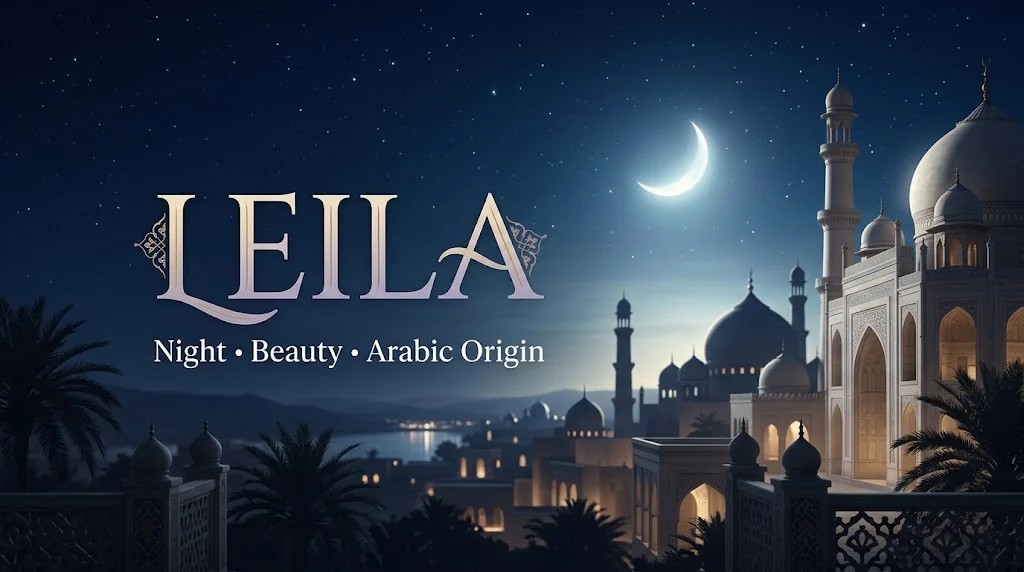
The Leila name meaning is commonly connected with “night” and is traditionally associated with an Arabic word referring to nighttime. Leila is a feminine name with a long history across Arabic, Persian, Turkish, and other cultural traditions. Different spellings, including Layla, Laila, and Leyla, reflect the name’s movement across languages and regions.
Leila is especially well known because of the famous Middle Eastern love story of Layla and Majnun, which became an influential theme in Arabic and Persian literature. Because of this literary tradition, the name has developed associations with beauty, love, mystery, nighttime, and poetic romance.
Today, Leila remains an attractive choice for parents looking for a feminine name with international recognition, historical depth, and a soft sound. This guide explores the Leila name meaning, origin, etymology, pronunciation, cultural history, symbolism, variants, nicknames, popularity, and related names.
What Is the Leila Name?
Leila is a feminine given name used across several cultures. It is most strongly associated with Arabic and Persian naming traditions, although related forms are also found in Turkish and other languages.
The name is commonly connected with the Arabic word layl, meaning “night.” The feminine form traditionally associated with the name is often explained in relation to nighttime or the darkness of night.
Leila is not simply a modern variation created from another popular name. It belongs to a long-standing naming tradition and has appeared in literature and cultural history for centuries.
The name can therefore be understood through several connected layers:
- Linguistic meaning: associated with night
- Arabic heritage: connected with Arabic vocabulary and naming
- Persian literary tradition: strongly represented in classical poetry
- Romantic symbolism: influenced by the Layla and Majnun story
- Modern usage: an internationally recognized feminine name
Because the name exists in several linguistic traditions, its exact interpretation can vary slightly depending on the language and cultural context.
Leila Name Meaning
The most commonly given Leila name meaning is “night.” It is associated with the Arabic word for night and has traditionally been connected with the beauty or darkness of nighttime.
The name’s meaning has also acquired poetic associations over time.
Literal Meaning
At its linguistic level, Leila is generally connected with night or nighttime.
This simple meaning has helped make the name especially attractive in poetry and literature, where night can symbolize beauty, mystery, quietness, longing, or romance.
Traditional Symbolism
The cultural symbolism surrounding Leila can include:
- Beauty
- Mystery
- Calmness
- Nighttime
- Romance
- Elegance
- Depth
These associations are largely cultural and literary. They should not be interpreted as a claim that someone named Leila will necessarily have these personality traits.
Modern Meaning
For modern parents, Leila can represent a name that feels elegant and feminine while still having a strong historical foundation.
Its short length and familiar pronunciation also make it relatively easy to use in multilingual families.
Leila Name Origin and Etymology
Leila is primarily associated with Arabic origin. Its linguistic background is connected with the Arabic root and vocabulary relating to night.
The Arabic word layl refers to night, and related feminine forms developed into names that were transmitted across different cultures and languages.
The name also became deeply established in Persian literary culture. Persian poets adopted and developed the famous story of Layla and Majnun, giving the name an important place in Persian literature as well as Arabic literary tradition.
This is why simply labeling Leila as belonging to only one modern nationality can be misleading. It has a broader cultural history that crosses linguistic and geographic boundaries.
Different transliterations of Arabic and related names also explain forms such as:
- Leila
- Layla
- Laila
- Leyla
- Leilah
These forms can have different levels of popularity depending on the country and language.
Leila Meaning in Arabic
In an Arabic context, Leila is associated with night and derives from the linguistic tradition surrounding layl, the Arabic word for night.
The nighttime association is particularly important because Arabic poetry has historically used night as a powerful literary image. Night can represent stillness, longing, beauty, separation, or contemplation depending on the context.
As a result, the name Leila has a naturally poetic quality within Arabic cultural traditions.
It is important to distinguish the linguistic meaning from later literary symbolism. “Night” is the basic semantic association, while ideas such as romance and mysterious beauty developed through cultural and literary usage.
Leila Meaning in Persian Culture
Leila has a particularly strong literary presence in Persian culture because of the story known as Layla and Majnun.
The story originated in Arabic literary tradition and was later adapted by Persian poets, most famously by Nizami Ganjavi in his 12th-century poem Layli o Majnun.
In this tradition, Layla becomes a symbol of idealized love and unattainable beauty. The literary treatment of the story helped spread the name and its romantic associations across Persian-speaking and neighboring cultures.
This history explains why Leila can carry a much richer cultural impression than the simple translation “night” suggests.
The Story of Layla and Majnun
One of the most important cultural connections associated with Leila is the famous story of Layla and Majnun.
The story tells of Qays and Layla, whose love becomes tragic and unattainable. Qays eventually becomes known as Majnun, a word associated with madness or being possessed by love.
The story was transmitted through Arabic literary traditions and later became a major subject of Persian literature. Nizami Ganjavi’s version became particularly influential.
Because Layla is the beloved central figure, her name became strongly associated with:
- Idealized love
- Beauty
- Longing
- Devotion
- Poetic romance
- Unattainable love
The literary story should not be confused with the literal meaning of the name. Leila means “night” in its primary linguistic association; the romantic symbolism comes largely from the literary tradition.
History and Cultural Context of Leila
Leila’s history demonstrates how personal names can move between languages and cultures.
Its Arabic roots helped establish the name in Arabic-speaking communities, while Persian literary works gave it another important cultural dimension. Related versions later appeared in Turkish and other naming traditions.
This movement across cultures has produced several spellings, but the central identity of the name has remained recognizable.
Leila’s historical associations include:
- Arabic language and culture
- Persian poetry
- Classical Middle Eastern literature
- Islamic-era literary traditions
- Turkish naming traditions
- Modern international baby naming
The name’s popularity across these contexts makes it a good example of how a traditional name can become internationally recognizable without losing its historical identity.
How Do You Pronounce Leila?
Leila has more than one pronunciation depending on language, country, and family preference.
In American English, Leila is commonly pronounced:
LAY-luh
A phonetic approximation is:
LAY-lah
Some speakers may use a pronunciation closer to LEE-lah, particularly depending on regional or family usage.
Because Leila has multiple cultural forms, it is useful to ask how a particular person pronounces their own name rather than assuming that every Leila uses exactly the same pronunciation.
Is Leila Easy to Pronounce?
For English speakers, Leila is generally approachable, although the spelling can lead to occasional questions about whether it should be pronounced “LAY-la” or “LEE-la.”
Once the preferred pronunciation is established, the name is short and easy to say.
Is Leila a Girl’s Name?
Yes. Leila is traditionally a feminine given name.
Its feminine use is established across the cultures in which the name and its related forms are found.
Parents may choose Leila because it combines a recognizable international sound with a rich Arabic and Persian cultural background.
Its related forms also give families flexibility. For example, Layla is especially familiar in English-speaking naming culture, while Leyla is associated with Turkish and other regional traditions.
Leila Name Symbolism
Leila has developed several symbolic meanings through its linguistic and literary history.
Night
The most direct association is with night. This is the core linguistic idea behind the name.
Beauty
Because nighttime imagery is common in poetry, the name has developed associations with beauty and elegance.
Mystery
Night can represent the unknown or mysterious, giving Leila a subtle association with mystery.
Love
The connection to Layla and Majnun has strongly influenced the name’s association with romantic love and devotion.
Calmness
Night can also suggest quietness, stillness, and peaceful surroundings.
These symbolic qualities are cultural interpretations rather than fixed personality characteristics.
Leila Name Popularity
Leila is a recognizable name in the United States and other English-speaking countries, while its related forms are also popular internationally.
The U.S. Social Security Administration maintains official baby-name data that can be used to track the name’s changing popularity over time. Because Leila, Layla, Laila, and Leyla are separate spellings, their rankings should be considered individually rather than automatically combining them into one name.
This distinction matters when researching baby-name popularity. A family considering Leila may encounter much higher or lower rankings for Layla, but those statistics do not necessarily represent the popularity of the exact spelling Leila.
The continued presence of Leila in modern naming reflects its combination of cultural familiarity, straightforward pronunciation, and literary history.
Leila Name Variations
Leila has several closely related spelling forms.
| Variant | General Usage |
|---|---|
| Leila | Internationally recognized form |
| Layla | Very common English-language spelling |
| Laila | Used in several international naming traditions |
| Leyla | Particularly associated with Turkish usage |
| Leilah | Alternative English spelling |
| Laylah | Less common extended spelling |
These forms are closely related, but they should not always be treated as completely interchangeable. Spelling preferences often reflect family heritage, local language, pronunciation, or cultural tradition.
Common Nicknames for Leila
Leila is already a short name, so many people simply use it without shortening it.
However, informal nicknames can include:
- Lei
- Lele
- Lela
- Lili
- Lala
Nickname preferences are personal, and not every Leila will use a shortened form.
For a child, parents may also naturally develop family-specific nicknames that have no direct connection to the original name.
Famous People Named Leila
Several notable people have carried Leila or closely related forms of the name.
One example is Leila Aboulela, a Sudanese novelist whose writing has explored themes of migration, identity, faith, and cultural experience.
Another is Leila Khaled, a Palestinian political figure who became internationally known in the 20th century.
There are also many notable people named Layla or Leyla, demonstrating how widely the broader name family has been used across cultures.
When discussing famous people associated with the name, it is useful to distinguish between the exact spelling Leila and related forms such as Layla or Leyla.
Leila vs. Layla
Leila and Layla are closely related forms, but spelling and pronunciation can differ by family and region.
| Feature | Leila | Layla |
|---|---|---|
| Gender | Feminine | Feminine |
| Main cultural association | Arabic/Persian and international | Arabic and international |
| Meaning | Commonly associated with “night” | Commonly associated with “night” |
| Pronunciation | Often LAY-luh | Usually LAY-luh |
| Style | Elegant and international | Familiar and lyrical |
| Literary connection | Layla and Majnun tradition | Strongly associated with Layla and Majnun |
Both forms belong to the same broader naming tradition, although individual usage and pronunciation can vary.
Leila vs. Laila
Leila and Laila are also closely related spellings.
The main difference is visual rather than conceptual. Leila has an established international appearance, while Laila is particularly familiar in several South Asian, Middle Eastern, and international naming contexts.
Neither spelling changes the fundamental cultural association with the Arabic tradition of the name.
Is Leila a Good Baby Name?
Leila can be a strong choice for parents who want a feminine name with cultural depth and an elegant sound.
It may appeal particularly to families who value:
- Arabic heritage
- Persian literary traditions
- International names
- Short feminine names
- Classic rather than invented names
- Names with poetic associations
- Names connected with historical literature
One advantage of Leila is that it works naturally in many different cultural environments. However, parents should consider whether they prefer the Leila, Layla, Laila, or Leyla spelling because each can communicate a somewhat different cultural or regional identity.
What Does the Name Leila Symbolize?
The name Leila most directly symbolizes night, but its literary history gives it additional associations with beauty, mystery, longing, and love.
The connection with Layla and Majnun is especially influential. In classical literature, Layla represents an idealized beloved whose love becomes the focus of intense devotion.
For modern parents, this makes Leila a name with both a simple natural image and a deeper literary background.
Its symbolism can therefore be summarized as:
Night → beauty → mystery → poetry → love
These associations are cultural rather than predictions about a person’s character.
Names Similar to Leila
If you like Leila, you may also be interested in names that have a similarly soft, feminine, international, or poetic quality.
| Name | General Character | Connection to Leila |
|---|---|---|
| Layla | Lyrical and familiar | Closely related spelling |
| Laila | International and feminine | Related form |
| Leyla | Turkish and international | Related form |
| Lena | Short and elegant | Similar sound and style |
| Lila | Soft and concise | Similar sound |
| Maya | International | Similar modern appeal |
| Nadia | Classic and international | Similar cross-cultural quality |
| Ayla | Modern and lyrical | Similar soft sound |
| Amira | Arabic and feminine | Similar cultural appeal |
| Zara | International and stylish | Similar concise structure |
The meanings and origins of these names differ, so they should be considered stylistic alternatives rather than synonyms for Leila.
Leila Name Meaning at a Glance
| Attribute | Details |
|---|---|
| Name | Leila |
| Gender | Feminine |
| Primary origin | Arabic |
| Cultural associations | Arabic, Persian, Turkish, international |
| Common meaning | “Night” |
| Related names | Layla, Laila, Leyla |
| Common pronunciation | LAY-luh |
| Literary association | Layla and Majnun |
| Symbolism | Night, beauty, mystery, love |
| Style | Elegant, traditional, international |
| Famous literary figure | Layla |
Why Is Leila Still a Popular Choice?
Leila has several qualities that help explain its continued appeal.
First, the name has genuine historical depth. It is not a recently created name designed around a modern trend. Its roots extend into Arabic language and literature.
Second, the name has strong literary associations. The story of Layla and Majnun has been retold and adapted across centuries, particularly in Arabic and Persian literary traditions.
Third, Leila is relatively easy to use internationally. Its short length and simple sound allow it to work across many languages, although pronunciation can differ.
Finally, its meaning provides a beautiful natural image. The connection with night gives the name a poetic quality without requiring a complicated interpretation.
FAQs
What does the name Leila mean?
Leila is commonly associated with “night” and has Arabic linguistic roots. The name also has poetic associations with beauty, mystery, and love because of its literary history.
What is the origin of the name Leila?
Leila is primarily associated with Arabic origin and has a strong cultural presence in Persian and other Middle Eastern literary traditions.
What does Leila mean in Arabic?
In Arabic naming tradition, Leila is connected with night and the Arabic word layl, meaning night.
Is Leila an Islamic name?
Leila is widely used in Muslim communities and has Arabic cultural roots, but it is better described as an Arabic name with Islamic-world usage rather than claiming that the name itself is exclusively religious.
How do you pronounce Leila?
Leila is commonly pronounced LAY-luh in English. However, pronunciation can vary by language, region, and family preference.
Conclusion
The Leila name meaning is most commonly associated with “night,” reflecting its Arabic linguistic roots. Over time, however, the name has acquired broader cultural meanings through poetry, literature, and the famous story of Layla and Majnun. These influences have connected Leila with beauty, mystery, longing, and romantic devotion.
Leila also has an unusually rich cross-cultural history. It is associated with Arabic naming traditions and became deeply established in Persian literature, while related forms such as Layla, Laila, and Leyla are used in different parts of the world. This gives the name an international character while preserving its historical identity.
For parents choosing a baby name, Leila offers a combination of elegance, cultural depth, and simplicity. It is feminine, recognizable, and connected with one of the most enduring literary traditions surrounding an Arabic name. Whether chosen for its meaning, heritage, sound, or poetic symbolism, Leila remains a beautiful and historically significant name.
Discover More Related Articles:

5 thoughts on “Leila Name Meaning | Origin, History, Pronunciation & More In 2026”