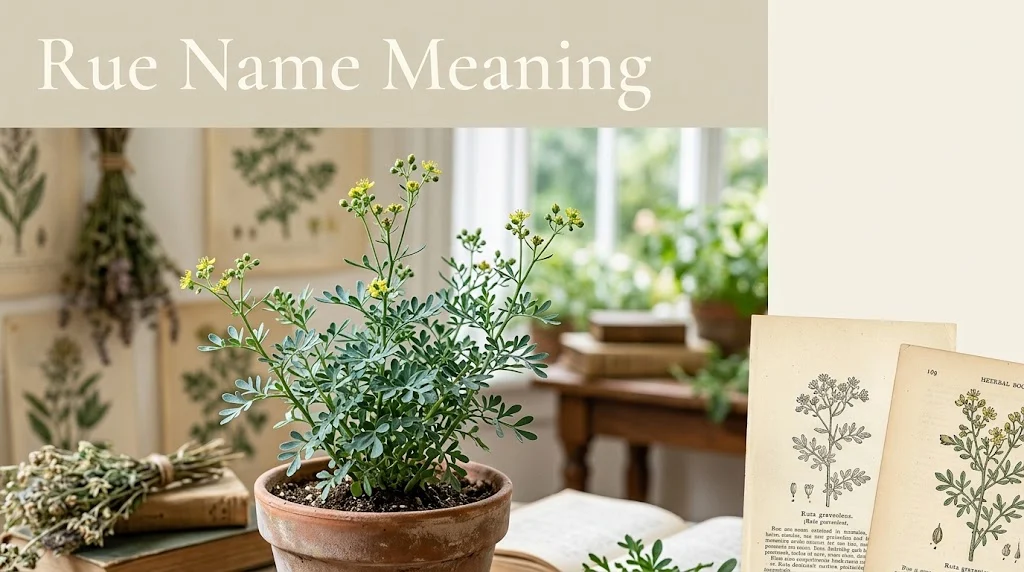
The Rue name meaning has several interesting associations, making this short name more layered than it may initially appear. Rue is connected with an aromatic herb commonly known as rue, whose botanical name is Ruta graveolens. The English word rue also means to feel regret or sorrow, while the plant name has roots in Latin and French.
As a personal name, Rue is short, distinctive, literary, and nature-inspired. It has been used as a feminine given name in modern English-speaking naming culture, although its meaning and associations can vary depending on whether someone is referring to the plant, the English verb, or the personal name.
This guide explains the Rue name meaning, its linguistic origins, pronunciation, history, botanical connection, symbolism, usage, related names, and questions parents may have when considering Rue as a baby name.
What Is the Rue Name?
Rue is a short given name with several linguistic and cultural associations. One of its strongest name-related connections is the rue plant, an aromatic herb traditionally known by the botanical name Ruta graveolens.
The English word rue has another meaning: to regret something or feel sorrow about it. This meaning comes from a different linguistic history than the plant name, so it is important not to treat every meaning associated with the spelling Rue as a single etymological definition.
As a personal name, Rue is generally appreciated for its brevity and distinctive sound. It can be categorized as a short nature-inspired name because of its connection with the rue herb.
A simple definition is:
Rue is a short given name associated with the rue herb, while the English word “rue” separately means to regret or feel sorrow. The name has botanical, linguistic, and literary associations.
This makes Rue unusual compared with names that have one clearly established literal translation.
Rue Name Meaning
The meaning associated with Rue depends on which linguistic connection is being discussed.
The strongest botanical association comes from the rue plant, an herb in the genus Ruta. Rue has historically been cultivated and used in different cultural settings, although the plant itself is not generally treated simply as a modern baby-name meaning.
The English verb rue means to regret or to feel sorrow over something. For example, the expression “to rue a decision” means to regret that decision.
Because of this second meaning, some people associate the spelling Rue with ideas such as:
- Reflection
- Regret
- Remembrance
- Emotional depth
- Resilience
- Nature
- Simplicity
- Independence
However, these should be understood as symbolic or linguistic associations rather than claims about a person’s personality.
When Rue is selected as a baby name, parents may be drawn more strongly to its botanical connection and soft sound than to the English verb meaning.
Rue Origin and Etymology
The botanical word rue ultimately traces back through French rue to Latin ruta, the name for the plant. The plant is classified in the genus Ruta and is commonly known in English as rue.
The English verb rue, meaning to regret, has a separate Germanic history. It is related to Old English hreowan, meaning to feel sorrow or regret. This distinction is important because the identical modern spelling does not mean the two words necessarily have the same origin.
Therefore, when discussing Rue name origin, it is more accurate to distinguish between:
Rue as a plant name: connected with French and Latin forms referring to the herb.
Rue as an English verb: connected with an older Germanic word expressing regret or sorrow.
As a modern given name, Rue can draw on the sound and spelling of either word, although its botanical association is especially useful when describing it as a nature-inspired name.
History and Cultural Context of Rue
The rue plant has a long history in European and Mediterranean cultures. It has been known since antiquity and has appeared in historical traditions involving gardening, symbolism, medicine, folklore, and religious or ceremonial contexts.
Historical references to rue can be found in classical and later European sources. The plant’s distinctive smell and bitter character contributed to various symbolic associations over the centuries.
In traditional European symbolism, rue could be connected with ideas of protection, repentance, or sorrow. These historical associations vary by culture and period, so they should not be treated as a single universal meaning.
The plant also appears in older literary and cultural traditions. Shakespeare, for example, referred to rue in Hamlet, where it carries a symbolic association with remembrance and grief. The appearance of the plant in literature helped reinforce its cultural symbolism in English-speaking contexts.
These historical connections give Rue more depth than a simple modern botanical name. At the same time, parents choosing Rue today are not necessarily adopting all of the historical symbolism associated with the herb.
Modern use of Rue as a personal name is better understood within the broader popularity of short, vintage, botanical, and literary names.
Is Rue a French Name?
Rue can be associated with French and Latin botanical terminology, but calling it simply a “French name” can be misleading.
The French word rue refers to the rue plant and is related to the Latin ruta. The English word for the plant was influenced by this linguistic history.
However, the English verb rue, meaning to regret, has a different Germanic origin.
As a modern given name, Rue can therefore be described as a multilingual and botanical-associated name rather than as exclusively French.
This distinction is useful for anyone researching name etymology because identical spellings can sometimes develop independently from different linguistic roots.
How Do You Pronounce Rue?
Rue is usually pronounced:
roo
It has one syllable and rhymes approximately with words such as “blue,” “true,” and “through.”
The pronunciation is one reason the name feels simple and accessible. There is little uncertainty about how English speakers are likely to say it when they encounter it as a first name.
Its short pronunciation also gives Rue a clean, modern sound.
Rue Name Symbolism
Rue has several possible symbolic associations because of its botanical and linguistic background.
The rue plant has historically carried different meanings in different traditions. Its association with remembrance and sorrow appears in older literary and cultural contexts.
The English verb rue adds another layer because it relates directly to regret.
At the same time, modern parents may interpret the botanical association independently from these older meanings. A plant-based name can simply suggest nature, simplicity, and individuality.
Possible modern symbolic associations include:
Nature: Rue is directly connected with a plant.
Reflection: The English verb connects the word with looking back on past choices.
Emotional depth: Historical and literary associations give the word a serious character.
Simplicity: The one-syllable form is minimal and uncomplicated.
Individuality: Rue is less conventional than many longer traditional names.
These are interpretations rather than literal definitions of the name.
Rue as a Nature-Inspired Baby Name
Rue fits comfortably into the category of botanical and nature-inspired baby names.
Its plant connection makes it similar in concept to names such as Rose, Ivy, Fern, Hazel, and Sage. However, Rue has a more unusual sound and a much shorter form.
Parents who prefer botanical names may appreciate Rue because it is recognizable as a word while still functioning naturally as a given name.
The name can also suit families who prefer understated names rather than elaborate or highly traditional choices.
Rue’s botanical connection does not require parents to have a particular interest in gardening. Like many nature names, its appeal can simply come from the image and sound associated with the word.
Rue Name Popularity
Rue is a relatively uncommon personal name compared with highly popular U.S. baby names. Its short length and botanical association have helped give it visibility within modern naming discussions.
Popularity should always be evaluated by a specific year because rankings change. The U.S. Social Security Administration provides annual baby-name data that allows parents and researchers to examine the number and ranking of names used for births in the United States.
Rue has also received cultural visibility through literature and popular entertainment. One well-known example is the character Rue in Suzanne Collins’s The Hunger Games. That fictional character helped make the name more recognizable to a broad modern audience.
Cultural visibility does not necessarily mean that a name is highly common. A name can be familiar because of literature or entertainment while remaining relatively uncommon as a legal given name.
For parents interested in using Rue, this combination can make the name feel recognizable without being an extremely common choice.
Rue and The Hunger Games
One important modern association with the name Rue is Rue, a character in Suzanne Collins’s The Hunger Games.
The character’s presence introduced the name to many readers and viewers who may not previously have encountered Rue as a personal name.
It is useful to distinguish this literary association from the name’s actual etymology. The character does not establish the historical meaning or origin of Rue. Instead, the character contributes to the name’s modern cultural recognition.
Parents who know the series may naturally associate Rue with the fictional character, while others may primarily think of the herb or the word meaning regret.
Rue Name Variations and Related Names
Rue is already a very short name, so it does not have a large number of standard spelling variants.
Some related or visually similar forms include:
| Name | Relationship to Rue |
|---|---|
| Rue | Short botanical-associated given name |
| Ruth | Different traditional name with a separate origin |
| Ruby | Similar short feminine name but different origin |
| Rhea | Similar compact sound but different etymology |
| Ruey | Possible phonetic or informal extension |
| Rueanne | Extended modern-style form |
Not every name that resembles Rue is etymologically related to it.
For example, Ruth may look somewhat similar in writing, but it comes from a different Hebrew name and should not be presented as a variant of Rue.
Rue vs. Similar Nature Names
Rue shares the nature-name category with several botanical and landscape names, but each has its own meaning.
| Name | Meaning or Association | Main Difference |
|---|---|---|
| Rue | Rue herb | Short botanical name |
| Rose | Rose flower | Floral name |
| Ivy | Ivy plant | Botanical climbing plant |
| Fern | Fern plant | Botanical nature name |
| Sage | Sage plant and wisdom association | Botanical and word-name meaning |
| Hazel | Hazel tree | Tree-inspired name |
What Personality Does the Name Rue Suggest?
A name cannot determine a person’s personality. However, people often create symbolic impressions from a name’s sound, meaning, and cultural associations.
Rue may suggest qualities such as:
- Independent
- Thoughtful
- Nature-loving
- Quiet
- Distinctive
- Sensitive
- Strong
- Reflective
These descriptions are subjective associations rather than established personality characteristics.
The name’s connection with a plant can create a natural and earthy impression, while its English meaning of regret can give it a more introspective tone.
Best Middle Names for Rue
Because Rue is a one-syllable first name, parents may choose a middle name with two or more syllables to create a balanced rhythm.
Some combinations include:
- Rue Amelia
- Rue Olivia
- Rue Elizabeth
- Rue Isabelle
- Rue Eleanor
- Rue Celeste
- Rue Victoria
- Rue Madeline
- Rue Evelyn
- Rue Josephine
Shorter middle names can also work, especially when the surname is longer.
For example:
- Rue Claire
- Rue Grace
- Rue Jane
- Rue Mae
- Rue Rose
There is no universally correct middle name for Rue. The sound of the full name and its connection to the family’s surname and naming traditions are usually more important than following a fixed naming rule.
Is Rue a Good Name for a Baby?
Rue may appeal to parents who want a name that is short, distinctive, and connected with nature.
Its main strengths are its simplicity, easy pronunciation, botanical association, and literary visibility. The name also has enough historical depth to give it an interesting story.
Parents should also be aware that Rue has more than one word association. In English, rue means to regret, while the botanical word refers to an herb. Some people may immediately think of one meaning rather than the other.
For families who are comfortable with these associations, Rue can provide a distinctive alternative to more familiar botanical names.
FAQs
What does Rue mean?
Rue has multiple associations. As a botanical term, rue is an aromatic herb from the genus Ruta. As an English verb, rue means to regret or feel sorrow about something.
What is the origin of the name Rue?
The botanical word Rue comes through French from Latin ruta, the name of the plant. The English verb rue, meaning regret, has a separate Germanic origin.
Is Rue a French name?
Rue has a French linguistic connection through the French word for the rue plant, which ultimately comes from Latin.
Is Rue a girl name?
Rue is used primarily as a feminine given name in modern English-language naming contexts, although short word names can sometimes be used more flexibly.
How do you pronounce Rue?
Rue is pronounced “roo” and has one syllable.
Conclusion
The Rue name meaning is especially interesting because the name has more than one linguistic association. The botanical Rue refers to an herb from the genus Ruta, with a name connected through French to Latin ruta. Separately, the English verb “rue” means to regret or feel sorrow. These different histories give the name a depth that goes beyond its simple one-syllable form.
As a baby name, Rue can be viewed as a short botanical and nature-inspired choice with literary and cultural associations. Its connection to the rue plant gives it a natural identity, while its appearance in literature, including The Hunger Games, has helped make the name recognizable to modern audiences. The symbolic associations of reflection, remembrance, nature, and individuality can make it especially appealing to parents who prefer names with an unusual story.
Ultimately, Rue offers a combination of simplicity and complexity. It is easy to pronounce, visually distinctive, and connected with both nature and language. For parents looking for a brief feminine name that feels modern while carrying historical and botanical associations, Rue provides an intriguing option with several layers of meaning.
Discover More Related Articles:
- Isabelle Name Meaning | Origin, History & Significance In 2026
- Maren Name Meaning | Origin, History, Popularity & More In 2026
