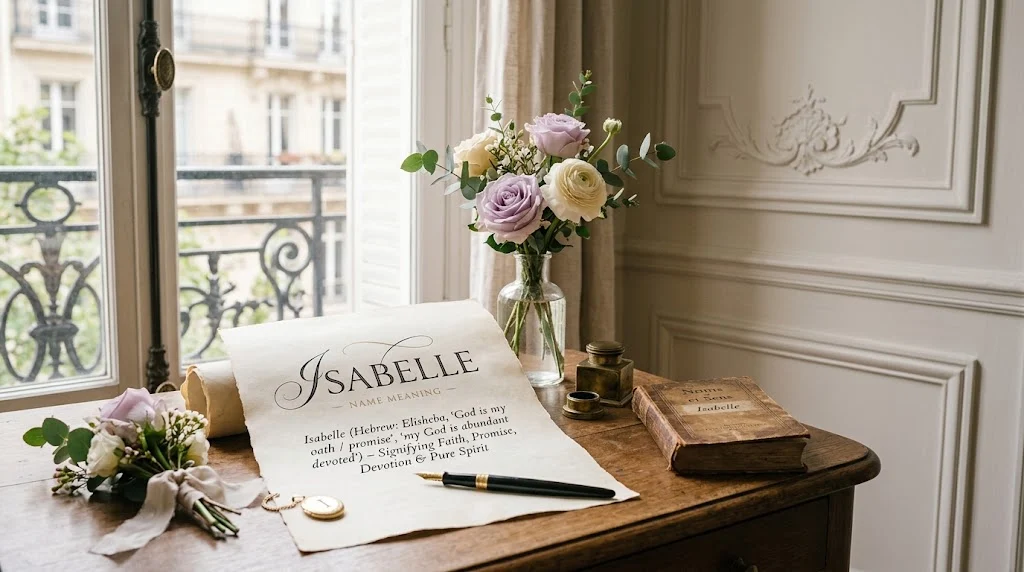
The Isabelle name meaning is commonly given as “God is my oath” or “pledged to God.” Isabelle is a French form of Elizabeth and ultimately traces its roots to the Hebrew name Elisheba. The name has a long history across European languages and has remained popular because of its elegant sound, traditional background, and religious meaning.
Isabelle is generally used as a feminine given name. It has strong connections with French naming traditions, although related forms of the name are found across many European languages and cultures. The name can feel classic and refined while still fitting comfortably into modern naming styles.
In this guide, you will learn the meaning of Isabelle, its origin and etymology, historical background, pronunciation, symbolism, popularity, related names, variations, suitable middle names, and answers to common questions about this beautiful name.
What Is the Isabelle Name?
Isabelle is a feminine given name and a French form of Elizabeth. Both names ultimately derive from the Hebrew name Elisheba, traditionally understood through elements associated with God and an oath or pledge.
The name has been used in different forms throughout European history. Isabelle became particularly associated with French and other Romance-language naming traditions, while Elizabeth remained especially prominent in English.
A concise definition is:
Isabelle is a feminine name of French usage derived from Elizabeth, ultimately from Hebrew Elisheba, traditionally interpreted as “God is my oath” or “pledged to God.”
The name is therefore both linguistic and religious in origin. Its meaning is not simply a description of a personality trait. Instead, it reflects an older naming tradition in which personal names could express faith, devotion, or a relationship with God.
Isabelle Name Meaning
The primary Isabelle name meaning is generally explained as “God is my oath.” It can also be expressed as “pledged to God” or “God is my promise.”
The meaning comes from the historical development of Elizabeth and its earlier forms. The precise interpretation of ancient Hebrew names can vary slightly between linguistic sources, so translations such as “God is my oath” should be understood as traditional interpretations rather than a single modern dictionary definition.
The name’s meaning can be understood through several ideas:
- Faith
- Devotion
- Commitment
- Promise
- Loyalty
- Spiritual dedication
- Trust
- Religious tradition
These associations are connected to the traditional etymological interpretation of the name.
Isabelle’s appeal also comes from the contrast between its deep historical meaning and its graceful modern sound. It can feel elegant and sophisticated without losing its traditional roots.
Isabelle Origin and Etymology
Isabelle has French usage and ultimately Hebrew origins.
The name is a form of Elizabeth, which developed from the Hebrew name Elisheba. The Hebrew form is generally analyzed using elements associated with El, referring to God, and a term associated with an oath or promise.
As the name moved through different languages and cultures, its form changed. Elizabeth became Elisabeth, Isabel, Isabelle, Isabella, and other related forms.
The French form Isabelle became particularly established in medieval and later European naming traditions. The ending and spelling distinguish it from English Elizabeth while retaining the same broad historical lineage.
This is why Isabelle should not be treated as an unrelated name simply because it looks and sounds different from Elizabeth. Isabelle and Elizabeth belong to the same historical name family.
History and Cultural Context of Isabelle
The history of Isabelle is connected with the long European history of the Elizabeth name family.
During the medieval period, forms related to Elizabeth and Isabel became established across different parts of Europe. Religious naming traditions contributed significantly to the spread of the name family because Elizabeth is a biblical name.
The biblical Elizabeth is traditionally identified as the mother of John the Baptist in the New Testament. Her story contributed to the religious significance of the Elizabeth name family in Christian cultures.
Different European languages developed their own forms. In French, Isabelle became an established version. In Spanish and Portuguese, Isabel became especially familiar, while Isabella developed as another major form. English retained Elizabeth as its dominant traditional form.
The name family was also carried by European royalty and aristocracy. Several queens and noblewomen throughout European history were named Isabel, Isabella, Isabelle, or Elizabeth. These historical associations helped keep the name family visible across generations.
It is important to distinguish the history of the name from the popularity of its individual forms. Isabelle has its own French identity, even though it belongs to the larger Elizabeth family.
Biblical Connection of Isabelle
Isabelle has an indirect biblical connection because it is a French form of Elizabeth.
In the New Testament, Elizabeth is described as the wife of Zechariah and the mother of John the Baptist. According to the Gospel of Luke, she was related to Mary, the mother of Jesus.
Because Elizabeth is a biblical name, Isabelle inherited a long-standing religious association through its linguistic relationship with Elizabeth.
The biblical connection can make Isabelle particularly meaningful to families who appreciate traditional Christian names or names with historical religious roots.
However, a person does not need to follow a particular religion to appreciate Isabelle. Modern names often retain historical meanings long after their original cultural context has expanded.
How Do You Pronounce Isabelle?
In common English usage, Isabelle is generally pronounced:
iz-uh-BELL
It is usually pronounced with three syllables:
Is-a-belle
The final part sounds like the familiar name Belle.
French pronunciation differs somewhat from the common English pronunciation. In French, Isabelle is typically pronounced with French vowel sounds and a French rhythm.
For English-speaking families, iz-uh-BELL is the pronunciation most people will recognize.
The pronunciation is one reason the name feels accessible in English-speaking environments despite its French form.
Is Isabelle a French Name?
Yes, Isabelle is a French form of Elizabeth, although its ultimate origin is Hebrew.
This distinction is important when discussing name origins.
A name can have:
- A linguistic root in one language
- A historical form in another language
- A modern cultural association in another country
For Isabelle, the basic pathway is Hebrew Elisheba to the broader Elizabeth name family, with Isabelle developing as a French form.
Therefore, Isabelle can accurately be described as a French feminine name of Hebrew origin.
Isabelle Name Symbolism
The traditional meaning of Isabelle gives the name strong symbolic connections with faith, commitment, devotion, and promise.
Because the name is traditionally interpreted as “God is my oath,” it can represent a serious personal commitment or spiritual dedication.
Common symbolic associations include:
- Faith
- Loyalty
- Devotion
- Promise
- Grace
- Tradition
- Elegance
- Strength of commitment
Some of these qualities come directly from the traditional meaning, while others are broader cultural associations.
For example, faith and devotion have a clearer connection to the traditional etymology. Elegance is more closely associated with the name’s sound, history, and cultural use rather than its literal meaning.
This distinction is useful because a name’s symbolism can develop beyond its original linguistic definition.
Isabelle as a Classic Baby Name
Isabelle is often appealing to parents looking for a name that feels both traditional and graceful.
It has several characteristics that contribute to this appeal:
- Long historical background
- French cultural association
- Biblical connection
- Familiar pronunciation
- Multiple related forms
- Traditional meaning
- Elegant sound
- Modern usability
Unlike a newly invented name, Isabelle has a substantial history behind it. At the same time, it does not necessarily feel old-fashioned because its sound remains familiar in contemporary naming culture.
Isabelle and Isabella: What Is the Difference?
Isabelle is especially associated with French usage, while Isabella is strongly associated with Italian, Spanish, and broader European naming traditions.
Both belong to the Elizabeth name family and share the same basic historical meaning.
| Name | Main Association | Historical Family |
|---|---|---|
| Isabelle | French | Elizabeth |
| Isabella | Italian and Spanish usage | Elizabeth |
| Isabel | Spanish and Portuguese | Elizabeth |
| Elizabeth | English | Hebrew Elisheba |
| Elisabeth | German and other European usage | Hebrew Elisheba |
The difference is therefore mainly one of linguistic form, pronunciation, and cultural tradition rather than completely different meaning.
Isabelle vs. Elizabeth
Isabelle and Elizabeth share the same broader origin, but they have different cultural impressions.
| Feature | Isabelle | Elizabeth |
|---|---|---|
| Main association | French | English |
| Ultimate origin | Hebrew | Hebrew |
| Traditional meaning | God is my oath | God is my oath |
| Style | French, elegant, romantic | Classic, traditional |
| Related forms | Isabel, Isabella | Elisabeth, Elisabet |
| Common nickname possibilities | Belle, Izzy, Isa | Liz, Lizzie, Beth, Ellie |
The two names are historically connected, but parents may choose one over the other because of sound, family heritage, or cultural preference.
Isabelle Name Variations
Because Isabelle belongs to a large international name family, it has many related forms.
Common forms include:
- Isabelle
- Isabel
- Isabella
- Elizabeth
- Elisabeth
- Elisabet
- Elisabetta
- Elisaveta
- Isabela
- Isabell
Some forms are more closely associated with particular languages and cultures.
For example, Isabel is strongly associated with Spanish and Portuguese usage, while Isabella is widely associated with Italian and Spanish traditions. Isabelle is particularly recognizable as the French form.
These variations allow families to select a version that reflects their language, heritage, or preferred pronunciation.
Nicknames for Isabelle
Isabelle can be shortened in several ways, depending on family preference.
Possible nicknames include:
- Izzy
- Iz
- Isa
- Belle
- Bella
- Elle
- Ellie
- Isa-Belle
Belle and Bella emphasize the elegant ending of the name, while Izzy gives it a more casual and playful feel.
A nickname does not have to follow a strict linguistic rule. Families often create shortened forms based on pronunciation, personality, or family tradition.
What Personality Does the Name Isabelle Suggest?
A name does not determine someone’s personality. However, names can develop cultural associations based on their meanings, history, sounds, and famous historical bearers.
Because Isabelle is traditionally associated with faith and an oath or promise, it can symbolically suggest:
- Loyal
- Devoted
- Graceful
- Traditional
- Thoughtful
- Strong-minded
- Trustworthy
- Elegant
These should be treated as symbolic impressions rather than factual personality characteristics.
The strongest connection comes from the name’s traditional meaning. Ideas such as elegance and grace are more subjective associations that arise from how the name sounds and how it has been used culturally.
Famous Historical Associations With Isabelle
The Isabelle name family has appeared throughout European history, particularly among royalty and nobility.
Forms such as Isabel, Isabella, Isabelle, and Elizabeth have been used by queens, princesses, noblewomen, and other historical figures.
One notable example is Isabella I of Castile, whose reign played an important role in late medieval Spanish history. Another is Isabella of France, a medieval queen of England.
These historical figures should not be treated as the source of the name itself. The name family existed before many of these individuals. Their importance lies in showing how widely related forms of the name were used in European societies.
The long history of these forms contributes to Isabelle’s traditional and established character.
Best Middle Names for Isabelle
Isabelle has a smooth three-syllable rhythm, so many short or moderately sized middle names can pair naturally with it.
Some examples include:
- Isabelle Rose
- Isabelle Grace
- Isabelle Claire
- Isabelle Jane
- Isabelle Mae
- Isabelle June
- Isabelle Kate
- Isabelle Marie
- Isabelle Hope
- Isabelle Celeste
These examples represent different styles rather than a definitive list of the best combinations.
When choosing a middle name, consider the rhythm of the full name, the pronunciation of the surname, family significance, and whether the initials create an unwanted combination.
Is Isabelle a Good Name for a Baby?
Isabelle may appeal to parents who want a name with a combination of historical depth, religious meaning, French influence, and modern familiarity.
It has a clear historical lineage and several international variations. The name also gives parents flexibility when choosing nicknames such as Belle, Bella, or Izzy.
Isabelle can be especially appealing to families who prefer:
- French-inspired names
- Classic girl names
- Biblical or religiously connected names
- Elegant names
- Traditional names with modern appeal
- Names with international variations
- Names connected with faith and commitment
The choice ultimately depends on personal preference, family background, cultural identity, and how the name sounds with the child’s surname.
FAQs
What does Isabelle mean?
Isabelle is traditionally interpreted to mean “God is my oath” or “pledged to God.” It is a French form of Elizabeth and ultimately traces back to the Hebrew name Elisheba.
What is the origin of the name Isabelle?
Isabelle is a French form of Elizabeth with an ultimate Hebrew origin. It belongs to the same historical name family as Isabel, Isabella, and Elisabeth.
Is Isabelle a biblical name?
Isabelle itself is a French form rather than the original biblical form. However, it is historically related to Elizabeth, a biblical name found in the New Testament.
Is Isabelle a French name?
Yes. Isabelle is widely recognized as the French form of Elizabeth. Its ultimate linguistic roots, however, go back to Hebrew.
What does Isabelle symbolize?
Isabelle can symbolize faith, devotion, loyalty, commitment, and promise because of its traditional interpretation, “God is my oath.”
Conclusion
The Isabelle name meaning is traditionally understood as “God is my oath” or “pledged to God.” The name is a French form of Elizabeth and ultimately comes from the Hebrew name Elisheba. Its historical meaning connects it with faith, devotion, promise, and commitment, while its graceful sound has helped it remain appealing across generations.
Isabelle also has a rich cultural history because it belongs to an international family of related names, including Isabel, Isabella, Elisabeth, and Elizabeth. Its French identity gives it a distinctive character, while its biblical connection provides additional historical depth. This combination makes Isabelle both culturally recognizable and linguistically interesting.
For parents choosing a baby name, Isabelle offers a balance between tradition and modern elegance. It can suit families looking for a French-inspired name, a name with religious roots, or simply a feminine name with a long and meaningful history. With nicknames such as Belle, Bella, and Izzy, Isabelle also provides plenty of flexibility for different stages of life.
Discover More Related Articles:
- Sylvia Name Meaning | Origin, History & Symbolism In 2026
- Akari Name Meaning| Japanese Origin, History & Symbolism In 2026

3 thoughts on “Isabelle Name Meaning | Origin, History & Significance In 2026”