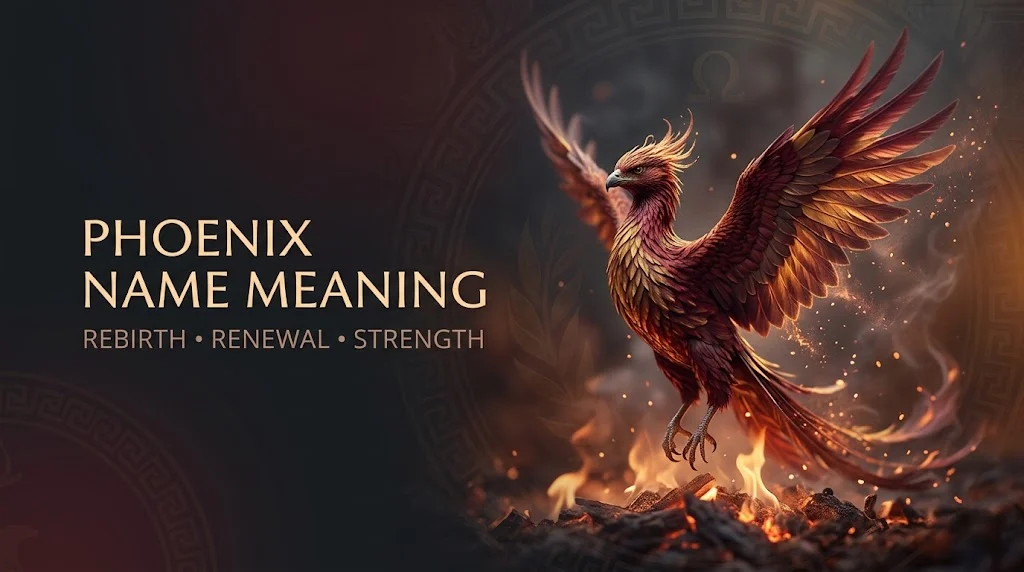
The Phoenix name meaning is closely connected to the legendary phoenix, a mythical bird traditionally associated with rebirth, renewal, transformation, and rising again after destruction. The name has ancient roots and is connected with traditions surrounding a remarkable bird said to have a long life before renewing itself. Because of this symbolism, Phoenix has become a modern name associated with resilience, new beginnings, strength, and transformation.
Unlike many traditional personal names that began as ordinary words or family names, Phoenix has a particularly vivid mythological identity. The phoenix appears in ancient Greek and Roman writings and has connections with older traditions from the Mediterranean and Near East. Over time, the legendary bird became a powerful symbol in literature, religion, art, and popular culture.
Today, Phoenix is used as both a boys’ and girls’ name, making it an appealing unisex choice. It also has a modern, nature-inspired quality because it evokes fire, flight, light, and renewal. This guide explores the Phoenix name meaning, origin, mythology, pronunciation, symbolism, history, gender usage, nicknames, related names, and modern appeal.
What Is the Phoenix Name?
Phoenix is a given name derived from the name of the mythical phoenix bird, a legendary creature known in different traditions for its extraordinary ability to renew itself.
The name is strongly associated with ideas such as:
- Rebirth
- Renewal
- Transformation
- Resilience
- Strength
- New beginnings
- Immortality
- Hope
Phoenix is also the name of a major city in Arizona, although the personal name and the city name should be treated as separate uses of the same word.
As a personal name, Phoenix is especially distinctive because its meaning comes largely from the symbolic identity of the mythical bird rather than from a simple everyday word.
Phoenix Name Meaning
The Phoenix name meaning is commonly understood through the symbolism of the phoenix bird.
The most familiar interpretation is “rebirth” or “renewal.” The legendary phoenix is traditionally described as a bird that eventually dies or is destroyed and then emerges renewed. Different ancient and later sources describe the process in different ways, so the familiar image of a bird rising from its own ashes represents a later and highly influential version of the tradition.
Because of this mythology, Phoenix can symbolize:
- Starting over after hardship
- Personal transformation
- Hope after difficulty
- Strength and resilience
- Renewal
- A new chapter in life
It is important to distinguish the symbolic meaning of Phoenix from a strict dictionary translation. Phoenix is primarily the name of a legendary creature, and its modern name associations come from the stories and symbolism surrounding that creature.
What Does Phoenix Mean Symbolically?
Phoenix has one of the strongest symbolic associations of any modern nature or mythology-inspired name.
Rebirth
The phoenix is most famously connected with being renewed after its previous life ends. Because of this, Phoenix can symbolize a fresh beginning.
Transformation
The phoenix changes from one state into another, making it a common symbol of personal growth and transformation.
Resilience
The story of the phoenix has often been interpreted as a metaphor for surviving adversity and returning stronger.
Hope
The idea of renewal naturally creates an association with hope. The phoenix represents the possibility that an ending can lead to a new beginning.
Strength
Although the phoenix is usually represented as a magnificent bird rather than a warrior, its ability to endure and renew itself gives the name a strong symbolic character.
For these reasons, Phoenix may appeal to parents who want a name with a meaningful message about resilience, renewal, and change.
Phoenix Name Origin and Etymology
The word phoenix comes into English through Latin and Greek traditions. The Greek word φοῖνιξ (phoînix) has several historical associations, and its exact etymological development is not completely straightforward.
The Greek term has been connected with the mythical bird as well as with meanings associated with purple-red or crimson, and it has also been associated in ancient contexts with the date palm. Scholars have discussed how these different meanings and associations developed and interacted.
Because of this complexity, it would be inaccurate to claim that Phoenix has only one universally agreed ancient translation.
For modern name purposes, however, the strongest association is undoubtedly the mythical phoenix bird and its symbolism of renewal.
The name’s historical development is therefore better understood as a combination of linguistic history and mythology rather than as a simple translation from one ancient word.
The Phoenix in Ancient Mythology
The phoenix is one of the best-known legendary birds in Western mythology.
Ancient Greek writers described a remarkable bird associated with long life and renewal. The Greek historian Herodotus mentioned a phoenix tradition in his writings, although his description differs in important ways from the version of the story that became popular much later.
Over the centuries, writers and artists added new elements to the phoenix legend.
Later traditions increasingly emphasized:
- Fire
- Death and renewal
- Ashes
- Rebirth
- Immortality
- A magnificent return
The familiar image of the phoenix rising from ashes is therefore the result of a long development of the legend rather than a single story preserved unchanged from ancient times.
Phoenix and Egyptian Traditions
The phoenix is also frequently connected with the ancient Egyptian Bennu, a sacred bird associated with creation, renewal, and the sun.
However, the Bennu and the Greek phoenix should not simply be treated as identical creatures. They belong to different cultural and religious traditions, although ancient writers and later interpreters drew connections between them.
The Bennu was associated with Egyptian religious ideas concerning creation and renewal. Greek writers and later cultures developed their own versions of the phoenix.
This distinction matters because popular descriptions sometimes combine Egyptian and Greek traditions as though they were one original myth.
A more accurate understanding is that the phoenix became part of a broader network of Mediterranean ideas about sacred birds, the sun, life, death, and renewal.
Phoenix in Greek and Roman Culture
The phoenix became particularly important in Greek and Roman literature.
Roman authors also wrote about the bird and its extraordinary lifespan. As the story moved through different literary traditions, its symbolic meaning expanded.
The phoenix came to represent ideas such as:
- Longevity
- Renewal
- Continuity
- Immortality
- Cosmic cycles
- Restoration
Its symbolism eventually extended beyond mythology into philosophy, religion, literature, heraldry, and art.
This long history helps explain why Phoenix can feel both ancient and modern as a personal name.
Phoenix as a Symbol of Rebirth
The idea of rebirth is probably the single most recognizable association of Phoenix.
The phoenix story provides a powerful metaphor: something can reach an ending and still be followed by a new beginning.
As a result, Phoenix is often interpreted symbolically as a name for someone associated with:
- New beginnings
- Personal growth
- Reinvention
- Recovery
- Change
- Hope
- Persistence
These interpretations are symbolic rather than predictions about a person’s character. A name can carry cultural associations without determining who someone becomes.
Phoenix Name History
Phoenix has a much longer history as a mythological word than as a conventional personal name.
For centuries, the phoenix appeared primarily in mythology, religious symbolism, literature, artwork, and heraldic imagery. Its symbolic strength made it useful for representing renewal and continuity.
The transition from mythical symbol to personal name reflects a broader modern naming trend in which parents choose words associated with nature, mythology, places, virtues, and powerful images.
Phoenix fits several of these categories simultaneously.
It is:
- A mythological name
- A nature-inspired name
- A symbolic name
- A place-associated name
- A modern unisex name
This combination gives Phoenix a distinctive identity compared with conventional biblical or family names.
Is Phoenix a Boy’s or Girl’s Name?
Phoenix is generally considered a gender-neutral or unisex name.
It can be given to boys or girls, and its usage does not depend on a single traditional gender association.
This makes Phoenix particularly appealing to parents looking for a modern name that does not feel strongly restricted to one gender.
Its imagery also works well across different naming styles. Some parents may see Phoenix as a powerful masculine name, while others may appreciate its creative and nature-inspired quality as a feminine name.
There is no requirement that a symbolic name such as Phoenix belong exclusively to one gender.
How Do You Pronounce Phoenix?
Phoenix is commonly pronounced:
FEE-niks
It has two syllables.
The first part sounds like “fee,” while the second sounds like “niks.”
The pronunciation is relatively straightforward once heard, although people unfamiliar with the spelling may initially hesitate because of the unusual combination of letters.
The spelling Phoenix is widely recognized and distinctive.
Is Phoenix a Good Baby Name?
Whether Phoenix is a good baby name depends on personal taste and the qualities parents want the name to communicate.
Phoenix may appeal to parents who want a name that is:
- Meaningful
- Symbolic
- Unisex
- Modern
- Distinctive
- Connected with mythology
- Associated with resilience
- Easy to recognize and pronounce
One advantage of Phoenix is that it has a story behind it. Someone asking about the name can easily be given an explanation involving the legendary bird and its association with renewal.
The main consideration is that Phoenix has a strong symbolic and mythological identity. Parents who prefer very traditional names may find it more unconventional, while parents interested in nature, mythology, or modern word names may find that quality appealing.
Phoenix Name Symbolism
The symbolism of Phoenix is unusually rich.
Renewal
Phoenix represents the idea that something can begin again.
Resilience
The legendary bird has become a metaphor for continuing after adversity.
Transformation
Phoenix represents change from one state into another.
Hope
Its renewal gives the name a strong connection with optimism and future possibilities.
Immortality
Ancient versions of the phoenix story emphasize its extraordinary lifespan and recurring renewal.
Fire
Later traditions strongly connect the phoenix with flames, creating associations with energy, passion, and transformation.
The exact symbolism can differ depending on the cultural or literary context, but renewal remains the central modern association.
Phoenix Name Personality Meaning
Name personality descriptions are symbolic rather than scientific. A name cannot determine someone’s personality, but parents often enjoy exploring the qualities traditionally associated with a name.
Because of the phoenix legend, Phoenix may symbolically suggest someone who is:
- Resilient
- Independent
- Adaptable
- Strong
- Creative
- Courageous
- Hopeful
- Transformative
These qualities come from the mythology and cultural symbolism of the phoenix rather than from evidence that people named Phoenix actually share these personality traits.
Common Nicknames for Phoenix
Phoenix is already relatively short, so many people use the full name rather than shortening it.
Still, possible informal nicknames include:
- Nix
- Nixie
- Fee
- Phin
- Phee
Not every nickname will feel natural for every person. The full name Phoenix is distinctive enough that it often works well without modification.
Phoenix Name Variations
Phoenix has fewer traditional personal-name variants than many ancient biblical names.
Some related spellings or forms may appear in historical, literary, or international contexts, but Phoenix is by far the most recognizable modern English spelling.
The word itself has also been represented differently across ancient languages because Greek and Latin writers transmitted the legend through their own linguistic systems.
This means that historical forms of the word should not automatically be treated as modern personal-name alternatives.
Names Similar to Phoenix
Parents who like Phoenix may also be interested in names connected with mythology, nature, strength, or unusual imagery.
| Name | General Style | Connection to Phoenix |
|---|---|---|
| Orion | Mythological | Shares an ancient mythological background |
| Atlas | Mythological | Strong modern mythology-inspired name |
| River | Nature-inspired | Shares a modern word-name quality |
| Ember | Nature-inspired | Connected with fire imagery |
| Ash | Nature-inspired | Symbolically connected with the phoenix’s ashes |
| Nova | Celestial | Associated with dramatic transformation and light |
| Aurora | Nature/celestial | Associated with light and renewal |
| Raven | Nature/mythology | Another distinctive bird-inspired name |
| Luna | Celestial | Shares a modern symbolic naming style |
These names are not direct translations or equivalents of Phoenix. They are simply similar in style, imagery, or cultural appeal.
Phoenix vs. Similar Mythological Names
Phoenix is different from many mythology-inspired names because its central meaning is based on renewal rather than a specific human character.
| Name | Origin or Association | Main Symbolic Idea |
|---|---|---|
| Phoenix | Greek and broader Mediterranean mythology | Rebirth and renewal |
| Atlas | Greek mythology | Strength and endurance |
| Orion | Greek mythology | Hunter and constellation |
| Aurora | Roman mythology | Dawn and light |
| Luna | Roman mythology | Moon |
| Raven | Bird symbolism and mythology | Mystery and intelligence |
This makes Phoenix particularly distinctive for parents who want a name with a powerful symbolic message rather than a traditional family or religious association.
Phoenix and the Meaning of New Beginnings
One reason Phoenix has become attractive as a modern name is its connection with new beginnings.
The phoenix story can be interpreted as a reminder that change does not necessarily mean the end of a person’s story. Instead, transformation can lead to something new.
That symbolism makes Phoenix particularly relevant to themes such as:
- Fresh starts
- Personal growth
- Change
- Reinvention
- Hope
- Resilience
This is one of the reasons Phoenix appears frequently in modern literature, art, entertainment, and inspirational symbolism.
Phoenix as a Modern Name
Phoenix fits naturally into the modern category of names inspired by words, nature, mythology, and powerful imagery.
Unlike a name with a single traditional religious or family origin, Phoenix has multiple layers of recognition. People may associate it with the mythical bird, the city in Arizona, fire, rebirth, or modern popular culture.
That gives the name strong contemporary visibility.
At the same time, its mythology reaches back thousands of years, giving it historical depth that many modern word names do not have.
The result is a name that combines ancient symbolism with contemporary naming style.
Famous Associations With the Name Phoenix
The word Phoenix has appeared extensively in literature, entertainment, mythology, sports, businesses, organizations, and place names.
One of the most famous non-personal associations is Phoenix, Arizona, whose name was chosen to symbolize a new city rising from the remains of an earlier settlement.
The mythical phoenix itself has also been used throughout literature and popular culture as a symbol of rebirth.
Because the word has so many cultural associations, a person named Phoenix may encounter references to both the mythical bird and the Arizona city.
Phoenix Name Meaning at a Glance
| Attribute | Details |
|---|---|
| Name | Phoenix |
| Gender | Unisex |
| Primary association | Mythical phoenix bird |
| Historical linguistic roots | Greek, with transmission through Latin |
| Common symbolic meaning | Rebirth and renewal |
| Pronunciation | FEE-niks |
| Syllables | 2 |
| Main symbolism | Renewal, transformation, resilience |
| Mythological connection | Legendary bird |
| Nature association | Fire, bird, renewal |
| Style | Modern, mythological, symbolic |
| Possible nicknames | Nix, Nixie, Fee, Phin |
| Related names | Orion, Atlas, Ember, Ash, Nova, Aurora |
The most important distinction is that rebirth and renewal are symbolic meanings associated with the phoenix, rather than a literal translation of the word Phoenix.
FAQs
What does the name Phoenix mean?
The name Phoenix is associated with the mythical phoenix bird and is commonly interpreted symbolically as rebirth, renewal, transformation, and resilience.
What is the origin of the name Phoenix?
Phoenix has ancient roots connected with Greek mythology and language, with the word later transmitted through Latin and other languages.
Is Phoenix a biblical name?
Phoenix is not primarily a biblical personal name. It is a name rooted in mythology and ancient Mediterranean traditions.
What is the phoenix bird?
The phoenix is a legendary bird associated with extraordinary longevity and renewal. Different ancient and later traditions describe it differently, but the modern version is especially associated with rebirth and rising again after destruction.
What does Phoenix symbolize?
Phoenix commonly symbolizes rebirth, renewal, resilience, transformation, hope, and new beginnings. Fire and immortality are also important associations in later versions of the legend.
Conclusion
The Phoenix name meaning is deeply connected with the legendary phoenix bird and its enduring symbolism of rebirth, renewal, transformation, and resilience. Although the word has complex ancient linguistic and cultural roots, its modern meaning is strongly shaped by the story of a remarkable mythical bird associated with renewal after destruction. This gives Phoenix a powerful symbolic identity that goes beyond an ordinary dictionary definition.
As a personal name, Phoenix combines ancient mythology with contemporary naming style. It works as a unisex name, has a memorable pronunciation, and offers associations with strength, hope, new beginnings, and personal transformation. Its connections to mythology, nature, fire, and renewal also make it appealing to parents looking for a name that feels meaningful without being tied exclusively to one traditional naming system.
Ultimately, Phoenix is a distinctive name with a story that has survived across centuries and cultures. For families who appreciate names connected with resilience and fresh starts, Phoenix offers a memorable combination of history and modern appeal. Its strongest symbolic message is simple: renewal, transformation, and the possibility of beginning again.
Discover More Related Articles:
