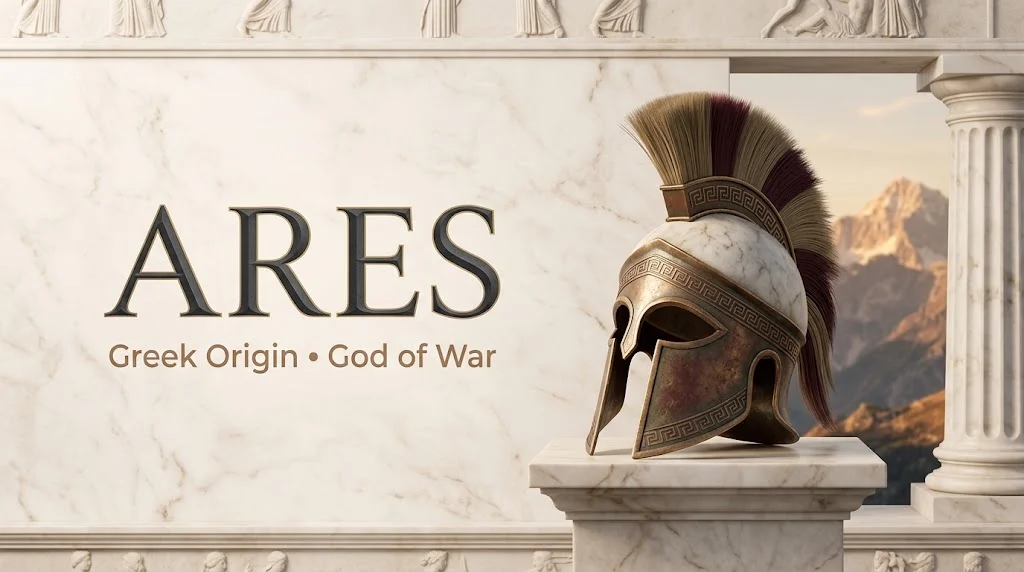
The Ares name meaning is commonly associated with war, battle, and the ancient Greek god of war. Ares is a masculine given name derived from the name of a major figure in Greek mythology. Although the name is often interpreted as meaning “warrior” or “god of war” in baby-name discussions, these descriptions refer more directly to the mythological association than to a proven literal translation.
Ares is a particularly interesting name because it combines a short, modern-sounding form with an ancient cultural background. Its four letters make it easy to recognize, while its connection to Greek mythology gives it a strong identity.
The name may appeal to parents who appreciate classical mythology, Greek heritage, distinctive names, or names with memorable historical associations.
Ares Name Meaning and Symbolism
Ares is most strongly associated with the Greek god of war. In ancient Greek mythology, he represents the violent and destructive aspects of warfare, including conflict, aggression, and the intensity of battle.
The precise etymology of Ares remains uncertain. One traditional theory connects it with the Greek word arē, associated with ruin, bane, or a curse. Other interpretations have been proposed, and some scholars consider a pre-Greek origin possible. Therefore, the name should not be assigned a single definitive literal translation. <Cite refs={[“turn873173search2″,”turn873173search4″,”turn873173search7”]}/>
Its symbolic meaning, however, is easier to understand through mythology.
Strength: The mythological figure is associated with physical power and the intensity of conflict.
Courage: Modern name interpretations often connect Ares with bravery, although courage is a symbolic association rather than a literal translation.
Determination: The name can suggest persistence and resolve in contemporary naming contexts.
Power: Its association with an Olympian deity gives the name a commanding and memorable character.
Independence: Because Ares is less traditional in English-speaking naming culture than names such as Alexander or Daniel, some parents choose it for its distinctive identity.
It is important to remember that these are cultural interpretations. A name does not determine a person’s character, behavior, or future.
Ares Name Origin and Etymology
Ares comes from ancient Greek mythology and is written in Ancient Greek as Ἄρης. The name was associated with the Greek god of war and appears in the literary and religious traditions of ancient Greece.
Its linguistic history is more complicated than a simple translation suggests. Some references connect Ares to the Greek word arē, meaning something like ruin or bane. Other interpretations explore possible connections with words relating to masculinity or battle. Linguistic scholars have also considered whether the name originated in a language spoken in the Aegean region before Greek became established there. <Cite refs={[“turn873173search2″,”turn873173search4”]}/>
This uncertainty matters when interpreting the name.
Ares is unquestionably a Greek mythological name, but its precise original linguistic meaning has not been established with the same certainty as some names derived from ordinary words.
For modern parents, the clearest explanation is that Ares is a name of ancient Greek origin, best known through its association with the god of war.
Ares in Greek Mythology
Ares occupies an important place among the gods of ancient Greek mythology. He is commonly described as the son of Zeus, king of the gods, and Hera, queen of the gods.
Unlike some Greek deities associated with wisdom, healing, or the arts, Ares represents the harsher side of warfare. His character is frequently associated with aggression, bloodshed, and the unpredictable nature of battle.
His portrayal is not identical across every ancient source. In Homer’s Iliad, for example, Ares is depicted as powerful but impulsive, and his conduct in battle does not always earn the respect of the other gods. The mythology therefore presents a more complicated character than a simple symbol of heroic courage. <Cite refs={[“turn873173search7″,”turn873173search25”]}/>
Several important figures are connected with Ares.
Zeus: Ares’s father and the ruler of Mount Olympus.
Hera: Ares’s mother and the queen of the Olympian gods.
Aphrodite: The goddess of love and beauty, who is closely associated with Ares in several Greek myths.
Athena: A goddess associated with wisdom and strategic warfare. Her approach to war is often contrasted with Ares’s association with its more violent aspects.
These relationships help explain why Ares remains recognizable in literature, art, popular culture, and modern baby-name discussions.
Ares and the Difference Between War and Wisdom
One of the most interesting aspects of Ares’s mythology is his contrast with Athena.
Both deities have connections to warfare, but they represent different aspects of it. Ares is associated with the intensity, violence, and destructive force of battle. Athena is more closely connected with strategy, practical wisdom, and disciplined military action.
This contrast is useful when considering the symbolism of the name Ares. Although modern naming websites often emphasize strength and courage, the original mythology also includes conflict, impulsiveness, and destruction.
Parents who choose Ares because of its mythological background may appreciate the historical complexity of the character rather than interpreting the name as a straightforward symbol of goodness or heroism.
Ares in Roman Mythology
Ares is frequently compared with Mars, the Roman god of war. The two deities share important characteristics, but they are not exact equivalents in every respect.
Greek and Roman religious traditions developed in different cultural settings. As Roman mythology absorbed and adapted Greek influences, the identities of several gods became closely associated across the two traditions.
Ares is the Greek name, while Mars is the Roman name most commonly used for the corresponding war deity.
Mars also had a particularly important place in Roman civic and religious traditions. His associations extended beyond warfare, and he was connected with Rome’s legendary origins and the protection of the Roman state.
This distinction helps explain why Ares and Mars are related mythological names but have separate histories and cultural identities.
History and Cultural Significance of the Name Ares
The history of Ares begins in the religious and literary traditions of ancient Greece. The name became known through mythology, poetry, and stories about the Olympian gods.
One important source is Homer’s Iliad, an ancient Greek epic centered on events connected with the Trojan War. Ares appears in the poem as a participant in the conflict, reflecting his identity as a god associated with battle.
Over time, Greek mythology influenced Roman literature, European art, classical education, and modern storytelling. The names of Greek gods consequently became familiar far beyond the religious communities in which their stories first developed.
Today, Ares appears in baby naming, books, films, games, and other forms of entertainment. Some parents choose it specifically because of the mythology, while others are drawn to its short spelling and distinctive sound.
The modern use of Ares as a personal name should be distinguished from its original religious role. Naming a child Ares does not mean that the family follows ancient Greek religious practices. A name can retain its historical associations while taking on a new role in contemporary culture.
How Do You Pronounce Ares?
Ares has more than one pronunciation in modern usage.
In English, a common pronunciation is AIR-eez, which sounds similar to “air” followed by “eez.” Some speakers use pronunciations closer to AH-rehs, reflecting a different approach to the name.
In Classical Greek, the pronunciation differed from common modern English usage. The name’s sound also varies between languages and regional accents. <Cite refs={[“turn873173search2″,”turn873173search5”]}/>
If you are choosing Ares for a baby, it is worth deciding which pronunciation you prefer and recognizing that other people may initially say it differently.
The name is short and relatively easy to spell, but its pronunciation is not completely uniform.
Is Ares a Boy’s Name?
Ares is traditionally a masculine name because of its connection to the male Greek deity. It is predominantly used for boys in the United States.
However, naming conventions can differ between countries and cultures. Ares has also been used as a feminine name in some Spanish and Catalan contexts, where separate cultural and place-name associations may apply. <Cite refs={[“turn873173search5″,”turn873173search12”]}/>
For most English-speaking baby-name searches, Ares is recognized primarily as a boys’ name.
Its short form and mythological background may appeal to parents looking for a name that feels contemporary while remaining connected to ancient history.
Ares Name Popularity
Ares has become more visible in recent U.S. baby-name rankings over the last decade.
According to data based on U.S. Social Security Administration records, Ares ranked #290 among boys in 2025, with 1,157 boys given the name in the United States that year. It ranked #295 in 2024 and #414 in 2023, showing a substantial rise in recent usage. <Cite refs={[“turn873173search3″,”turn873173search5”]}/>
These figures suggest that Ares is no longer an extremely rare choice in the United States, although it remains less established than long-standing favorites such as James, William, or Alexander.
Its growing visibility may reflect several naming preferences:
- Interest in Greek mythology and classical history
- Preference for short, memorable names
- Popularity of distinctive names with strong associations
- Interest in names that work across different languages
- Renewed attention to ancient names in modern baby naming
Popularity changes over time, so the latest available Social Security Administration data are the best reference for checking its current ranking.
Personality Traits Associated With Ares
Baby-name discussions often associate Ares with qualities such as strength, confidence, independence, and determination. These ideas come largely from the name’s mythological background and modern cultural interpretations.
The associations may appeal to parents who want a name that feels bold and memorable.
However, the original mythological character should not be confused with a prediction about a real person’s personality. Someone named Ares may be gentle, thoughtful, artistic, outgoing, quiet, or anything else. A name does not determine temperament or behavior.
A balanced interpretation of Ares can recognize both its striking symbolism and the complexity of its ancient history.
Ares Nicknames and Short Forms
Ares is already a short name, so it does not require a nickname. Still, families sometimes create affectionate forms for everyday use.
Possible nicknames include:
- Ari: A short, friendly option that shares the opening sound.
- Res: A brief, informal shortening of the name.
- Rey: A creative nickname based on the ending sound.
- A: A simple initial-based nickname.
- Ari-Bear: A playful family nickname that can be used informally.
These are suggested nicknames rather than established historical variants of Ares. The best choice depends on personal preference and the way the name sounds with the child’s full name.
Names Similar to Ares
If you like Ares but want to explore other names with a similar style, several Greek, mythological, and short masculine names may be worth considering.
| Name | Origin or Association | Similarity to Ares |
|---|---|---|
| Aris | Greek name and related form | Similar sound and spelling |
| Atlas | Greek mythology | Short, memorable mythological name |
| Apollo | Greek mythology | Associated with an Olympian god |
| Orion | Greek mythology | Strong connection to ancient stories |
| Atlas | Greek mythological figure | Distinctive classical identity |
| Ajax | Greek mythology | Short name connected with Greek epic tradition |
| Mars | Roman mythology | Directly related through the war-god comparison |
| Ari | Used in several naming traditions | Short and easy to say |
| Leo | Latin origin | Short, recognizable, and bold-sounding |
| Evander | Greek origin | Classical feel with a longer form |
These names are similar in style or cultural association, but they do not all share the same meaning or etymological origin.
Ares vs. Mars: What Is the Difference?
Ares and Mars are closely connected because both are associated with war in Greek and Roman mythology.
However, the names come from different cultural traditions.
| Feature | Ares | Mars |
|---|---|---|
| Mythological tradition | Greek | Roman |
| Main association | God of war | God of war |
| Cultural background | Ancient Greek religion | Ancient Roman religion |
| Modern name style | Distinctive Greek mythological name | Short Roman mythological name |
| Relationship | Greek deity | Common Roman counterpart |
Ares may appeal to parents who prefer Greek mythology, while Mars may appeal to those who like Roman history or an especially short name. Both carry strong historical associations, but neither has a personality meaning that applies automatically to everyone who bears it.
Is Ares a Good Baby Name?
Ares may be a good choice for parents who want a distinctive name with an unmistakable connection to classical mythology.
Its main advantages include its short spelling, memorable sound, recognizable cultural background, and growing modern use. It also pairs naturally with many traditional middle names.
For example:
- Ares James
- Ares Alexander
- Ares Gabriel
- Ares Thomas
- Ares Elijah
- Ares William
These combinations are illustrative suggestions rather than established naming traditions.
There are also a few considerations. Some people will immediately associate Ares with the Greek god of war, whose mythology includes destructive and aggressive qualities. Others may be unfamiliar with the name or pronounce it differently.
Ultimately, the best baby name is one that suits the family’s preferences and feels comfortable in everyday use. Ares is worth considering if you appreciate ancient Greek culture and want a short name with a distinctive identity.
Ares Name Meaning at a Glance
| Attribute | Details |
|---|---|
| Name | Ares |
| Common usage | Primarily masculine |
| Origin | Ancient Greek |
| Original form | Ἄρης |
| Common meaning association | War and battle through Greek mythology |
| Proposed etymology | Possibly related to Greek arē, meaning ruin or bane |
| Etymological certainty | Uncertain; multiple theories exist |
| Mythological figure | Greek god of war |
| Parents | Zeus and Hera |
| Roman counterpart | Mars |
| Common English pronunciation | AIR-eez |
| Name style | Short, distinctive, mythological |
| Common symbolism | Strength, power, determination |
| U.S. boys’ ranking in 2025 | #290 |
| Nickname ideas | Ari, Res, Rey |
The distinction between meaning and association is important. Ares is certainly the name of a Greek god associated with war, but the exact linguistic origin of the name remains debated.
FAQs
What does the name Ares mean?
Ares is best known as the name of the Greek god of war. Its exact linguistic meaning is uncertain, although one proposed etymology connects it with the Greek word for ruin or bane.
What is the origin of Ares?
Ares comes from ancient Greek mythology. The name is associated with one of the Olympian gods and has been used as a modern personal name.
Is Ares a Greek name?
Yes. Ares is an ancient Greek mythological name written as Ἄρης in Ancient Greek.
Is Ares a biblical name?
No. Ares is associated with Greek mythology rather than being a traditional biblical name.
Is Ares a boy’s name or a girl’s name?
Ares is predominantly used as a boy’s name in the United States. However, it can be used for girls in some cultural and linguistic contexts.
Conclusion
The Ares name meaning is best understood through its connection to ancient Greek mythology. Ares is the Greek god of war, and his name has become associated with battle, power, strength, and determination. Although some etymological theories connect the name with the Greek word for ruin or bane, the precise linguistic meaning is uncertain. Understanding this distinction provides a more accurate picture of the name’s history.
Ares has also developed a place in modern baby naming. Its short spelling, distinctive sound, and classical background make it appealing to parents who want something memorable without choosing a long or complicated name. Recent U.S. naming data show that Ares has gained popularity, suggesting that mythological names continue to interest modern families.
Ultimately, Ares may be a suitable choice if you appreciate Greek mythology, ancient history, and distinctive names. Its cultural associations are powerful, but they do not define the personality or future of the person who carries it. Whether you choose Ares for its sound, history, or mythological significance, understanding its origins can help you make a thoughtful naming decision.
Discover More Related Articles:
- Leila Name Meaning | Origin, History, Pronunciation & More In 2026
- Gemma Name Meaning | Origin, History & Symbolism In 2026
