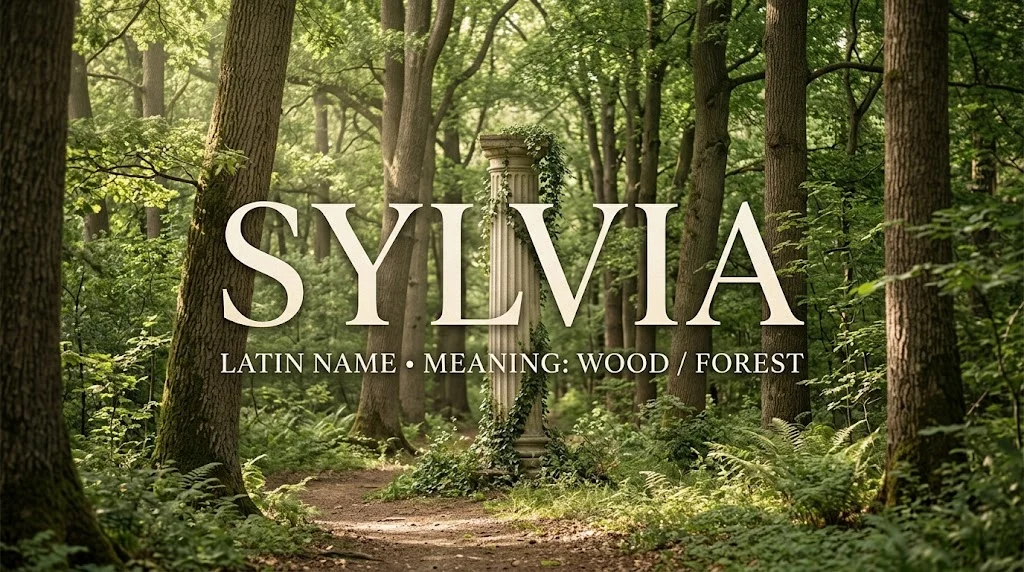
The Sylvia name meaning is traditionally connected with “wood” or “forest,” from the Latin word silva. Sylvia is the English spelling of Silvia, a feminine name with Ancient Roman roots. Its history reaches back to Roman tradition and mythology, where Rhea Silvia is remembered as the mother of the legendary founders of Rome, Romulus and Remus.
Because of its connection with forests and the natural world, Sylvia can have a gentle, nature-inspired quality while still carrying a long classical history. The name has also been used across European languages and cultures, with forms such as Silvia, Sylvie, Silvija, and Sylwia.
This guide explores the Sylvia name meaning, Latin origin, Roman history, pronunciation, symbolism, variations, nicknames, popularity, and modern appeal.
What Is the Sylvia Name?
Sylvia is a traditionally feminine given name associated with Latin and Ancient Roman naming traditions. It is the English spelling of Silvia, which is the feminine form of Silvius. The name ultimately connects to the Latin word silva, meaning “wood” or “forest.”
The name therefore has a strong connection with nature. Unlike names whose meanings come from abstract qualities such as wisdom or strength, Sylvia’s traditional meaning comes from a physical part of the natural landscape.
Sylvia can be associated with:
- Forests
- Woods
- Nature
- Classical history
- Roman heritage
- Elegance
- Traditional femininity
- Vintage naming style
These are cultural and symbolic associations. The literal etymological meaning is connected to the Latin silva, while qualities such as elegance or gentleness are later impressions associated with the name.
Sylvia Name Meaning
The traditional Sylvia name meaning is “wood” or “forest.” The name comes through the Latin family of names related to silva, meaning “wood” or “forest.”
This gives Sylvia a distinctly nature-based meaning.
Literal Meaning
At its simplest, Sylvia can be understood as a name associated with a forest or woodland.
Nature Meaning
Because forests symbolize living landscapes, trees, shelter, and natural beauty, Sylvia may be interpreted symbolically as a name connected with nature and the outdoors.
However, these symbolic meanings should not be confused with the literal etymology. The historical meaning is based on the Latin word silva.
Modern Interpretation
Today, parents may choose Sylvia because it combines a classic sound with a natural meaning. It can feel traditional without being tied exclusively to one modern naming trend.
Sylvia Name Origin
Sylvia has Latin and Ancient Roman roots. It is the English spelling of Silvia, a feminine form related to the Roman name Silvius. The underlying Latin word is silva, meaning “wood” or “forest.”
The name therefore belongs to the broader family of names connected with Latin silva, including Silvius and Silvanus.
The spelling Sylvia became particularly established in English. According to Behind the Name, Sylvia is a variant of Silvia and has been the more common English spelling since the 19th century.
This distinction is useful because Silvia and Sylvia are closely related names, rather than completely separate names with unrelated meanings.
The Latin Root Behind Sylvia
The key word behind Sylvia is the Latin silva, meaning “wood” or “forest.”
This root also appears in other Latin-derived names.
For example, Silvanus is a Roman name meaning “of the woods” and is also associated with the Roman god of forests. Silvius is another ancient Roman name derived from silva.
This gives Sylvia a broader linguistic family:
silva → Silvius → Silvia → Sylvia
The exact historical development of individual names can be more complicated than this simple sequence suggests, but the shared Latin root explains their strong connection with woodland imagery.
Sylvia in Roman Mythology
One of the most famous historical and mythological associations of Sylvia comes from Rhea Silvia.
In Roman mythology, Rhea Silvia is traditionally described as the mother of Romulus and Remus, the legendary founders of Rome. Her story is part of the traditional foundation mythology surrounding ancient Rome.
This gives the name Silvia, and by extension Sylvia, a particularly interesting connection with Roman history and mythology.
Rhea Silvia’s story is different from the modern use of Sylvia as a personal name, but the connection helps explain why the name has such a strong classical identity.
The Roman association also makes Sylvia more than simply a nature-inspired name. It belongs to a naming tradition that reaches back to the ancient world.
Sylvia and the History of Rome
The relationship between Sylvia and Roman tradition is especially interesting because the name family appears in stories connected with the legendary origins of Rome.
The name Silvius was associated with several legendary kings of Alba Longa in Roman tradition. The feminine form Silvia is also connected with Rhea Silvia.
This means the name family has both:
- A linguistic connection with forests
- A historical and mythological connection with ancient Rome
For someone interested in classical names, Sylvia therefore offers a combination of natural imagery and Roman heritage.
Saint Silvia and the Religious History of the Name
Sylvia also has an important Christian historical association through Saint Silvia, a sixth-century woman traditionally identified as the mother of Pope Gregory the Great.
The name Silvia has been used in Christian contexts for centuries, adding another layer to its history beyond Ancient Roman mythology.
This is one reason Sylvia and Silvia have remained recognizable across different European naming traditions.
It is worth noting that the spelling and pronunciation can vary depending on language and region. The English form Sylvia is especially established in English-speaking contexts.
How Do You Pronounce Sylvia?
In English, Sylvia is commonly pronounced:
SIL-vee-uh
A simple phonetic guide is:
SIL-vee-uh
It is normally pronounced with three syllables.
The first part sounds like “sil,” followed by “vee,” and then “uh.”
Pronunciation differs somewhat across languages. For example, the related form Silvia has its own established pronunciations in Italian, Spanish, Portuguese, and other languages. Behind the Name lists English pronunciation approximately as /ˈsɪl.vi.ə/.
Is Sylvia a Girl’s Name?
Yes. Sylvia is traditionally a feminine given name.
It belongs to a long-established European naming tradition and is widely recognized as a female name in English and several other languages.
Related feminine forms include:
- Silvia
- Silvija
- Sylwia
- Sílvia
- Sylvie
- Silvie
- Sylva
These forms occur in different languages and naming traditions, so they should not all be treated as identical spellings.
Sylvia Name Symbolism
The strongest symbolic association of Sylvia comes from its connection with the forest.
Forests can symbolize:
- Nature
- Growth
- Life
- Stability
- Renewal
- Mystery
- Beauty
- Connection with the natural world
These are symbolic interpretations rather than literal meanings of the name.
Because the name has both a nature-related etymology and a classical history, Sylvia can also carry a sense of timelessness and tradition.
For parents, this combination can make Sylvia appealing if they want a name that feels both classic and nature-inspired.
Sylvia Name History
The history of Sylvia extends across several periods and cultures.
Its roots are connected with Latin and Ancient Roman naming traditions. The related form Silvia was used in Italian and other European languages, while the spelling Sylvia became particularly common in English-speaking contexts.
The name was also used in literature. Behind the Name notes that Silvia was introduced to England by William Shakespeare, who used the name for a character in The Two Gentlemen of Verona, first performed in the late 16th century.
Over time, Sylvia became established as an English feminine name in its own right.
This gives the name an unusually broad historical path:
Latin → Ancient Rome → European languages → English usage → modern baby naming
Sylvia Name Popularity
Sylvia has a long history of use in the United States and remains recognizable as a traditional girls’ name.
According to U.S. Social Security Administration data, Sylvia ranked #361 for girls in 2025, up from #422 in 2024. The SSA’s 2025 data therefore show a 61-place increase in its ranking during that year.
This does not make Sylvia one of the most common girls’ names in the United States, but it does show that the name remains active in contemporary American naming.
The SSA explains that its baby-name statistics are based on names recorded through Social Security card applications and that its rankings cover names dating back to 1880.
Because name popularity changes from year to year, current rankings are more useful than relying on older descriptions of Sylvia as either extremely common or rare.
Is Sylvia a Vintage Name?
Sylvia is often perceived as a classic or vintage name because of its long history and strong use in earlier generations.
However, vintage does not mean obsolete.
Its Latin origin, connection with nature, and recognizable pronunciation allow Sylvia to work in modern naming contexts as well.
The name can appeal to parents who like:
- Traditional names
- Literary names
- Classical names
- Nature-inspired names
- European names
- Vintage baby names
Its established history also means that it does not require an unusual spelling to feel distinctive.
Common Nicknames for Sylvia
Sylvia is already relatively short, but several informal forms can be used.
Possible nicknames include:
- Syl
- Sylvie
- Sylvy
- Via
- Vivi
Sylvie is especially interesting because it is also an established French form or related form within the Sylvia/Silvia name family. It can therefore function as either a nickname or a separate given name depending on the family and language context.
Not every Sylvia needs a nickname. The full name is short enough to work comfortably in everyday conversation.
Sylvia Name Variations
Sylvia has many international forms.
| Name | Language or Usage | Relationship |
|---|---|---|
| Sylvia | English and several European languages | English spelling of Silvia |
| Silvia | Italian, Spanish, Portuguese, Romanian and others | Closely related traditional form |
| Sylvie | French | Related French form |
| Sylwia | Polish | Polish form |
| Silvija | Several Slavic languages | Related form |
| Sílvia | Portuguese, Catalan | Related form |
| Silvie | Czech | Related form |
| Sylva | Czech / literary usage | Related form |
Behind the Name lists Sylvia as a variant of Silvia and records many related forms across European languages.
Sylvia vs. Silvia
Sylvia and Silvia are closely related names, but their spelling and linguistic usage differ.
| Feature | Sylvia | Silvia |
|---|---|---|
| Origin | Latin / Ancient Roman | Latin / Ancient Roman |
| Meaning | “Wood” or “forest” | “Wood” or “forest” |
| Common association | English spelling | Italian, Spanish, Portuguese and other forms |
| Gender | Feminine | Feminine |
| Style | Classic, English, literary | European, classical |
| Related root | silva | silva |
Behind the Name specifically describes Sylvia as a variant of Silvia and notes that Sylvia became the more common English spelling from the 19th century onward.
Names Similar to Sylvia
If you like Sylvia, several other names may appeal to you because of their sound, classical history, or nature associations.
| Name | General Style | Connection to Sylvia |
|---|---|---|
| Sylvie | French and elegant | Closely related form |
| Silvia | European and classic | Directly related name |
| Olivia | Classic and familiar | Similar rhythm and ending |
| Celia | Literary and classic | Similar soft sound |
| Flora | Nature-inspired | Strong connection with nature |
| Clara | Traditional and elegant | Similar classic character |
| Violet | Floral and vintage | Shares nature-inspired appeal |
| Lydia | Traditional | Similar established feminine style |
These names are not all etymologically related to Sylvia. Their similarity is mainly based on sound, style, history, or nature-related appeal.
Sylvia in Literature and Culture
Sylvia has a strong literary and cultural identity.
One early English literary connection comes from Shakespeare’s use of Silvia in The Two Gentlemen of Verona. The character helped establish the name within English literary culture.
The name has also appeared frequently in literature, poetry, and popular culture, contributing to its image as a refined and literary feminine name.
However, a name’s cultural associations can change over time. A modern Sylvia may be chosen simply because the family likes the sound and meaning, without any particular connection to a historical or literary figure.
What Does Sylvia Symbolize?
Sylvia’s primary symbolic image is the forest.
Because of its Latin root, the name can evoke ideas of:
- Natural beauty
- Growth
- Roots
- Strength
- Peace
- Life
- Renewal
The forest can also represent mystery and exploration, giving Sylvia a slightly poetic quality.
These interpretations are symbolic rather than fixed personality traits. A person’s name does not determine who they will become.
Is Sylvia a Good Baby Name?
Sylvia can be an appealing choice for parents who want a name with substantial historical depth and a natural meaning.
Some reasons families may choose Sylvia include:
- It has ancient Latin roots.
- Its traditional meaning is connected with forests.
- It has a long history across Europe.
- It has recognizable pronunciation.
- It offers several international variations.
- It has literary and classical associations.
- It has a vintage style while remaining in modern use.
One consideration is that Sylvia has a distinctly traditional sound. Parents who prefer very contemporary or highly unusual names may want something different.
For someone looking for a classic name that does not depend on an invented spelling, however, Sylvia has a strong historical foundation.
Sylvia Name Meaning at a Glance
| Attribute | Details |
|---|---|
| Name | Sylvia |
| Gender | Feminine |
| Origin | Latin / Ancient Roman |
| Root | Latin silva |
| Meaning | “Wood” or “forest” |
| Related form | Silvia |
| Pronunciation | SIL-vee-uh |
| Roman connection | Rhea Silvia |
| Nature association | Forest and woodland |
| Style | Classic, vintage, literary |
| Common nickname | Syl, Sylvie |
| 2025 U.S. rank | #361 for girls |
Why Choose the Name Sylvia?
Sylvia brings together several qualities that are difficult to combine in a single name. It has an ancient linguistic foundation, a clear nature connection, Roman historical associations, and a long history of use in English and other European languages.
Its meaning is also easy to understand. The connection with wood and forest gives the name a natural image without requiring a complicated interpretation.
For parents who appreciate traditional names, Sylvia can feel established without being completely ordinary. Its related forms also make it adaptable across different languages and cultures.
FAQs
What does the name Sylvia mean?
The name Sylvia traditionally means “wood” or “forest.” It comes from the Latin word silva, which means “wood” or “forest.”
What is the origin of Sylvia?
Sylvia has Latin and Ancient Roman origins. It is the English spelling of Silvia, a feminine name related to the Roman name Silvius.
Is Sylvia a biblical name?
No. Sylvia is not a biblical name. Its roots are Latin and Ancient Roman, although the name has later been used in Christian cultures and has an association with Saint Silvia.
How do you pronounce Sylvia?
Sylvia is commonly pronounced SIL-vee-uh in English. Behind the Name gives the English pronunciation as approximately /ˈsɪl.vi.ə/.
Is Sylvia a girl’s name?
Yes. Sylvia is traditionally a feminine given name and is widely recognized as a girl’s name.
Conclusion
The Sylvia name meaning is traditionally connected with “wood” or “forest,” from the Latin word silva. The name has deep Ancient Roman roots and is closely related to Silvia, the feminine form associated with the Roman name Silvius. This gives Sylvia a distinctive combination of natural imagery and classical history.
Sylvia’s history extends beyond its Latin etymology. Rhea Silvia connects the name with the legendary origins of Rome, while later use across European languages and English literature helped establish Sylvia and Silvia as enduring feminine names. The name’s many international forms also show how successfully this ancient name has traveled across cultures.
Today, Sylvia remains a recognizable choice for parents who appreciate classic, vintage, literary, or nature-inspired names. Its 2025 U.S. ranking of #361 shows that it continues to be used by modern families. With its forest meaning, Roman heritage, graceful sound, and long cultural history, Sylvia offers a name that feels both rooted in the past and suitable for the present.
Discover More Related Articles:

2 thoughts on “Sylvia Name Meaning | Origin, History & Symbolism In 2026”