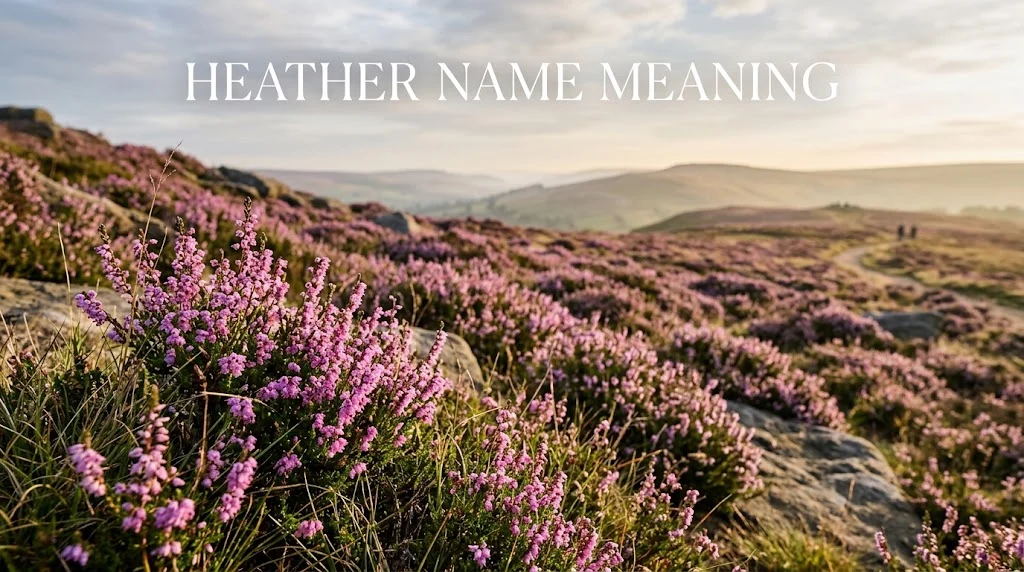
The Heather name meaning comes directly from the English word heather, the name of a small flowering shrub commonly found in rocky or open areas. The plant is known for its delicate pink, purple, or white flowers and its ability to grow in landscapes where other plants may find conditions difficult. As a given name, Heather is an English feminine name with a strong connection to nature, flowers, and the countryside.
Heather became established as a first name in the late 19th century and became especially popular during the second half of the 20th century. It belongs to the same broad category of English nature names as names such as Holly, Hazel, and Rose.
In this guide, you will learn what Heather means, where it comes from, how to pronounce it, its linguistic history, symbolism, popularity, related names, and why it continues to be recognized as a nature-inspired feminine name.
What Is the Heather Name?
Heather is an English feminine given name taken from the common English noun heather. The word refers to various small shrubs that produce flowers and commonly grow in rocky, open, or heathland environments.
Unlike many traditional given names that originated from personal names, religious figures, occupations, or surnames, Heather developed from a plant name. This makes it a nature or botanical name.
A concise definition is:
Heather is an English feminine name derived from the word for a small flowering shrub, traditionally associated with rocky landscapes and heathland.
The name therefore has a direct botanical meaning. When people use Heather as a personal name, its associations usually come from the plant itself and the landscapes where it grows.
Heather is generally feminine in modern English usage. Name references classify it as an English feminine name.
Heather Name Meaning
The literal Heather name meaning is the name of the heather plant, a group of small flowering shrubs commonly associated with rocky terrain and heathland.
Unlike some names that have a translated meaning such as “strength,” “wisdom,” or “grace,” Heather does not traditionally translate into a personality quality. Its literal meaning is botanical.
However, the plant can inspire several symbolic associations. Because heather grows in rugged natural environments and produces delicate flowers, the name is often connected symbolically with ideas such as:
- Natural beauty
- Resilience
- Simplicity
- Gentleness
- Endurance
- Peace
- Connection with nature
- Rural landscapes
- Quiet strength
These qualities are symbolic interpretations, not additional dictionary meanings of Heather.
The contrast between the plant’s delicate flowers and its ability to grow in rocky environments can also make Heather an appealing metaphor for beauty and resilience. That symbolism comes from the characteristics of the plant rather than from the linguistic meaning of the name.
Heather Origin and Etymology
Heather has an English origin. It comes from the English vocabulary word heather, which refers to the flowering shrub.
The modern English word developed from the Middle English word hather. The transition from the older form to modern heather reflects the linguistic development of English over time.
As a given name, Heather was first used in the late 19th century, according to name-history references. It did not immediately become one of the most widely used first names. Its popularity increased considerably during the second half of the 20th century.
This history places Heather within the broader development of English word names and nature names. English speakers have long adopted words referring to flowers, plants, colors, places, and natural objects as personal names.
Heather is therefore not simply a modern invented name. It is a vocabulary word with an established history that later became a personal name.
History and Cultural Context of Heather
The plant itself has a long association with landscapes commonly called heathlands or moorlands. Heather can grow in relatively exposed and rocky environments, making it a familiar feature of parts of Britain and other regions with suitable conditions.
This geographical association gives the name a distinctly natural and countryside-oriented character.
As a personal name, Heather emerged in the late 19th century. Its use expanded significantly in the 20th century, especially during the latter half.
The name’s popularity reflects a broader naming pattern in English-speaking societies. Parents have often chosen names taken from plants and flowers because they combine recognizable words with pleasant natural imagery.
Heather belongs to this group alongside names such as:
- Hazel
- Holly
- Rose
- Violet
- Ivy
- Daisy
- Lily
These names do not all have the same history, but they share the characteristic of drawing directly or indirectly from botanical vocabulary.
Heather’s particular appeal comes from its connection with a plant rather than a single showy flower. The name can therefore suggest a more natural, countryside-oriented image.
How Do You Pronounce Heather?
Heather is usually pronounced:
HEH-ther
The common American English pronunciation is approximately /ˈhɛð.ɚ/, while British English commonly uses /ˈhɛð.ə/.
The name has two syllables:
Heath-er
The first syllable receives the primary stress.
The pronunciation is generally straightforward for English speakers because it closely follows the pronunciation of the ordinary English word heather.
This makes Heather relatively easy to pronounce and recognize in English-speaking settings.
Is Heather an English Name?
Yes. Heather is generally classified as an English name because it comes directly from an English vocabulary word.
The underlying word refers to the flowering shrub, and the personal name developed from that word. Unlike names borrowed from Greek, Hebrew, Latin, or Germanic personal naming traditions, Heather’s origin is directly connected to English botanical vocabulary.
It is therefore best described as an English nature name or English botanical name.
The name also has a strong cultural association with Britain because the heather plant is characteristic of many heath and moorland landscapes there.
Heather Name Symbolism
Heather has several symbolic associations inspired by the plant and its natural environment.
One of the strongest is resilience. Heather can grow in rocky and exposed environments, so the plant can represent persistence and the ability to thrive in challenging surroundings.
Another association is natural beauty. The plant’s flowers can create colorful landscapes while maintaining a relatively delicate appearance.
Heather can also symbolize simplicity. Unlike names associated with grand historical figures or elaborate religious traditions, Heather comes from an ordinary element of the natural world.
Some common symbolic associations include:
Resilience: The plant’s ability to grow in rugged environments can inspire this association.
Natural beauty: Heather’s flowers give the name a clear floral and botanical image.
Gentleness: The soft appearance of its flowers can create a delicate impression.
Endurance: Its association with persistent natural growth can symbolize lasting strength.
Peacefulness: Heathlands and open landscapes can evoke calm and quiet surroundings.
Connection with nature: The name has a direct botanical meaning.
These are interpretations rather than official meanings. The literal meaning remains the name of the plant.
Heather as a Nature-Inspired Baby Name
Heather is a classic example of a nature-inspired baby name.
It differs slightly from names such as Lily or Rose because the word refers to a broader type of flowering shrub rather than a single familiar garden flower.
The nature connection can make Heather appealing to parents who prefer names inspired by:
- Plants
- Flowers
- Trees
- Landscapes
- Countryside
- Seasons
- Natural environments
Heather also has a familiar quality. Someone hearing the name usually recognizes it immediately as a personal name and as the name of a plant.
That dual identity gives the name a straightforward meaning without making it feel overly unusual.
For parents who want a botanical name that feels established rather than newly invented, Heather has a long history of use as a personal name.
Heather Name Popularity
Heather became particularly popular during the second half of the 20th century. Name references specifically note that although it was first used as a given name in the late 19th century, it did not become popular until much later.
The U.S. Social Security Administration’s historical data also demonstrates the name’s substantial use in the United States. In its ranking of names used over the last 100 years, Heather appears at No. 49 among girls’ names, with 524,154 recorded births in the period covered by that table.
Historical popularity should not be confused with current popularity. A name can have a large number of historical uses while being much less frequently chosen for newborns today.
The Social Security Administration’s baby-name database covers names dating back to 1880 and provides year-by-year information based on Social Security card applications.
Heather’s history therefore shows an interesting pattern: it became a widely recognized name during the 20th century and remains familiar even as naming trends have changed.
Heather Name Variations and Related Names
Heather has relatively straightforward spelling because it comes directly from an English vocabulary word.
Some names may be considered related by theme rather than by etymology.
| Name | Meaning or Association | Relationship to Heather |
|---|---|---|
| Heather | Flowering shrub | Core English botanical name |
| Erica | Heather plant association | Also coincides with the Latin word for heather |
| Erika | Heather association in some languages | Related by botanical meaning in certain languages |
| Holly | Holly tree | English nature name |
| Hazel | Hazel tree or hazel color | English botanical name |
| Rose | Rose flower | Flower-inspired name |
| Violet | Violet flower | Botanical name |
Erica and Erika are especially interesting comparisons because the names can correspond with the word for heather in some languages, although their primary name histories are not identical to Heather’s.
It is important not to describe every flower or plant name as a linguistic variant of Heather. Most are simply names that share the broader category of nature-inspired naming.
Heather vs. Similar Nature Names
Heather shares a botanical theme with many familiar English names, but each has a different literal meaning and linguistic history.
| Name | Literal Association | Main Difference |
|---|---|---|
| Heather | Flowering shrub | Associated with heathland and rocky landscapes |
| Rose | Rose flower | Refers to a specific flowering plant |
| Holly | Holly tree | Tree-based botanical name |
| Hazel | Hazel tree or color | Plant and color associations |
| Violet | Violet flower | Flower-based name |
| Lily | Lily flower | Flower-based name with a long naming history |
What Personality Does the Name Heather Suggest?
A person’s name does not determine their personality. However, names can create cultural and symbolic impressions.
Because Heather is a botanical name associated with a resilient flowering shrub, people may symbolically connect it with qualities such as:
- Calmness
- Gentleness
- Resilience
- Naturalness
- Simplicity
- Thoughtfulness
- Quiet confidence
These should not be treated as factual personality characteristics. They are simply associations inspired by the plant and the name’s cultural image.
The name’s soft sound and botanical meaning can give it a gentle impression, while the plant’s ability to grow in rugged landscapes adds an underlying association with endurance.
Heather in Different Cultural Contexts
Heather has its strongest linguistic connection with English.
The plant itself is particularly familiar in British landscapes, especially heath and moorland environments. This contributes to the name’s association with the British countryside.
The name later became widely recognizable in other English-speaking communities, including the United States.
It is also useful to distinguish between the plant’s cultural symbolism and the name’s etymological meaning. Different cultures may assign different symbolic meanings to flowers and plants, but the English name Heather simply comes from the English word for the plant.
Therefore, claims that Heather universally means a particular quality such as “good luck,” “protection,” or “love” should be treated cautiously unless they are tied to a specific cultural or historical tradition.
Best Middle Names for Heather
Heather has two syllables and a familiar English sound, so it can pair with both short and longer middle names.
Some combinations that demonstrate different styles include:
- Heather Rose
- Heather Grace
- Heather Jane
- Heather Claire
- Heather Marie
- Heather Elise
- Heather Louise
- Heather June
- Heather Anne
- Heather Olivia
A short middle name can give the full name a crisp rhythm, while a longer middle name can create a more flowing combination.
There is no objectively perfect middle name for Heather. The best choice depends on the surname, family traditions, cultural background, and the sound the parents prefer.
Is Heather a Good Name for a Baby?
Heather may appeal to parents looking for a name with a clear connection to nature and a long history of English usage.
Its main characteristics include:
- English origin
- Feminine usage
- Botanical meaning
- Two-syllable pronunciation
- Familiar spelling
- Nature-inspired symbolism
- Strong historical use in the United States
- Association with flowers and countryside landscapes
The name can also feel more established than some newer nature-inspired names because Heather has been used as a given name since the late 19th century and became particularly popular in the 20th century.
For families interested in botanical names, Heather provides a natural alternative to more common flower names while remaining easy to recognize.
FAQs
What does Heather mean?
Heather refers to a small flowering shrub commonly found in rocky or heathland environments. As a personal name, Heather therefore has a botanical and nature-inspired meaning.
What is the origin of the name Heather?
Heather is an English name derived directly from the English word heather. The word developed from Middle English hather.
Is Heather a girl name?
Yes. Heather is traditionally used as a feminine given name in English.
Is Heather a nature name?
Yes. Heather is a nature or botanical name because it comes directly from the word for a flowering shrub.
How do you pronounce Heather?
Heather is generally pronounced HEH-ther, with two syllables and emphasis on the first syllable.
Conclusion
The Heather name meaning comes directly from the English word for a small flowering shrub that commonly grows in rocky or heathland environments. This gives Heather a simple but vivid botanical identity, connecting the name with flowers, natural landscapes, and the countryside. Its English origin and straightforward pronunciation have helped make it a familiar feminine name.
Heather also has an interesting naming history. Although it was first used as a given name in the late 19th century, it became particularly popular during the second half of the 20th century. U.S. historical naming data shows just how widely the name was used over the last century, while modern data helps distinguish that historical popularity from current naming trends.
For families choosing a botanical or nature-inspired name, Heather offers a meaningful combination of natural beauty and resilience. Its literal meaning remains the name of the plant, while its association with rugged landscapes can inspire ideas of endurance, calmness, and quiet strength. With its established English history and recognizable sound, Heather remains a name with a clear connection to nature and a distinctive cultural identity.
Discover More Related Articles:
- Bellamy Name Meaning | Origin, History & Symbolism In 2026
- Rue Name Meaning | Origin, History & Symbolism In 2026
