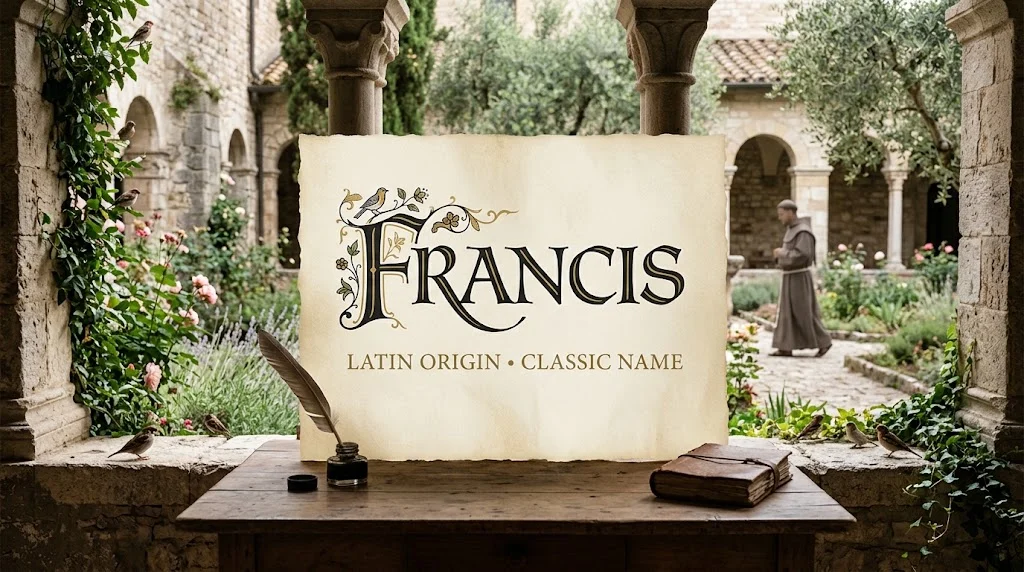
The Francis name meaning is traditionally connected to the Late Latin name Franciscus, commonly interpreted as “Frenchman” or someone associated with France. The name ultimately traces back to the Franks, the Germanic people whose name became connected with the territory that developed into France. Francis became especially influential in European naming history because of Saint Francis of Assisi, the 13th-century Italian religious figure who founded the Franciscan order.
Francis is a classic name with centuries of history behind it. It has been used in English and French, while related forms appear across many European languages. Although traditionally masculine in English, the name has also had some feminine usage, particularly in English and French naming traditions.
This guide explains the Francis name meaning, its Latin and Germanic roots, historical development, connection to Saint Francis of Assisi, pronunciation, variations, nicknames, symbolism, popularity, and related names.
What Is the Francis Name?
Francis is a traditional given name derived from the Late Latin Franciscus. The name became widely established in Europe during the Middle Ages, largely because of the influence and reputation of Saint Francis of Assisi.
In English, Francis has traditionally been used as a masculine given name, although it can also have feminine usage. The related feminine name Frances is particularly familiar in English.
Francis can therefore be understood as both:
- A historic European personal name
- A name with Latin linguistic roots
- A name connected with the Franks and France
- A major Christian cultural name
- A traditional name that remains recognizable today
Its long history gives it a formal and established character, while shorter forms such as Frank and Frankie can make it feel more casual.
Francis Name Meaning
The traditional Francis name meaning is “Frenchman.” The meaning comes from the Late Latin Franciscus, which was associated with the Franks and eventually with France.
The name has an interesting linguistic history because its ultimate origin is not simply the modern country name France. Instead, Francis developed through an older chain of linguistic and cultural connections.
The basic progression can be summarized as:
Franks → Francia → Franciscus → Francis
The Franks were a Germanic people whose name became associated with the region known as Francia. From this geographical and ethnic association came forms meaning something like “Frankish” or “French.”
Literal Meaning
The most commonly given meaning is:
“Frenchman”
This describes the historical association of the name with France or the Franks rather than describing a personality trait.
Symbolic Meaning
Because of Saint Francis of Assisi, Francis later acquired strong cultural associations with:
- Compassion
- Humility
- Simplicity
- Service
- Peace
- Care for nature
- Religious devotion
These are symbolic associations connected with the famous bearer of the name, rather than the literal etymological meaning of Francis.
Francis Name Origin and Etymology
Francis ultimately comes from the Late Latin name Franciscus. The name was associated with the Franks, a Germanic people whose name is also connected in historical etymological discussions with the word for a type of spear.
The name’s history is therefore connected to several layers of European language and culture.
Late Latin
Franciscus was the Latin form from which Francis developed.
The Franks
The Franks were a Germanic people who became particularly influential in Western Europe during the early medieval period.
Francia
The territory associated with the Franks became known as Francia, a name that ultimately contributed to the modern name France.
Francis
The English form developed from this wider Latin and European naming tradition.
Because names often change as they move between languages, Francis has numerous related forms across Europe.
Saint Francis of Assisi and the History of Francis
One of the most important reasons Francis became such a well-known name is Saint Francis of Assisi, who lived in Italy during the 12th and 13th centuries.
According to historical tradition, he was born Giovanni di Pietro di Bernardone and later became known as Francesco. His father had connections with French culture and reportedly used the name Francesco for his son.
Francis eventually rejected a wealthy lifestyle and devoted himself to religious life and service . He founded the religious movement that became the Franciscan order.
His influence had a major effect on the spread of the name.
The name Francis became especially associated with:
- Religious devotion
- Simplicity
- Charity
- Service
- Humility
- Peace
- Care for creation
The saint’s reputation helped the name spread widely through Western Europe during the Middle Ages.
Francis and the Franciscan Tradition
The connection between Francis and the Franciscan tradition is one of the most distinctive features of the name.
Franciscan communities developed from the movement associated with Saint Francis of Assisi. Their traditions emphasized a life of simplicity, service, and religious devotion.
As a result, the name Francis acquired a cultural meaning that goes beyond its linguistic origin.
Someone researching the name today may encounter Francis in historical, religious, literary, and cultural contexts because of this long association.
This is also why Francis may feel more spiritually significant than its literal meaning of “Frenchman” would suggest.
Francis Name Meaning in Different Contexts
The name can carry slightly different associations depending on the context.
Linguistic Meaning
From a linguistic perspective, Francis comes from Franciscus, traditionally interpreted as “Frenchman” and ultimately associated with the Franks.
Historical Meaning
Historically, the name became established across Europe through medieval naming traditions.
Religious Meaning
In Christian culture, Francis is strongly associated with Saint Francis of Assisi and the Franciscan tradition.
Modern Meaning
Today, Francis is often viewed as a classic, formal, traditional, and internationally recognizable name.
These meanings should not be confused. The name’s etymological meaning and its cultural symbolism developed at different points in its history.
How Do You Pronounce Francis?
In English, Francis is commonly pronounced:
FRAN-sis
A simple phonetic spelling is:
FRAN-siss
The name normally has two syllables.
The pronunciation is relatively straightforward for English speakers because the spelling closely corresponds to the common pronunciation.
French pronunciation can differ. Behind the Name lists the English pronunciation as approximately /ˈfræn.sɪs/ and the French pronunciation as /fʁɑ̃.sis/.
Is Francis a Boy’s Name or a Girl’s Name?
Francis has traditionally been used as a masculine name, especially in English.
However, the name is not exclusively masculine across all naming traditions. Behind the Name identifies Francis as having both masculine and feminine usage in English and French.
In English, the feminine form Frances is much more strongly established as a separate spelling.
This creates a useful distinction:
| Name | Typical Usage |
|---|---|
| Francis | Traditionally masculine, with some feminine usage |
| Frances | Traditionally feminine in English |
| Francisca | Feminine form in several languages |
| François | French masculine form |
| Francesco | Italian form |
| Francisco | Spanish and Portuguese form |
Usage varies by language and culture, so these forms should be considered related names rather than exact equivalents in every context.
Francis Name History
Francis became widespread in Western Europe during the Middle Ages, particularly following the fame of Saint Francis of Assisi.
Over subsequent centuries, the name became established in English and French naming traditions and developed related forms throughout Europe.
Its history demonstrates how a personal name can move through different cultural settings while retaining recognizable elements.
The name has appeared in religious communities, royal and aristocratic families, literature, politics, scholarship, and ordinary family naming traditions.
Its longevity is one reason Francis is often described as a classic name rather than a temporary naming trend.
Francis Name Symbolism
The literal meaning of Francis does not describe a personality trait. However, cultural associations surrounding the name have created several symbolic interpretations.
Compassion
Saint Francis is strongly associated with service to care for others.
Humility
His rejection of wealth and commitment to a simple life contributed to the name’s association with humility.
Peace
Francis has often been connected with peaceful and charitable ideals because of the saint’s legacy.
Nature
Saint Francis is especially well known for his association with care for creation and the natural world.
Service
The Franciscan tradition contributes a strong association with helping others.
These qualities are cultural and historical associations, not predictions about someone who carries the name.
Francis Name Popularity
Francis is a long-established name in the United States and has a much longer naming history than modern popularity lists alone can show.
The U.S. Social Security Administration maintains baby-name records dating back to 1880 and publishes current annual rankings based on Social Security card application data.
For current popularity research, the SSA is the most useful primary source because it provides year-by-year U.S. birth-name data. Popularity can differ significantly depending on whether the name is being considered for boys or girls and which historical period is examined.
Francis Nicknames
Francis has several established short forms and affectionate nicknames.
Common possibilities include:
- Frank
- Frankie
- Fran
- Franny
- Franc
- Fritz in some naming traditions and contexts, although it is not a direct everyday English nickname for Francis
Frank is particularly important because it developed as a traditional short form of Francis and related names.
Frankie can sound more casual and youthful, while Francis itself tends to have a more formal character.
Francis Name Variations
Francis has many international forms because the name has traveled extensively across European languages.
Some important related forms include:
| Language or Tradition | Related Form |
|---|---|
| Latin | Franciscus |
| English | Francis |
| French | François |
| Italian | Francesco |
| Spanish | Francisco |
| Portuguese | Francisco |
| German | Franz |
| Irish | Proinsias |
| Polish | Franciszek |
| Czech | František |
| Hungarian | Ferenc |
| Dutch | Frans |
| Croatian | Franjo |
| Slovenian | Frančišek |
Behind the Name lists many of these forms as related names of Francis.
These variations demonstrate the name’s broad European history.
Francis vs. Frances
One of the most common points of confusion is the difference between Francis and Frances.
In traditional English usage:
- Francis is generally masculine.
- Frances is generally feminine.
The pronunciation can also differ slightly in some English-speaking contexts, particularly in the final vowel sound.
The two names are closely related historically, but spelling matters when identifying a person’s actual given name.
For someone researching a historical document, genealogy record, or family tree, it is therefore important not to automatically treat Francis and Frances as the same spelling.
Francis vs. Frank
Francis is the longer traditional form, while Frank developed as a shortened form and is also an independent given name.
The two names can therefore share historical roots and naming traditions while still functioning as separate names today.
Frankie can serve as an informal form of either Francis or Frank, depending on the family and cultural context.
Names Similar to Francis
If you like Francis because of its traditional sound, European history, or religious associations, several names may have a similar style.
| Name | Origin | Similarity |
|---|---|---|
| Frank | Germanic/European | Closely connected to Francis |
| Francesco | Italian | International form of Francis |
| Francisco | Spanish/Portuguese | International form of Francis |
| Franz | German | Related European form |
| Vincent | Latin | Traditional Christian name |
| Benedict | Latin | Classic religious association |
| Augustine | Latin | Historic Christian name |
| Dominic | Latin | Traditional religious name |
The similarities here involve naming style, history, or cultural associations. The names have different etymologies and individual histories.
Is Francis a Biblical Name?
Francis is not a biblical name in the sense of originating from the Bible.
Unlike names such as John, Matthew, David, or Daniel, Francis does not come from a biblical Hebrew or Greek personal name.
Its importance in Christian culture comes primarily from Saint Francis of Assisi, who lived many centuries after the biblical period.
This distinction is useful because Francis is sometimes grouped with religious or Christian names even though its linguistic origin is European and Late Latin rather than biblical.
Is Francis a Good Baby Name?
Whether Francis is the right baby name depends on personal preference and family circumstances.
Francis may appeal to parents who want a name that is:
- Traditional
- Historically established
- Internationally recognizable
- Connected with European culture
- Associated with Saint Francis of Assisi
- Easy to shorten to Frank or Frankie
- Formal enough for an adult but adaptable to childhood
One potential consideration is that Francis has a distinctly traditional character. Parents looking for an extremely modern or highly unusual name may prefer something different.
For families who appreciate names with centuries of history, however, Francis offers substantial cultural depth.
What Does Francis Symbolize?
Francis can symbolize different things depending on whether you focus on its linguistic history or its religious associations.
Its traditional linguistic meaning points toward the Franks and France, while its cultural history connects it with Saint Francis of Assisi.
Because of Saint Francis, the name can symbolically suggest:
Compassion • Humility • Peace • Service • Simplicity • Care for nature
These symbolic qualities developed through the historical reputation of Saint Francis rather than from the literal meaning of the name itself.
Francis Name Meaning at a Glance
| Attribute | Details |
|---|---|
| Name | Francis |
| Traditional gender | Masculine |
| Additional usage | Feminine usage also exists |
| Origin | Late Latin |
| Latin form | Franciscus |
| Traditional meaning | “Frenchman” |
| Ultimate association | The Franks |
| Famous historical bearer | Saint Francis of Assisi |
| Common English pronunciation | FRAN-sis |
| Common nicknames | Frank, Frankie, Fran, Franny |
| Italian form | Francesco |
| Spanish form | Francisco |
| French form | François |
| German form | Franz |
| Style | Classic, traditional, European |
| Religious association | Franciscan tradition |
FAQs
What does the name Francis mean?
Francis traditionally means “Frenchman.” It comes from the Late Latin name Franciscus, which is associated with the Franks and the historical region of Francia.
What is the origin of the name Francis?
Francis has a Late Latin origin. Its historical development is connected with the Franks, a Germanic people whose name became associated with Francia and eventually France.
Is Francis a biblical name?
No. Francis is not a biblical name in origin. It became strongly associated with Christianity because of Saint Francis of Assisi, who lived during the medieval period.
Is Francis a boy’s name or a girl’s name?
Francis is traditionally a masculine name in English, although it also has feminine usage in English and French. Frances is the more familiar feminine spelling in English.
How do you pronounce Francis?
Francis is commonly pronounced FRAN-sis in English. It normally has two syllables.
Conclusion
The Francis name meaning is traditionally explained as “Frenchman,” from the Late Latin name Franciscus and its connection with the Franks. Although the name’s linguistic roots are connected with a people and a geographical tradition, its cultural significance became much broader through centuries of European use.
Saint Francis of Assisi played a particularly important role in the history of the name. His life and religious legacy helped Francis become widespread in medieval Western Europe and gave the name enduring associations with compassion, humility, service, peace, and care for creation.
Today, Francis remains a recognizable classic with numerous international forms, including Francesco, Francisco, François, and Franz. Its combination of historical depth, simple pronunciation, flexible nicknames, and long-standing cultural significance makes Francis a name with a strong connection to European and Christian history while still remaining usable in modern families.
Discover More Related Articles:

8 thoughts on “Francis Name Meaning | Origin, History & Significance In 2026”