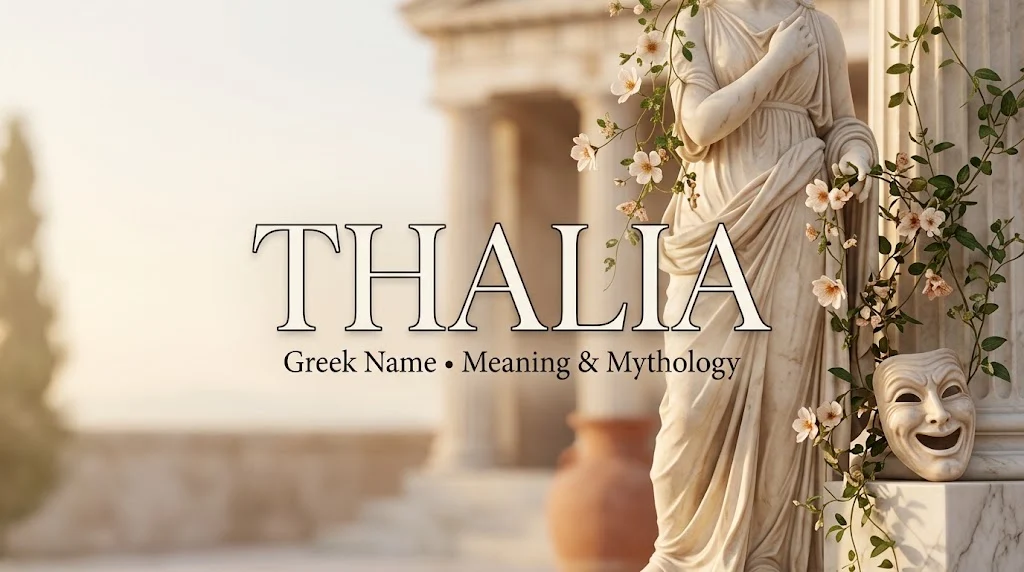
The Thalia name meaning is traditionally connected with the Greek idea of “to flourish,” “to bloom,” or “to be abundant.” Thalia is an ancient Greek feminine name with a particularly rich cultural history because it was also the name of one of the nine Muses in Greek mythology.
Thalia, the Muse associated especially with comedy and idyllic or pastoral poetry, represents a lively connection between the name and creativity, celebration, and artistic expression.
Today, Thalia has a graceful and distinctive sound that appeals to parents looking for a feminine name with classical roots. Its connection to Greek mythology gives it historical depth, while its meaning of flourishing or blooming gives it a positive and uplifting quality.
This guide explores the Thalia name meaning, Greek origin, etymology, mythology, pronunciation, symbolism, variations, nicknames, popularity, and related names.
What Is the Thalia Name?
Thalia is a feminine given name of Greek origin. In Ancient Greek, the name is associated with the word thallein, meaning “to bloom,” “to flourish,” or “to thrive.”
The name is particularly significant in Greek mythology because Thalia was one of the nine Muses, the divine figures traditionally associated with artistic and intellectual inspiration.
Thalia is commonly associated with:
- Flourishing
- Blooming
- Abundance
- Joy
- Celebration
- Creativity
- Artistic inspiration
- Beauty
The name therefore combines a pleasant literal meaning with a substantial cultural history.
It is also worth distinguishing Thalia from similar-sounding names. Although some names may share letters or pronunciation patterns, they do not necessarily have the same Greek origin or etymology.
Thalia Name Meaning
The traditional Thalia name meaning is connected with the Greek concept of “flourishing” or “blooming.” Depending on the source and translation, the name may also be expressed through ideas such as abundance, prosperity, or something that grows and thrives.
The underlying Greek vocabulary gives the name a positive and life-affirming quality.
Literal Meaning
The name is traditionally associated with the Greek verb thallō, meaning to bloom, flourish, or thrive.
This creates a natural symbolic connection with:
- Growth
- Freshness
- Vitality
- Prosperity
- Beauty
- Abundance
Mythological Meaning
Thalia’s mythological identity adds another dimension. As one of the Muses, she represents artistic inspiration, particularly comedy and pastoral poetry.
Her name can therefore evoke both flourishing in the literal sense and creative expression in its cultural context.
Modern Interpretation
For parents choosing Thalia today, the name may symbolize a child who grows, flourishes, and brings creativity and joy into the lives of others.
These are symbolic interpretations rather than predictions about personality. A name can carry cultural associations, but it does not determine who someone will become.
Thalia Name Origin and Etymology
Thalia comes from Ancient Greek. It is commonly written in Greek as Θάλεια (Tháleia).
The name is associated with the Greek word thallō, relating to flowering, blooming, flourishing, or thriving.
This etymology is especially fitting because the mythological Thalia was connected with celebration and artistic creativity. The linguistic meaning and mythological identity reinforce one another, giving the name a particularly cohesive history.
Over time, Greek names entered other languages through classical literature, mythology, historical texts, and religious and educational traditions. As a result, Thalia can appear in different transliteration and spelling forms.
Thalia in Greek Mythology
One of the most important reasons Thalia has remained recognizable is her role among the Nine Muses of Greek mythology.
The Muses were traditionally regarded as sources of inspiration for arts, literature, music, and intellectual pursuits.
Thalia, the Muse of Comedy
Thalia is particularly associated with comedy. She is also connected with pastoral or idyllic poetry.
In artistic representations, she is often depicted with attributes associated with comedy, especially a comic mask.
Her mythological identity gives the name associations with:
- Humor
- Celebration
- Creativity
- Performance
- Artistic expression
- Joy
- Literature
This makes Thalia an especially interesting choice for families who appreciate names connected with classical mythology and the arts.
Thalia and the Other Muses
Thalia was one of nine Muses. The others were traditionally associated with different areas of artistic or intellectual inspiration.
| Muse | Traditional Association |
|---|---|
| Calliope | Epic poetry |
| Clio | History |
| Erato | Love poetry |
| Euterpe | Music and lyric poetry |
| Melpomene | Tragedy |
| Polyhymnia | Hymns |
| Terpsichore | Dance |
| Thalia | Comedy and pastoral poetry |
| Urania | Astronomy |
The exact roles and attributes of the Muses developed through classical tradition, so descriptions can vary somewhat between ancient and later sources.
History and Cultural Context of Thalia
Thalia belongs to the classical naming tradition of Ancient Greece. Greek mythology has had an enormous influence on literature, visual art, theater, philosophy, and Western education, which helped preserve names such as Thalia long after the ancient Greek world changed.
Unlike a name that exists only in a modern naming trend, Thalia has a documented cultural association stretching back to classical mythology.
Its history can therefore be understood through several connected layers:
- Ancient Greek language
- Classical mythology
- The tradition of the Nine Muses
- Greek literature and art
- Later European use of classical names
- Modern baby naming
This long history gives Thalia an unusual combination of elegance and cultural depth.
How Do You Pronounce Thalia?
Thalia has more than one pronunciation in English, and pronunciation can vary by country and personal preference.
A common English pronunciation is:
THAY-lee-uh
Another pronunciation you may encounter is:
THAH-lee-uh
Some speakers may also pronounce it closer to the original Greek form, depending on their linguistic background.
Because the name has moved between Greek and English-speaking traditions, there is no need to assume that every Thalia will pronounce her name identically.
If you are considering the name for a baby, choosing the pronunciation you prefer and using it consistently can help avoid confusion.
Is Thalia a Girl’s Name?
Yes. Thalia is traditionally a feminine given name.
Its connection with the Muse Thalia gives it a particularly strong historical association with feminine naming traditions.
Today, it is primarily used as a girl’s name in English-speaking naming contexts and in communities influenced by Greek culture and classical traditions.
Parents may choose it because it sounds feminine and graceful while still being less conventional than some widely used classical names.
Thalia Name Symbolism
Thalia has several layers of symbolism because its linguistic meaning and mythology both contribute to its identity.
Flourishing
The strongest literal association is with blooming or flourishing. This can symbolize growth and positive development.
Abundance
Because the underlying Greek word can convey ideas related to thriving and abundance, Thalia may suggest prosperity and fullness.
Creativity
As one of the Muses, Thalia is closely connected with artistic inspiration.
Joy
Her association with comedy and celebration gives the name a cheerful quality.
Beauty
The imagery of flowering and artistic expression can naturally evoke beauty and grace.
Growth
A blooming plant provides a simple metaphor for development, possibility, and new beginnings.
These associations make Thalia a name with an unusually positive symbolic profile.
Thalia Name Popularity
Thalia is used in the United States and other countries, although its popularity can vary by region and year.
Unlike some extremely common modern names, Thalia generally maintains a more distinctive position. Parents may recognize the name because of Greek mythology, literature, entertainment, or its classical sound.
Popularity statistics should be interpreted carefully because rankings can change from one year to another. The best source for current U.S. birth-name data is the Social Security Administration’s baby-name database.
Thalia’s appeal is not based solely on popularity. Its strongest features are arguably its:
- Ancient Greek origin
- Mythological history
- Positive meaning
- Feminine sound
- Artistic associations
- Distinctive spelling
Is Thalia a Greek Name?
Yes. Thalia is a Greek name with Ancient Greek roots.
Its connection to Greek mythology is particularly strong because Thalia was one of the Nine Muses. The name’s traditional etymology is also connected with a Greek word for flourishing or blooming.
This makes Thalia a good choice for someone looking specifically for a name with authentic classical Greek associations.
Thalia Name Variations and Spellings
Because Greek names can be transliterated into the Latin alphabet in different ways, several spelling forms may appear.
Commonly encountered forms include:
- Thalia
- Thaleia
- Thália
- Thalie — a related form used in some naming traditions
The spelling Thaleia more closely reflects the Greek form Θάλεια, while Thalia is the familiar English-language form.
Accent marks may also appear in languages that use them to indicate pronunciation.
These variations are related to language and transliteration rather than necessarily representing completely different names.
Common Nicknames for Thalia
Thalia already has a relatively compact and melodic form, so many people may use the full name.
Possible nicknames include:
- Thal
- Tali
- Lia
- Lili
- Thally
- Talia
Some of these forms overlap with names that are independently used as given names. For that reason, a nickname does not always uniquely identify someone as Thalia.
Names Similar to Thalia
If you like Thalia’s Greek origin, feminine sound, or mythological background, several other names may appeal to you.
| Name | Origin/Association | Similarity to Thalia |
|---|---|---|
| Calliope | Greek mythology | Another name of a Muse |
| Clio | Greek mythology | Classical Muse name |
| Elara | Greek mythology | Distinctive Greek mythological style |
| Athena | Greek mythology | Strong classical Greek connection |
| Daphne | Greek mythology | Ancient Greek feminine name |
| Thea | Greek | Short, elegant Greek name |
| Celia | Latin | Similar graceful sound |
| Talia | Various traditions | Very similar spelling and sound |
These names are not identical in meaning or origin. Their similarity mainly comes from sound, classical associations, or naming style.
Thalia vs. Talia
Thalia has a clear connection to the Ancient Greek name Θάλεια and the Muse of comedy.
Talia, meanwhile, can have different origins depending on the specific naming tradition being discussed. It should not automatically be treated as simply another spelling of Thalia.
| Name | Main Association | Key Difference |
|---|---|---|
| Thalia | Ancient Greek | Connected to flourishing and the Muse Thalia |
| Talia | Multiple naming traditions | Can have different origins and meanings |
| Thaleia | Ancient Greek | A transliterated form closer to Greek |
If historical Greek mythology is the reason you like the name, Thalia or Thaleia makes the connection clearer.
Is Thalia a Good Baby Name?
Thalia can be an appealing baby name for parents who want something feminine, distinctive, and connected to classical history.
Its biggest strengths are its combination of positive meaning and cultural depth. “Flourishing” gives it an optimistic interpretation, while the Muse connection gives it an artistic dimension.
Thalia may be particularly suitable for parents who enjoy:
- Greek mythology
- Classical literature
- Artistic names
- Nature-inspired meanings
- Elegant feminine names
- Distinctive traditional names
One practical consideration is pronunciation. Because English speakers may use more than one pronunciation, a child named Thalia may occasionally need to clarify how her name is pronounced.
What Does Thalia Symbolize?
Thalia can symbolize growth, flourishing, creativity, joy, and artistic inspiration.
The flourishing meaning creates a nature-inspired image of something growing and blooming. Meanwhile, Thalia’s role as a Muse connects the name to comedy, poetry, performance, and creative expression.
Together, these associations make Thalia a name that can be interpreted as representing a life that flourishes creatively and joyfully.
That interpretation is symbolic rather than literal, but it is one reason the name has such a positive feel.
Thalia Name Meaning at a Glance
| Attribute | Details |
|---|---|
| Name | Thalia |
| Gender | Traditionally feminine |
| Origin | Greek |
| Language | Ancient Greek |
| Greek form | Θάλεια |
| Traditional meaning | “To flourish,” “to bloom,” or “to thrive” |
| Mythological figure | One of the Nine Muses |
| Muse association | Comedy and pastoral poetry |
| Common English pronunciation | THAY-lee-uh |
| Symbolism | Growth, creativity, joy, abundance |
| Related spelling | Thaleia |
| Style | Classical, feminine, elegant |
| Common nickname possibilities | Tali, Lia, Thal |
Why Choose the Name Thalia?
Thalia stands out because it has several qualities that work together rather than relying on a single meaning.
Its Greek origin gives it historical credibility. Its traditional association with flourishing and blooming provides a warm and optimistic meaning.
At the same time, Thalia does not require someone to know Greek mythology to appreciate it. The name works simply as a graceful modern given name while retaining its classical history for those who want to explore it more deeply.
For parents looking beyond extremely common names, this balance can make Thalia especially attractive.
FAQs
What does the name Thalia mean?
Thalia is traditionally associated with the Greek concepts of “to flourish,” “to bloom,” or “to thrive.” The name can also carry associations with abundance and prosperity.
What is the origin of the name Thalia?
Thalia is a Greek name with Ancient Greek roots. It is commonly written as Θάλεια in Greek and is associated with a Greek word relating to flourishing or blooming.
Is Thalia a Greek name?
Yes. Thalia is an Ancient Greek name and is strongly connected with Greek mythology through Thalia, one of the Nine Muses.
Who was Thalia in Greek mythology?
Thalia was one of the Nine Muses in Greek mythology. She was traditionally associated with comedy and pastoral poetry and is often represented with a comic mask.
How do you pronounce Thalia?
A common English pronunciation is THAY-lee-uh, although THAH-lee-uh and other variations may also be heard. Pronunciation can depend on language, region, and personal preference.
Conclusion
The Thalia name meaning is traditionally connected with flourishing, blooming, thriving, and abundance, giving the name a naturally positive sense of growth and vitality. Its Ancient Greek roots make it a name with genuine classical heritage rather than a modern invention, while its feminine sound allows it to fit comfortably into contemporary naming.
Thalia’s mythology makes the name even more distinctive. As one of the Nine Muses, Thalia is traditionally associated with comedy and pastoral poetry, connecting her with creativity, performance, joy, and artistic inspiration. This combination of linguistic meaning and mythology gives the name several layers of symbolism.
Overall, Thalia is a beautiful option for parents looking for a Greek girl name with history, elegance, creativity, and a positive meaning. Whether you are drawn to its association with blooming and flourishing or its place in classical mythology, Thalia offers a timeless identity that can feel both ancient and modern.
Discover More Related Articles:
- Margot Name Meaning | Sweet, Elegant & Timeless In 2026
- Liliana Name Meaning | Origin, History, Symbolism & More In 2026

1 thought on “Thalia Name Meaning | Greek Origin, History & Symbolism In 2026”