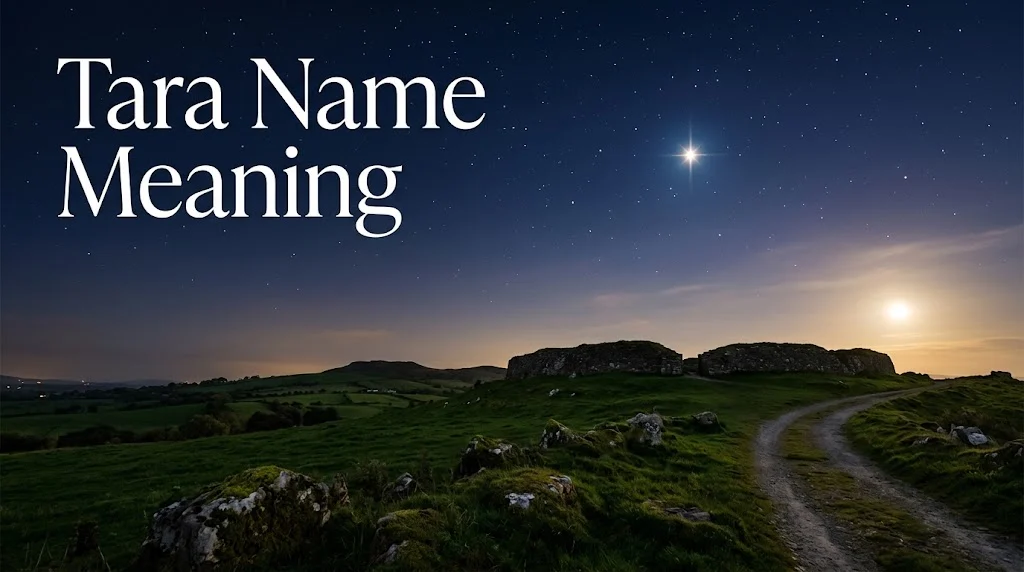
The Tara name meaning has more than one established cultural origin. In Irish usage, Tara is an anglicized form of the Irish place name Teamhair, associated with the historic Hill of Tara and possibly meaning “elevated place.” In Sanskrit, Tara means “star” and has important associations in Hindu and Buddhist traditions.
Because of these different origins, Tara can carry several layers of meaning depending on the cultural context. The Irish form connects the name with an important historic landscape in Ireland, while the Sanskrit form connects it with stars, spirituality, protection, and religious traditions.
Tara is generally used as a feminine given name in English and in several South Asian cultural and religious contexts. Its short spelling and simple pronunciation have helped it become familiar internationally.
This guide explores the Tara name meaning, its origins, etymology, history, pronunciation, cultural significance, symbolism, popularity, related names, and common questions about choosing Tara as a baby name.
What Is the Tara Name?
Tara is a feminine given name with multiple independent origins and meanings.
The most commonly documented origins include:
- Irish: an anglicized form of Teamhair, the name associated with the Hill of Tara in Ireland.
- Sanskrit: a name meaning “star,” used in Hindu and Buddhist traditions.
- South Asian usage: Tara is found in Hindi and Nepali naming contexts and has religious and cultural associations.
- Persian usage: Tara is also used as a feminine name in Persian contexts.
These origins should not be treated as one single etymology. The Irish and Sanskrit forms are distinct linguistic and cultural traditions that happen to share the spelling Tara.
A concise definition is:
Tara is a feminine name with several cultural origins. In Irish usage it is connected with the historic Hill of Tara and possibly means “elevated place,” while in Sanskrit it means “star.”
This makes Tara particularly interesting for name research because its meaning changes depending on which tradition is being discussed.
Tara Name Meaning
The Tara name meaning is best understood through its separate linguistic traditions.
In the Sanskrit tradition, Tara means “star.” This gives the name a celestial association and connects it with light, the night sky, and spiritual symbolism.
In the Irish tradition, Tara comes from Teamhair, the Irish place name associated with the Hill of Tara. The exact original meaning of Teamhair is not completely certain, although it is commonly explained as possibly meaning “elevated place.”
These meanings create two very different but complementary images:
Tara as “star” suggests something celestial, bright, distant, and beautiful.
Tara as an “elevated place” suggests height, landscape, history, and prominence.
Neither meaning should automatically be applied to every person named Tara. The appropriate meaning depends on the cultural and linguistic tradition behind the individual name.
Tara Name Origin and Etymology
Tara does not have one universal origin.
Irish Origin
The Irish Tara is an anglicized form of Teamhair, an Irish place name associated with the Hill of Tara. The historical site is located in County Meath, Ireland, and has strong connections with Ireland’s early kingship traditions. The original meaning of Teamhair is uncertain, although “elevated place” is a commonly cited possibility.
This means the Irish name is fundamentally connected with a place name rather than beginning as an ordinary descriptive personal name.
Sanskrit Origin
The Sanskrit Tara has a separate origin. It comes from the Sanskrit word tārā, meaning “star.” It is also the name of important religious figures in Hindu and Buddhist traditions.
The Sanskrit form therefore has a celestial and religious dimension that is different from the Irish geographical origin.
Because these are separate etymological traditions, it is more accurate to describe Tara as a name with multiple origins rather than claiming that every Tara has one shared linguistic history.
History and Cultural Context of Tara
Tara has a particularly rich history because the name appears in both Irish historical tradition and South Asian religious traditions.
Tara in Irish History
The Hill of Tara is one of Ireland’s best-known historic and archaeological landscapes. It was traditionally associated with the high kings of Ireland and became an important symbol of Irish political and cultural history.
The modern English form Tara comes from the Irish place name Teamhair. The name later entered wider English-language naming culture.
Tara also received a major boost in familiarity through Gone with the Wind, Margaret Mitchell’s 1936 novel and the 1939 film adaptation. In that story, Tara is the name of the O’Hara plantation. The fictional setting helped introduce or reinforce Tara as a recognizable name for English-speaking audiences.
This is an important part of the modern name’s history because it helped transform a historically Irish place name into a familiar personal-name choice.
Tara in Hindu Tradition
In Hindu tradition, Tara is the name of an important mythological figure. She is described as the wife of Brihaspati and is associated with a story involving Chandra, the god of the moon. The story is part of Hindu mythology and should be understood within its religious and literary context.
Tara in Buddhism
Tara has an important place in Buddhist traditions as well. In Buddhist belief, Tara is a bodhisattva associated with salvation and protection. Different Buddhist traditions developed different forms and interpretations of Tara.
This religious history gives the Sanskrit Tara a much deeper cultural context than simply translating the name as “star.”
What Does Tara Mean in Sanskrit?
In Sanskrit, Tara means “star.” This is one of the best-established meanings associated with the name.
The word’s celestial meaning naturally creates associations with:
- Light
- The night sky
- Guidance
- Beauty
- Hope
- Spirituality
- Wisdom
- Protection
Some of these are symbolic interpretations rather than literal dictionary definitions. The literal meaning remains “star.”
The religious significance of Tara in Hindu and Buddhist traditions adds another layer to the name. In those contexts, Tara is not merely a word for a star but also the name of important religious figures.
What Does Tara Mean in Irish?
In Irish naming history, Tara is an anglicized form of Teamhair, associated with the Hill of Tara. The original place-name meaning is uncertain, although it is often given as possibly meaning “elevated place.”
The Irish meaning is therefore different from the Sanskrit meaning.
A useful way to remember the distinction is:
| Cultural origin | Meaning or association |
|---|---|
| Irish | Possibly “elevated place” |
| Sanskrit | “Star” |
| Hindu tradition | Mythological figure named Tara |
| Buddhist tradition | Bodhisattva associated with protection and salvation |
This distinction prevents the common mistake of treating all uses of Tara as though they came from exactly the same linguistic source.
How Do You Pronounce Tara?
Tara can have different pronunciations depending on language, region, and family preference.
Common English pronunciations include:
TAH-ruh
TAIR-uh
Some speakers use a pronunciation closer to TAR-uh.
Behind the Name records multiple English pronunciations, including forms represented approximately as TAH-ruh, TAIR-uh, and TAR-uh.
In South Asian contexts, pronunciation can also reflect the original Sanskrit and the speaker’s regional language.
Because Tara is an international name, there is no single pronunciation that applies universally across every language and culture.
Tara Name Symbolism
Tara has particularly rich symbolism because its two major traditions create different images.
Star Symbolism
When Tara is understood through its Sanskrit meaning, “star” can symbolize:
- Light
- Guidance
- Hope
- Beauty
- Wisdom
- Spiritual awareness
- Protection
Stars have been important symbols across many cultures, although these broader associations should not be confused with the literal Sanskrit definition.
Elevated Place Symbolism
The Irish connection to the Hill of Tara can suggest:
- Height
- Strength
- Historical importance
- Leadership
- Heritage
- Connection to the land
Again, these are symbolic interpretations rather than additional dictionary meanings.
The combination makes Tara especially versatile. One cultural tradition gives it a celestial image, while another connects it with an important historic landscape.
Tara as a Baby Name
Tara can appeal to parents looking for a short, recognizable name with substantial cultural depth.
It has several characteristics that make it distinctive:
- It is short and easy to spell.
- It has multiple cultural backgrounds.
- It has both geographical and celestial associations.
- It has a long history in religious and cultural traditions.
- It is familiar in English-speaking countries.
- It can be pronounced in several natural ways.
Parents interested in Irish heritage may be drawn to the Hill of Tara connection, while families interested in Sanskrit or South Asian traditions may value the meaning “star.”
Because the name exists independently in different traditions, families should consider which cultural meaning they want to emphasize when choosing it.
Tara Name Popularity
Tara has been used as a feminine name in the United States for many decades. Its popularity has changed considerably over time.
The U.S. Social Security Administration maintains annual baby-name statistics based on Social Security card application data. In its 2025 statistics, Tara ranked No. 847 among girls’ names, compared with No. 1,020 in 2024. The SSA therefore recorded a substantial increase in Tara’s ranking between those two years.
A ranking describes usage in a specific year’s U.S. birth data. It does not determine whether a name is culturally significant, attractive, traditional, or appropriate for a particular family.
The current data also shows why name popularity should be discussed with a year attached. Tara’s ranking can change from one birth year to another.
Tara Name Variations
Tara has several spelling variants and related forms.
Some documented English variants include:
- Tarah
- Tera
- Terra
- Tarina
These forms do not necessarily have identical histories or meanings.
There are also names that sound similar to Tara but come from different linguistic backgrounds. Similar pronunciation does not automatically mean two names are etymological variants.
For example, a parent considering Tara should distinguish between a true spelling variant and a completely separate name that happens to sound similar.
Tara vs. Related Names
| Name | Meaning or Origin | How It Differs |
|---|---|---|
| Tara | “Star” in Sanskrit; Irish place-name connection | Multiple established origins |
| Stella | “Star” in Latin | Direct Latin celestial meaning |
| Astrid | Scandinavian name with a different etymology | Not derived from “star” |
| Cora | Greek literary and mythological associations | Different linguistic origin |
| Terra | Latin word associated with earth | Similar spelling but different meaning |
| Tarah | Variant spelling of Tara | Same or closely related modern form |
Tara is particularly unusual because it can be understood through both a celestial meaning and an Irish geographical history, depending on the origin being considered.
Famous Cultural References to Tara
One of the most influential modern cultural references to Tara is Gone with the Wind.
In Margaret Mitchell’s novel, published in 1936, Tara is the name of the O’Hara family’s plantation. The 1939 film adaptation further popularized the reference. Behind the Name identifies this work as an important influence on the name’s popularity as a given name.
The fictional Tara should not be confused with the historical Hill of Tara in Ireland. They are separate references that happen to share the same name.
The historical Tara is an Irish place, while the fictional Tara in Gone with the Wind is a plantation setting created for the story.
What Personality Does the Name Tara Suggest?
A person’s name does not determine their personality. However, names can inspire symbolic associations based on their meanings and cultural histories.
Because Tara can mean “star,” people may associate it with qualities such as:
- Brightness
- Hope
- Guidance
- Grace
- Wisdom
The Irish historical connection may inspire associations with:
- Strength
- Heritage
- Leadership
- Independence
- Stability
These are interpretive associations rather than established personality traits.
Is Tara a Good Name for a Baby?
Tara offers a combination of simplicity and cultural depth.
It is short, recognizable, relatively easy to spell, and supported by multiple established naming traditions. The Sanskrit meaning “star” gives it an appealing celestial image, while the Irish connection provides historical and geographical significance.
Tara may especially appeal to families interested in:
- Irish names
- Sanskrit names
- Hindu or Buddhist cultural traditions
- Short girl names
- Celestial names
- Traditional yet familiar names
- Names with historical significance
The most important consideration is which cultural origin and meaning resonate with the family. Since Tara has multiple independent histories, understanding that distinction can make the name choice more meaningful.
FAQs
What does Tara mean?
Tara has several meanings depending on its origin. In Sanskrit, Tara means “star.” In Irish usage, it is an anglicized form of Teamhair, associated with the Hill of Tara and possibly meaning “elevated place.”
Is Tara an Irish name?
Yes. Tara is an anglicized form of the Irish place name Teamhair, associated with the historic Hill of Tara. Its original meaning is uncertain, although “elevated place” is commonly suggested.
Is Tara a Sanskrit name?
Yes. Tara is a Sanskrit name meaning “star.” It also has important associations in Hindu and Buddhist traditions.
What does Tara mean in Hinduism?
Tara is the name of a Hindu mythological figure and is associated with the Sanskrit meaning “star.”
What does Tara mean in Buddhism?
In Buddhist traditions, Tara is a bodhisattva associated with salvation and protection. The religious figure Tara has an important place in several Buddhist traditions.
Conclusion
The Tara name meaning is especially interesting because the name has more than one established cultural origin. In Sanskrit, Tara means “star,” creating beautiful celestial associations with light, guidance, wisdom, and hope. In Irish usage, Tara comes from the place name Teamhair and is connected with the historic Hill of Tara, with “elevated place” often suggested as a possible meaning.
Tara also has a rich cultural history. It appears in Hindu and Buddhist traditions, has an important place in the Ramayana, and is connected with a significant Irish historical landscape. Its modern popularity in English-speaking culture was also influenced by Gone with the Wind, where Tara is the name of the O’Hara plantation. These different influences make Tara more than a simple short name.
For parents choosing Tara, the name offers simplicity, familiarity, and meaningful cultural depth. Whether you prefer its Sanskrit connection to the stars or its Irish connection to an important historic place, Tara has a distinctive identity. Its multiple origins also make it important to explain the cultural context rather than assigning one meaning to every use of the name.
Discover More Related Articles:
- Callan Name Meaning | Origin, History & Symbolism In 2026
- Ann Name Meaning | Origin, History & Symbolism In 2026
