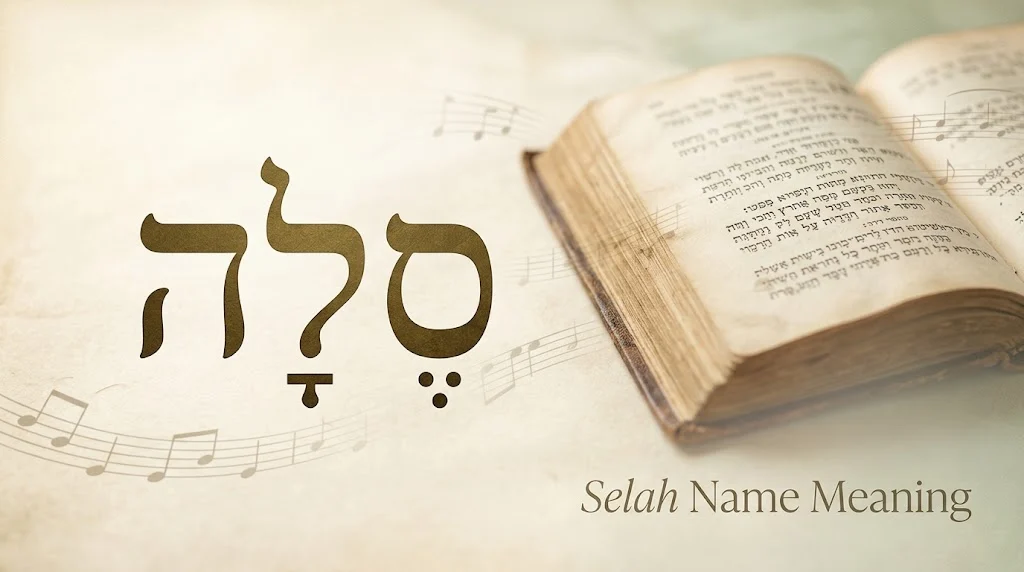
Selah is a distinctive Biblical name associated with a Hebrew word found primarily in the Book of Psalms. The selah name meaning is commonly connected with a pause, musical interlude, or moment of reflection, although scholars caution that the precise meaning of the ancient Hebrew term is uncertain. It appears 71 times in 39 Psalms and three times in Habakkuk 3, where it functions as a musical or liturgical marker.
As a modern given name, Selah has an appealing combination of Biblical roots, gentle pronunciation, and reflective symbolism. It can suggest ideas such as pause, contemplation, stillness, worship, and taking time to consider something meaningful. However, it is important not to present “pause and reflect” as a proven one-word translation. The original term has been interpreted in several ways, and its exact etymology remains debated.
This guide explores the Selah name meaning, Hebrew background, Biblical usage, pronunciation, history, symbolism, related names, and practical considerations for parents choosing Selah as a first name.
What Is the Name Selah?
Selah is a Biblical name derived from the Hebrew term סֶלָה (selah). Unlike many Biblical names, it is not primarily the personal name of a Biblical character. Instead, it comes from a word appearing within Biblical poetry, especially the Psalms.
The term is generally classified as a musical or liturgical expression. Traditional explanations connect it with a pause, suspension, interlude, or a direction concerning how a Psalm should be performed. The exact ancient instruction is not known with certainty.
That distinction matters when researching the name. Selah is sometimes given a simple definition such as “pause and reflect,” but that phrase is better understood as an interpretive description of the name’s symbolism than as a definitive dictionary translation.
As a personal name, Selah is generally presented as a feminine Biblical name in modern name references. Behind the Name lists it as feminine, Biblical in usage, and written in Ancient Hebrew as סֶלָה. It gives the English pronunciation approximately as SEE-luh.
Quick meaning at a glance
| Attribute | Selah |
|---|---|
| Name | Selah |
| Hebrew form | סֶלָה |
| Origin | Biblical Hebrew |
| Biblical association | Psalms and Habakkuk |
| Common interpretation | Pause, musical interlude, reflection |
| Pronunciation | SEE-luh |
| Name style | Biblical, distinctive, gentle |
| Modern use | Primarily used as a given name |
Selah Name Meaning in Hebrew
The Selah name meaning in Hebrew requires a little caution because the ancient word does not have one universally accepted translation.
Biblical and Hebrew reference works generally describe selah as a difficult or uncertain term associated with music and poetry. One established interpretation connects it with a pause or suspension in the music. Other scholarly proposals have connected it with ideas such as lifting up, emphasizing, or raising the voice.
The uncertainty comes partly from the fact that the Biblical text does not stop to define selah. Instead, the word appears at particular points in poetic passages. Because of its placement and its association with musical instructions, researchers have tried to reconstruct how ancient singers and musicians understood it.
For a modern name, the most useful interpretation is therefore:
Selah represents a pause, musical interlude, or intentional moment to stop and reflect.
This makes the name particularly attractive to people who appreciate names with a contemplative or spiritual quality.
It is also worth separating Selah from the Hebrew word sela, which can have a different spelling and meaning. Similar-looking names and words should not automatically be treated as variants of Selah.
Selah Name Origin and Etymology
The origin of Selah is Biblical Hebrew, but its precise etymology is uncertain.
The Hebrew spelling is סֶלָה, and lexicons commonly identify it as a technical term associated with music or poetic performance. Strong’s Hebrew Lexicon connects the term with a suspension or pause in music, while also listing the concept of lifting up or exalting among its lexical associations.
Another Hebrew reference, the Klein Dictionary available through Sefaria, describes selah as a technical musical term in the Psalms and Habakkuk that indicates a pause, while proposing a possible connection with a root associated with raising or lifting.
Because these explanations differ, a responsible discussion of the Selah name origin should acknowledge the uncertainty rather than claiming that the name definitely means one particular phrase.
Why are there different meanings?
Ancient musical terminology can be difficult to interpret because modern readers do not have the original performance traditions that accompanied the texts.
The word may have indicated:
- A pause in singing
- An instrumental interlude
- A musical emphasis
- A change or interruption in performance
- A moment intended to emphasize the preceding words
Some reference works specifically describe the term as a musical pause or interlude, while others emphasize that its exact function remains uncertain.
So when people describe Selah as “pause and reflect,” they are expressing the reflective significance commonly associated with the Biblical word, rather than claiming that this is its uncontested literal translation.
Selah in the Bible
The strongest historical connection of Selah is to the Book of Psalms.
Reference sources count the term 71 times in the Psalms and three times in Habakkuk chapter 3, for 74 occurrences under the commonly cited Hebrew lexical entry.
Its placement within Biblical poetry is one reason scholars believe it had a musical or liturgical function.
For readers today, seeing the word in a Psalm can create the impression of an intentional break: the preceding statement has been made, and there is now space before the poetic thought continues.
That has led to a long-standing devotional association between Selah and reflection.
The idea can be understood in a simple way:
Speak → pause → consider → continue.
This symbolism gives Selah a special quality as a modern name. Instead of referring to a physical object or a conventional personality trait, it evokes a practice: slowing down and giving attention to something meaningful.
Selah in Psalms
Selah appears throughout several collections of Psalms and is especially associated with texts intended for poetic or musical performance. The word occurs in Psalms attributed to or associated with different Biblical collections, including Psalms connected with David, the Korahites, and Asaph.
Importantly, the presence of Selah does not mean that every occurrence has exactly the same musical instruction. The precise function may have varied, which is another reason scholars continue to treat its interpretation cautiously.
History and Cultural Context of Selah
Selah belongs to the world of ancient Hebrew poetry and worship. Its Biblical context is therefore different from that of a conventional personal name such as Sarah, Hannah, or David.
The term appears within poetic and musical material rather than functioning primarily as an individual’s name. Smith’s Bible Dictionary describes it as a term from the musical vocabulary of the Hebrews and notes that its exact meaning is a matter of conjecture.
The word’s presence in Habakkuk 3 is also significant. Habakkuk 3 is presented as a prayer or poetic hymn, showing that Selah was not restricted to the Psalms alone. Lexical references identify three occurrences there.
Over time, the word acquired a broader devotional association with stopping and reflecting on what has just been expressed.
Modern parents who choose Selah may therefore be attracted to several layers of meaning:
- A connection with Biblical poetry
- A connection with Hebrew language and Scripture
- The idea of slowing down
- Reflection and contemplation
- Musical beauty
- Spiritual significance
- A distinctive and uncommon sound
These modern associations should be viewed as symbolic interpretations, not as a claim that every historical community used Selah as a personal name with these exact meanings.
What Does Selah Mean Spiritually?
The spiritual meaning of Selah is commonly understood through the word’s Biblical context.
If Selah represents a pause or musical interlude, it can symbolically suggest making space to reflect, listen, pray, or consider what has just been said.
That interpretation makes the name appealing to families looking for a name with a quiet spiritual quality.
Some possible symbolic ideas associated with Selah include:
Reflection
The most recognizable modern association is reflection. A pause creates room to think before moving forward.
Stillness
Selah can symbolize stepping away from constant activity and appreciating a moment of stillness.
Worship
Because the word appears in Biblical songs and prayers, it has a natural connection with worship and sacred music.
Thoughtfulness
The name can represent the idea of considering words carefully rather than immediately rushing ahead.
Peace
Although “peace” is not the literal definition of Selah, peace can be a modern symbolic association because a pause or quiet moment may evoke calmness.
This distinction is important: peace, calm, and reflection are symbolic qualities associated with the name, not necessarily direct Hebrew dictionary translations.
How Do You Pronounce Selah?
Selah is commonly pronounced SEE-luh, with two syllables.
Pronunciation: SEE-luh
The first syllable sounds like “see,” while the second is a soft “luh.”
Some people may pronounce Biblical or Hebrew words differently depending on linguistic tradition, accent, or religious background. For a modern English-language given name, however, SEE-luh is a commonly listed pronunciation. Behind the Name gives the English pronunciation as approximately /ˈsiː.lə/.
Example
“Selah” → SEE-luh
Because it is short and phonetic for many English speakers, the name is relatively easy to say once the preferred pronunciation is established.
Is Selah a Biblical Name?
Yes, but with an important qualification.
Selah is considered a Biblical name in modern naming references, but it originates from a Biblical Hebrew word used in Scripture rather than being primarily the personal name of a Biblical figure.
Behind the Name categorizes Selah as a feminine Biblical name and traces it to the Hebrew musical term found in the Psalms.
This makes Selah somewhat different from names such as:
- Hannah, the name of a woman in the Old Testament
- David, the name of the famous king of Israel
- Sarah, the name of Abraham’s wife
- Esther, the name of the Biblical queen
Selah is better described as a Biblical word adopted as a personal name.
Selah as a Girl’s Name
In modern naming references, Selah is generally categorized as a feminine given name.
Its appeal comes from several characteristics:
- Short and memorable
- Two syllables
- Biblical association
- Distinctive without being extremely complicated
- Gentle sound
- Strong spiritual symbolism
- Connection with music and poetry
The name also has a modern, minimalist quality. It can work well for parents who like traditional Biblical roots but want something less conventional than some of the most familiar Biblical names.
Because names can have different cultural and personal associations, the meaning parents attach to Selah may also vary. One family may focus on its Biblical musical background, while another may emphasize reflection and stillness.
Selah Name Symbolism
The strongest symbolism surrounding Selah comes from its function in Biblical poetry.
Rather than representing a physical thing, the name can symbolize an action or state of mind.
| Symbolism | What it can represent |
|---|---|
| Pause | Taking time before moving forward |
| Reflection | Thinking carefully about something meaningful |
| Music | A connection with Biblical song and poetry |
| Stillness | Creating room for quiet |
| Worship | Association with sacred Biblical texts |
| Thoughtfulness | Considering words and experiences deeply |
| Emphasis | Giving important ideas time to stand out |
Again, these are symbolic interpretations, not separate literal translations of the Hebrew word.
That is part of what makes Selah interesting as a name: its meaning is connected not only to a word but also to the experience of pausing.
Selah vs. Similar Names and Words
Selah is sometimes confused with other short names that look or sound similar. Understanding the differences can prevent inaccurate etymological claims.
| Name or term | Meaning/origin | How it differs from Selah |
|---|---|---|
| Selah | Biblical Hebrew term associated with music, pause, or interlude | The focus of this article; used as a modern given name |
| Sela | A separate Hebrew form/word | Similar spelling, but should not automatically be treated as a variant of Selah |
| Sarah | Hebrew name meaning “lady,” “princess,” or “noblewoman” | A conventional Biblical personal name |
| Shalom | Hebrew word associated with peace | A Hebrew concept, but not the etymological meaning of Selah |
| Sela(h) | Transliteration can vary between sources | Different spellings can reflect transliteration practices rather than identical historical forms |
The key point is that Selah should not be casually equated with Sarah, Sela, or Shalom simply because the words sound somewhat similar or are associated with Biblical/Hebrew naming.
Examples of Using Selah as a Name
Selah works naturally as a first name in a variety of naming styles.
Simple first-name examples
- Selah Grace
- Selah Rose
- Selah Jane
- Selah Claire
- Selah Hope
These combinations pair the distinctive Biblical name with familiar middle names.
Example sentences
- “Selah is a beautiful name with a Biblical musical connection.”
- “They chose Selah because they loved its association with reflection.”
- “Selah has a gentle two-syllable pronunciation.”
- “The name Selah comes from a Hebrew term found in the Psalms.”
These examples describe the name accurately without claiming that “Selah” has one universally agreed translation.
Is Selah a Good Name?
Whether Selah is a good name is ultimately a personal decision, but it has several qualities that make it appealing.
For parents who value Biblical connections, Selah provides a direct link to the Hebrew Scriptures and the Psalms.
For parents who like meaningful names, its association with pause and reflection can provide a thoughtful symbolic message.
One consideration is that people may ask what the name means because its history is less immediately familiar than names such as Sarah or Hannah. A parent choosing Selah should also be comfortable explaining that the precise ancient meaning of the Biblical term is debated.
Names Similar to Selah
If you like Selah because of its Biblical, gentle, or distinctive style, several other names may appeal to you.
Biblical names
- Shiloh
- Hannah
- Leah
- Naomi
- Esther
- Ruth
- Miriam
- Lydia
Short, soft-sounding names
- Lyla
- Elia
- Zora
- Thea
- Nola
- Lila
These names are not necessarily etymological relatives of Selah. They are simply examples of names that may share a similar sound, length, style, or naming appeal.
What Makes Selah Unique?
Selah stands out because its meaning is connected to Biblical poetry rather than a conventional personal-name definition.
Many names can be translated into a simple noun or adjective. Selah is different. Its historical meaning appears to have involved the performance or structure of sacred poetry, and scholars still debate exactly what the ancient term instructed singers or musicians to do.
That uncertainty does not make the name meaningless. Instead, it gives Selah a layered character.
At the most historically cautious level, it is a Hebrew Biblical term associated with music or liturgy. At the modern symbolic level, it can evoke pause, reflection, stillness, and thoughtful attention.
That combination gives the name a quiet but memorable identity.
FAQs
What does Selah mean?
Selah is a Biblical Hebrew term associated with a musical or liturgical pause, interlude, or suspension. Its exact ancient meaning is uncertain.
Is Selah a Hebrew name?
Selah comes from the Hebrew term סֶלָה found in the Hebrew Bible. As a personal name, it is generally categorized as Biblical and is derived from this Biblical word.
What is the Biblical meaning of Selah?
The Biblical term Selah is generally associated with music, recitation, pause, or interlude.
How do you pronounce Selah?
A common English pronunciation is SEE-luh, with two syllables.
Is Selah a girl’s name?
Modern name references generally classify Selah as a feminine Biblical name.
Conclusion
Selah is a distinctive name with an unusually interesting Biblical background. The selah name meaning is most responsibly explained as a Hebrew Biblical term associated with a musical or liturgical pause, interlude, or suspension. It appears predominantly in the Psalms and also in Habakkuk 3, where its exact ancient function remains a subject of scholarly discussion.
As a modern given name, Selah carries a beautiful symbolic quality. The idea of pausing can suggest reflection, stillness, thoughtful attention, worship, and appreciating an important moment before continuing. These ideas are interpretations inspired by the Biblical context rather than definitive alternative translations, but they help explain why the name has such a contemplative appeal.
Ultimately, Selah is a strong choice for someone seeking a short, memorable, Biblical name with a musical and reflective character. Its combination of Hebrew roots, Scriptural history, gentle pronunciation, and layered symbolism gives it an identity that feels both ancient and modern.
