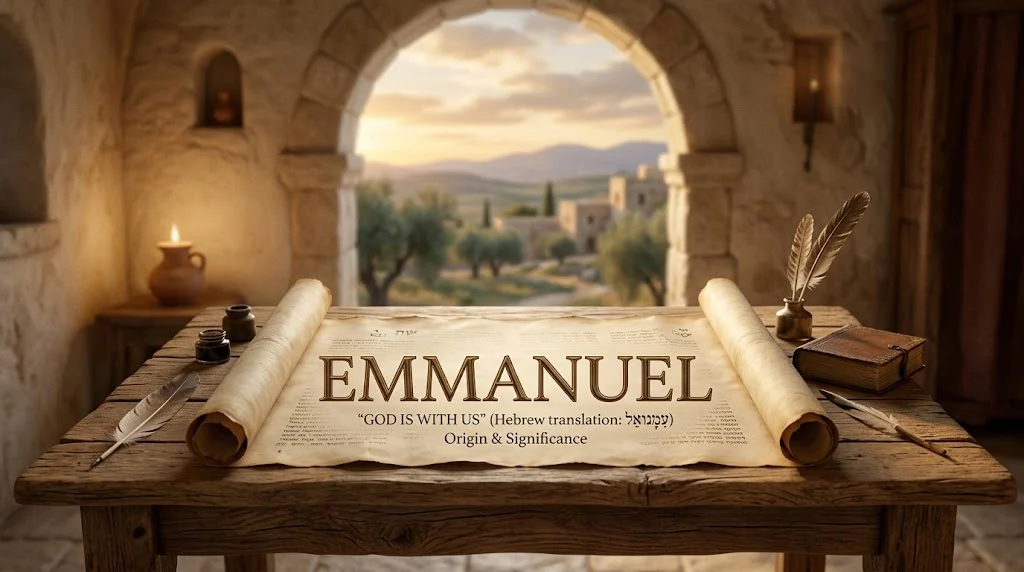
The Emmanuel name meaning is traditionally “God is with us.” Emmanuel comes from the Hebrew name Immanuel, written עִמָּנוּאֵל, and has deep biblical significance. The name appears in the Book of Isaiah and is later referenced in the Gospel of Matthew in connection with Jesus. Because of this history, Emmanuel is strongly associated with God’s presence, faith, hope, comfort, and spiritual reassurance.
Emmanuel is used today as a masculine given name in many countries and language communities. The spelling Emmanuel is especially familiar in English and French contexts, while related forms such as Immanuel, Emanuel, Manuel, and Manoel appear in different linguistic traditions. Behind the Name notes that the Hebrew form is derived from elements meaning “with” and “God.”
This guide explores the Emmanuel name meaning, Hebrew origin, biblical background, pronunciation, history, popularity, symbolism, variants, nicknames, and related names.
What Is the Emmanuel Name?
Emmanuel is a traditional masculine given name with Hebrew biblical origins. Its underlying Hebrew form is Immanuel, which means “God is with us.”
The name is especially important in Christian tradition because Matthew 1:23 connects the name Immanuel with a passage from Isaiah and explains its meaning as “God with us.” The underlying phrase also appears in Isaiah, where it occurs in the context of a sign and God’s presence with his people.
As a personal name, Emmanuel has developed beyond its original biblical setting and is now used across different cultures and countries.
The name is commonly associated with:
- Faith
- Divine presence
- Hope
- Comfort
- Protection
- Spiritual reassurance
- Religious devotion
These are symbolic associations that developed from the name’s biblical meaning. They should not be understood as characteristics automatically given to someone who has the name.
Emmanuel Name Meaning
The traditional Emmanuel name meaning is “God is with us.”
This meaning comes from the Hebrew form ʿImmanuʾel. The name can be understood through its component elements. The Hebrew word ʿim means “with,” while El refers to “God.”
This gives Emmanuel a straightforward literal structure:
Emmanuel = “God is with us.”
Unlike some names whose meanings have become uncertain over centuries, Emmanuel retains a clear and important religious interpretation.
What Does Emmanuel Mean Spiritually?
In religious contexts, Emmanuel represents the idea of God’s presence among or with people.
This makes the name particularly meaningful within Christian traditions, where it is connected with the identity and significance of Jesus. The name can therefore symbolize reassurance and closeness to God.
What Does Emmanuel Mean in Hebrew?
The Hebrew name behind Emmanuel is Immanuel, written עִמָּנוּאֵל.
Its traditional meaning is:
“God is with us.”
The spelling Emmanuel represents a form that developed through the transmission of the biblical name into other languages.
Emmanuel Name Origin and Etymology
Emmanuel ultimately comes from Hebrew. The ancient Hebrew form is commonly transliterated as Immanuel or ʿImmanuel.
The name consists of elements associated with:
- ʿim: “with”
- El: “God”
Together, these elements produce the traditional interpretation “God is with us.”
The name was transmitted through biblical languages and later adapted into various European naming traditions. As a result, several related spellings and forms exist today.
The distinction between Emmanuel and Immanuel is therefore mainly connected with spelling, language, and transliteration rather than a completely different underlying name.
Emmanuel in the Bible
Emmanuel has an important place in biblical tradition.
The name appears in the Book of Isaiah, particularly in Isaiah 7:14 and again in Isaiah 8. The surrounding passage concerns a historical situation involving Judah and threats from neighboring powers. The name is presented in connection with a sign and the assurance associated with God’s presence.
The name later appears in the Gospel of Matthew. Matthew 1:23 quotes the Isaiah passage and identifies the name as Emmanuel, explaining its meaning as “God with us.”
This connection is particularly important to Christian interpretation.
Emmanuel and Jesus
In the Gospel of Matthew, Emmanuel is connected with Jesus through the quotation from Isaiah. This is why Emmanuel has such a strong Christian association.
It is important, however, to distinguish between Emmanuel as a name and Jesus as the personal name of the central figure of Christianity. Emmanuel functions in the biblical text as a significant name or title associated with the theological idea of God’s presence.
The connection has given Emmanuel a lasting place in Christian tradition, worship, theology, music, and personal naming.
History and Cultural Context of Emmanuel
Emmanuel has a long history because biblical names were transmitted across languages and religious communities.
The original Hebrew form, Immanuel, became known through biblical texts. Over time, different linguistic traditions developed their own spellings and related forms.
The spelling Emmanuel is used in English and French, while other forms are especially common in European and international naming traditions. Behind the Name identifies Emmanuel as a biblical name used in French and English, while noting related forms such as Manuel and Manoel in other traditions.
The name therefore has both an ancient religious identity and a broad international presence.
Its cultural associations can include:
- Biblical heritage
- Christianity
- Hebrew language
- Religious naming traditions
- European naming history
- Contemporary multicultural communities
Because the name occurs across multiple cultures, its pronunciation and preferred spelling may vary.
How Do You Pronounce Emmanuel?
In common English usage, Emmanuel is usually pronounced:
eh-MAN-yoo-el
A simple phonetic guide is:
ih-MAN-yoo-el
The name generally has four syllables in English.
The pronunciation can change slightly depending on the speaker’s language or accent. French pronunciation differs from English pronunciation, and related forms such as Manuel have developed their own established pronunciations.
Is Emmanuel Difficult to Pronounce?
Emmanuel may take a little practice for someone who has never encountered it before, but the spelling is familiar in many English-speaking communities.
The name’s four-syllable rhythm gives it a formal and traditional sound.
Is Emmanuel a Boy’s Name?
Emmanuel is traditionally a masculine given name.
It is used as a boys’ name in the United States and in many other countries. Its biblical background makes it particularly familiar among families who appreciate traditional religious names.
The related form Emanuel is also used as a masculine name, although spelling preferences differ between cultures and families.
Emmanuel Name Popularity
Emmanuel remains an established boys’ name in the United States.
According to the U.S. Social Security Administration’s 2025 baby-name data, Emmanuel ranked #179 among boys, compared with #181 in 2024. The SSA’s official popularity table records the change as a two-rank increase in 2025.
The name also appears among the 200 most popular boys’ names for the 2020 to 2025 period, ranking #173 across that six-year period with 12,863 recorded occurrences.
These figures show that Emmanuel is not simply a rare historical name. It remains a recognizable choice in contemporary U.S. baby naming.
Popularity rankings can vary considerably by country, however, so U.S. statistics should not be treated as a worldwide ranking.
Emmanuel Name Symbolism
The symbolism of Emmanuel comes primarily from its meaning and biblical associations.
God’s Presence
The central idea behind the name is the presence of God. This is the most direct symbolic meaning of Emmanuel.
Faith
Because of its biblical and Christian history, Emmanuel is strongly associated with religious faith.
Hope
The biblical contexts surrounding the name have contributed to associations with reassurance and hope during difficult circumstances.
Comfort
The idea that God is present with people can be understood as a source of comfort, particularly within Christian devotional traditions.
Spiritual Connection
For many families, Emmanuel expresses a desire to remember faith and spiritual identity through a child’s name.
These associations are cultural and religious interpretations. A person’s character is shaped by many factors beyond their name.
Emmanuel vs. Immanuel
One of the most common questions about this name is whether Emmanuel and Immanuel are different names.
They are closely related forms of the same biblical name.
| Name | Origin/Form | Meaning | Common Context |
|---|---|---|---|
| Emmanuel | English/French form | “God is with us” | Personal name |
| Immanuel | Hebrew-based biblical form | “God is with us” | Biblical and religious contexts |
| Emanuel | Variant spelling | “God is with us” | International personal name |
| Manuel | Related form | Connected to Emmanuel | Spanish and Portuguese naming traditions |
| Manoel | Portuguese form | Connected to Emmanuel | Portuguese naming tradition |
The exact history of each form differs, but they are linguistically related through the same underlying biblical name.
Emmanuel vs. Emanuel
Emmanuel and Emanuel are spelling variants.
Both are used as masculine given names and ultimately trace back to the same Hebrew name. The choice between them often depends on cultural, linguistic, or family preference.
Emmanuel is especially recognizable in English and French usage, while Emanuel is also established internationally.
Neither spelling changes the traditional core meaning: “God is with us.”
Emmanuel vs. Manuel
Manuel is a related form that became established in Spanish and Portuguese naming traditions.
Although Manuel is much shorter than Emmanuel, the two names share historical roots. Manuel developed through the transmission and adaptation of the biblical name into Romance-language traditions.
This is a good example of how names can change significantly in spelling and pronunciation while retaining a connection to the same ancient source.
Common Nicknames for Emmanuel
Because Emmanuel is a relatively long name, it can naturally produce shorter informal forms.
Possible nicknames include:
- Em
- Emmy
- Eman
- Manu
- Manuel in contexts where it is treated as a related form rather than a nickname
- Manny
Nickname preferences vary greatly between families and cultures. A person named Emmanuel may also simply use the full name.
Names Similar to Emmanuel
If you like Emmanuel because of its biblical history, spiritual meaning, or formal sound, several other names may have a similar appeal.
| Name | General Meaning/Association | Connection to Emmanuel |
|---|---|---|
| Gabriel | Biblical angelic name | Strong biblical and Christian association |
| Michael | Biblical Hebrew name | Long-established religious name |
| Isaiah | Biblical Hebrew name | Connected to the Isaiah passage involving Immanuel |
| Nathaniel | Biblical Hebrew name | Traditional biblical style |
| Raphael | Biblical and religious tradition | Similar formal, multi-syllable sound |
| Samuel | Biblical Hebrew name | Established traditional boy’s name |
| Ezekiel | Biblical Hebrew name | Similar distinctive biblical character |
| Jeremiah | Biblical Hebrew name | Long traditional form with religious history |
These names share certain stylistic or cultural qualities with Emmanuel, but their individual meanings and histories are different.
Emmanuel Name Meaning in Different Contexts
The meaning of Emmanuel can be understood differently depending on the context.
In Hebrew Context
The name refers to the phrase traditionally translated as “God is with us.”
In Biblical Context
The name appears in Isaiah and is later referenced in Matthew. Its meaning is tied to the biblical theme of God’s presence.
In Christian Context
Emmanuel has a particularly strong association with Jesus because Matthew applies the Isaiah passage to the birth narrative.
In Modern Naming
Parents may choose Emmanuel because they appreciate its religious meaning, cultural heritage, traditional sound, or international character.
This makes the name both historically significant and practical as a modern given name.
Is Emmanuel a Religious Name?
Yes, Emmanuel has a strong religious identity, particularly within Judaism and Christianity because of its Hebrew biblical origin and its appearance in Isaiah and Matthew.
For Christian families, the name can have especially direct theological significance because of its association with the phrase “God with us” and its connection to Matthew’s account of Jesus.
At the same time, Emmanuel is also a personal name used in everyday life. Someone may carry the name because of family tradition, cultural heritage, or personal preference without using it as a statement of religious belief.
Is Emmanuel a Good Baby Name?
Whether Emmanuel is a good baby name depends on your personal preferences and family circumstances.
It may appeal to parents looking for a name with:
- A clear and meaningful definition
- Hebrew roots
- Strong biblical history
- Christian significance
- International usage
- A formal and traditional sound
- Several nickname possibilities
Its length may be one consideration. Emmanuel is longer than names such as Eli, Noah, or Luke, although its length also gives it a distinctive and formal quality.
Another consideration is its strong religious association. Families who appreciate biblical names may see this as an important advantage, while parents looking for a completely secular name may prefer something with a less obvious religious history.
Emmanuel Name Meaning at a Glance
| Attribute | Details |
|---|---|
| Name | Emmanuel |
| Gender | Traditionally masculine |
| Origin | Hebrew |
| Underlying Hebrew form | Immanuel |
| Meaning | “God is with us” |
| Biblical books | Isaiah and Matthew |
| Common pronunciation | eh-MAN-yoo-el |
| Religious association | Strongly biblical and Christian |
| Related forms | Immanuel, Emanuel, Manuel, Manoel |
| Possible nicknames | Em, Emmy, Manu, Manny |
| Style | Biblical, traditional, international |
| U.S. boys’ rank in 2025 | #179 |
The central meaning is stable across the major forms, although pronunciation, spelling, and cultural usage can vary.
What Makes Emmanuel Meaningful as a Name?
The strongest feature of Emmanuel is the clarity of its meaning.
Many traditional names have meanings that require extensive historical explanation, but Emmanuel preserves a complete phrase: “God is with us.”
That phrase can carry different personal meanings for different families. For some, it expresses religious faith. For others, it represents family heritage or a connection to biblical tradition.
The name also has an interesting balance between ancient origin and modern use. Although its roots reach back to ancient Hebrew, Emmanuel remains an established contemporary boys’ name in the United States. The SSA recorded it at #179 for boys in 2025.
FAQs
What does the name Emmanuel mean?
Emmanuel traditionally means “God is with us.” The name comes from the Hebrew form Immanuel and is made from elements associated with “with” and “God.”
What is the origin of Emmanuel?
Emmanuel has Hebrew biblical origins. Its underlying Hebrew form is Immanuel, which appears in the Book of Isaiah.
Is Emmanuel a biblical name?
Yes. Emmanuel is a biblical name derived from Immanuel. It is particularly associated with Isaiah and is referenced in Matthew 1:23 in connection with Jesus.
What does Emmanuel mean in Hebrew?
The Hebrew form Immanuel is traditionally understood to mean “God is with us.” It combines Hebrew elements associated with “with” and “God.”
How do you pronounce Emmanuel?
In common English pronunciation, Emmanuel is generally pronounced eh-MAN-yoo-el or ih-MAN-yoo-el, depending on accent.
Conclusion
The Emmanuel name meaning is “God is with us,” making it one of the most directly meaningful biblical names in the Hebrew naming tradition. Its underlying Hebrew form, Immanuel, combines elements meaning “with” and “God.” The name appears in Isaiah and is later referenced in Matthew, where the meaning is explicitly explained.
Emmanuel also has a rich cultural history. Its related forms, including Immanuel and Emanuel, have been used across different languages and naming traditions, while forms such as Manuel and Manoel developed in Romance-language contexts. This gives Emmanuel an international character while preserving its ancient Hebrew roots.
For modern parents, Emmanuel offers a combination of religious depth, recognizable pronunciation, traditional style, and contemporary usage. Its central idea of God’s presence can make the name especially meaningful for families who value biblical heritage or faith. In the United States, it remains a well-established boys’ name, ranking #179 in 2025 according to the Social Security Administration.
Discover More Related Articles:
- Monica Name Meaning | Origin, History & Significance In 2026
- Philip Name Meaning | Greek Origin, History & Significance In 2026
