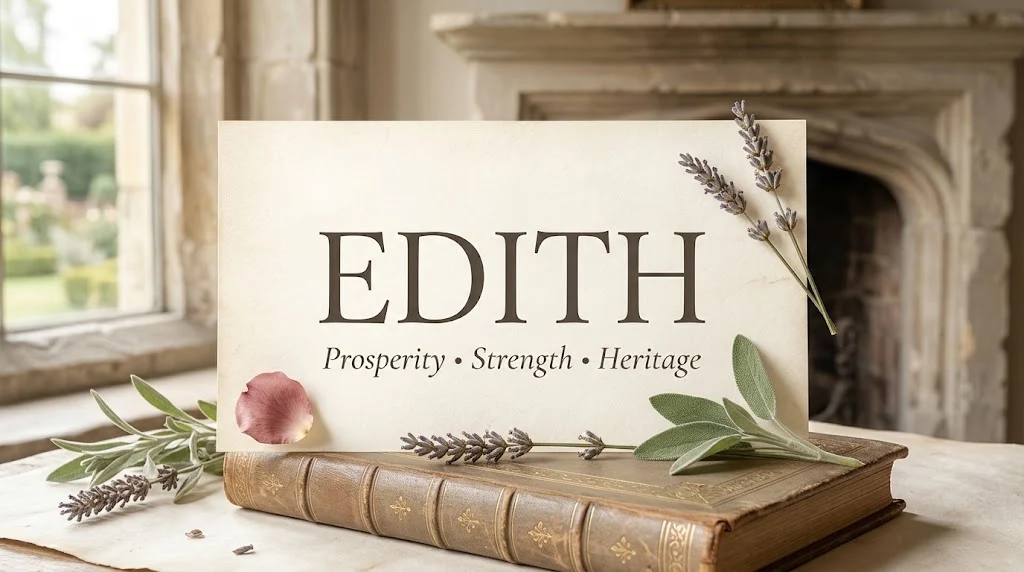
The Edith name meaning is “prosperous in war” or “wealthy in battle.” Edith is a feminine name of Old English origin, derived from the Anglo-Saxon name Eadgyð. Its elements relate to wealth, fortune, and prosperity on one side, and war or battle on the other. Today, Edith is appreciated for its classic sound, rich history, and associations with strength, dignity, and timeless elegance.
Edith has been used for centuries, including by Anglo-Saxon royalty and notable historical figures. Although the name became less fashionable for a period, it experienced a revival and remains a recognizable choice for parents who enjoy traditional and vintage baby names.
In this guide, you will discover the Edith name meaning, its origin, pronunciation, history, symbolism, popularity, spelling variations, and related names. You will also learn whether Edith is a good choice for a baby and what makes this traditional name distinctive.
What Is the Edith Name?
Edith is a feminine given name that originated in Old English. It developed from Eadgyð, an Anglo-Saxon name whose elements refer to prosperity and battle.
The name has a long history in England and has also been used in German, Dutch, Scandinavian, and other European naming traditions. Its enduring presence across languages reflects its historical importance and adaptability.
Edith is generally considered a classic or vintage name. It has a traditional character, but its straightforward spelling and recognizable pronunciation make it accessible to modern families.
Quick Answer: Edith is an Old English feminine name meaning “prosperous in war” or “wealthy in battle.” It combines ancient elements associated with wealth, fortune, and battle, giving it a historical meaning connected with prosperity and strength.
Unlike names derived from flowers, landscapes, or everyday objects, Edith originated as a personal name within an early Germanic naming tradition. Its meaning reflects the values and language of the period in which it developed.
Edith Name Meaning
The Edith name meaning comes from two Old English elements that were combined in the earlier name Eadgyð.
- Ead: Associated with wealth, riches, fortune, and prosperity.
- Gyð: An element associated with war or battle.
Together, these elements produce the traditional interpretation “prosperous in war” or “wealthy in battle.”
This meaning may sound unusual to modern readers because contemporary baby names are often associated with qualities such as beauty, happiness, love, or peace. However, historical Germanic names frequently incorporated elements relating to wealth, power, protection, victory, and battle.
The original meaning should not be confused with a prediction about someone’s future or personality. A name’s etymology describes its linguistic history, not the characteristics its bearer must possess.
Traditional Meaning of Edith
Traditionally, Edith expresses the idea of prosperity connected with battle. The wealth element could refer to material riches, good fortune, or a prosperous position, while the battle element reflects an older naming tradition.
The meaning does not necessarily suggest aggression. In its historical context, names containing battle-related elements could communicate strength, status, or the qualities valued by the society in which they were used.
Modern Symbolism of Edith
Today, people may associate Edith with qualities such as:
- Strength and resilience
- Wisdom and maturity
- Independence
- Dignity and confidence
- Traditional elegance
- Determination
- Stability and reliability
These qualities are modern symbolic interpretations, not additional literal translations. Parents may find them appealing because Edith combines a substantial historical background with a gentle, understated sound.
Edith Name Origin and Etymology
Edith has its roots in Old English, the early form of the English language spoken in Anglo-Saxon England.
The name developed from Eadgyð, also written in historical forms such as Eadgyth. It combines the elements ead, meaning wealth or prosperity, and gyð, meaning war or battle. These elements are also found in the wider Germanic tradition of compound personal names.
The name’s etymology is documented in historical name references, including Behind the Name and the Online Etymology Dictionary.
The development of Edith illustrates how historical names can change as languages evolve. The original Anglo-Saxon form eventually gave rise to the familiar modern English spelling, Edith.
As pronunciation and spelling conventions changed, related forms also appeared in different languages. These include Édith in French, Edit in Swedish and Hungarian, and Edita in several European languages.
Although the spellings vary, many of these forms share a historical relationship with the older Germanic name.
History and Cultural Significance of Edith
Edith has a particularly strong connection with English history. Its earlier forms were used during the Anglo-Saxon period, when compound Germanic personal names were common.
The name was associated with royalty and prominent historical figures. One notable bearer was Edith of Wilton, a tenth-century English saint and the daughter of King Edgar the Peaceful. Another was Edith of Wessex, the wife of Edward the Confessor and an important figure in the royal history of England.
These historical associations helped preserve the name’s place in English naming traditions.
Edith in Anglo-Saxon England
During the Anglo-Saxon period, personal names often contained meaningful linguistic elements. Names could express prosperity, strength, protection, or other qualities valued by families.
Edith’s original form, Eadgyð, fits this pattern. Its combination of wealth and battle-related elements reflects the naming conventions of early medieval England.
The name continued to be used after the Norman Conquest, although naming fashions changed over the following centuries.
Edith in Later English Naming Traditions
Edith eventually became less common, particularly after the medieval period. It experienced a revival during the nineteenth century, when traditional English names regained popularity.
During the Victorian era, parents often revisited names with historical, literary, and family associations. Edith fit this preference because it had deep English roots and a recognizable form.
The name also became familiar through literature and notable women in public life. Its historical background and literary associations contributed to its reputation as a traditional, respectable name.
Edith in Modern Culture
Today, Edith is often described as a vintage or revival name. It appeals to parents who appreciate older names that feel established rather than newly invented.
Its two-syllable structure, simple spelling, and affectionate nickname Edie make it versatile. It can feel formal in a professional setting while still allowing for a warm, informal nickname among family and friends.
How Do You Pronounce Edith?
Edith is commonly pronounced EE-dith in English.
Its International Phonetic Alphabet transcription is approximately /ˈiː.dɪθ/.
The name has two syllables:
- EE: The first syllable receives the emphasis.
- dith: The second syllable ends with the unvoiced “th” sound heard in words such as “think.”
The pronunciation is generally straightforward for English speakers, although the final consonant may be unfamiliar to speakers of some other languages.
In German and Dutch, the name is commonly pronounced closer to EH-deet, reflecting differences in the pronunciation of the letters and the final consonant.
For English-speaking families, EE-dith is the most widely recognized pronunciation.
Is Edith a Biblical Name?
Edith is not a biblical name. Its origin is Old English, and its historical development belongs to the Anglo-Saxon and wider Germanic naming tradition rather than the Hebrew or Greek naming traditions of the Bible.
However, parents who value religious or spiritual themes may still appreciate Edith’s historical meaning. Its traditional associations with prosperity and strength can be personally meaningful without making it a biblical name.
It is useful to distinguish between a name’s religious associations and its linguistic origin. A name may be chosen by a religious family without appearing in a sacred text or originating in a religious language.
Edith Name Meaning in Different Languages
Edith and its related forms appear in several European languages. The spelling and pronunciation may change, but many of these forms are historically connected to the Old English or Germanic name.
| Language or Tradition | Name Form |
|---|---|
| English | Edith |
| Anglo-Saxon | Eadgyð |
| French | Édith |
| German | Edith |
| Swedish | Edit |
| Hungarian | Edit |
| Croatian | Edita |
| Czech | Edita |
| Polish | Edyta |
| Portuguese | Edite |
| Lithuanian | Edita |
| Latvian | Edīte |
These forms should not automatically be treated as identical in every cultural context. Some languages have their own established pronunciations, naming customs, and variant forms.
The underlying historical relationship, however, gives the name a broad European presence.
Edith Name Symbolism and Personality Associations
Names do not determine personality, intelligence, success, or future achievements. Nevertheless, their meanings and historical associations can influence how people interpret them.
Edith’s traditional meaning connects it with prosperity and battle. Its history also gives it associations with endurance, tradition, and dignity.
Strength and Resilience
The battle-related element in Edith’s origin can inspire a symbolic interpretation of determination and resilience. Some parents may appreciate a name that reflects the idea of facing challenges with courage.
Prosperity and Good Fortune
The ead element is associated with wealth, fortune, and prosperity. In a modern naming context, this can suggest hopes for a fulfilling and successful life.
Wisdom and Maturity
Because Edith has a long history and has been used by notable historical figures, some people perceive it as a thoughtful, mature, or intellectual-sounding name. This is a cultural impression rather than an established personality trait.
Timeless Elegance
Edith has a simple, traditional structure. It does not depend on a recent trend or a complicated spelling, which helps explain its appeal to parents who prefer classic names.
Together, these associations make Edith a name that can feel both gentle and strong.
Famous People Named Edith
Several notable women have helped maintain the name’s visibility in history, literature, music, and design.
Edith Wharton
Edith Wharton was an American novelist and short-story writer. Her literary works examined social customs, relationships, and class in American society. She won the Pulitzer Prize for Fiction in 1921 for The Age of Innocence.
Edith Piaf
Édith Piaf was a celebrated French singer known for her expressive performances and lasting influence on French popular music. Her name is commonly written with an acute accent in French.
Edith Head
Edith Head was an influential American costume designer who worked extensively in Hollywood. She became known for her work on film costumes and received multiple Academy Awards for costume design.
Edith of Wessex
Edith of Wessex was an English queen consort and the wife of Edward the Confessor. She is an important historical figure associated with eleventh-century English royal history.
These individuals demonstrate the name’s presence across different fields and historical periods. Their achievements are not consequences of the name’s meaning, but they provide useful cultural context for readers researching Edith.
Edith Name Popularity
Edith was especially familiar in earlier generations and has attracted renewed interest among parents who like vintage baby names.
In the United States, the name has appeared in Social Security Administration baby-name records since the nineteenth century. According to a name database using SSA data, Edith ranked No. 499 among girls’ names in 2025, with 595 recorded births that year. This indicates that Edith remains in use without being among the very most frequently chosen names.
Popularity can vary significantly by country and year. A name that feels vintage in one region may be a familiar contemporary choice in another.
Parents should also remember that rankings measure frequency, not quality. A name does not need to rank highly to be meaningful or suitable for a child.
For the latest official U.S. statistics, the Social Security Administration’s Popular Baby Names database allows visitors to explore names by year and popularity.
Edith Name Variations and Nicknames
Edith has several spelling variations and affectionate short forms.
Common Variations
- Edythe: A traditional alternative English spelling.
- Edyth: A less common spelling variant.
- Editha: A related form used in some European naming traditions.
- Édith: The French form.
- Edit: A form used in languages including Swedish and Hungarian.
- Edita: A related form used in several European languages.
- Edyta: The Polish form.
These names have different levels of popularity depending on the language and country.
Nicknames for Edith
Popular and informal nickname possibilities include:
- Edie
- Edy
- Edi
- Eda
- Dee
- Didi
Edie is particularly appealing to parents who want a softer, more playful everyday form while retaining Edith as the formal name.
Not every Edith will use a nickname. The choice depends on personal preference and family tradition.
Names Similar to Edith
Parents who like Edith may also appreciate other classic, vintage, or traditional names.
| Name | General Style | Why It May Appeal |
|---|---|---|
| Eleanor | Classic | Traditional and dignified |
| Evelyn | Vintage | Familiar and graceful |
| Ethel | Vintage | Strong historical roots |
| Esther | Traditional | Long-standing religious and cultural history |
| Alice | Classic | Simple and enduring |
| Florence | Vintage | Historical and elegant |
| Agnes | Traditional | Short, established, and distinctive |
| Ada | Vintage | Brief and easy to pronounce |
| Mabel | Vintage | Warm, traditional character |
| Beatrice | Classic | Formal with friendly nickname options |
These names do not necessarily share Edith’s literal meaning or etymology. They are related mainly through their traditional style and appeal to parents who enjoy classic names.
Best Middle Names for Edith
Edith pairs well with a variety of middle names. Since Edith has two syllables, both short and longer middle names can create a pleasing rhythm, depending on the surname.
Here are some combinations to consider:
- Edith Rose
- Edith Grace
- Edith Claire
- Edith Jane
- Edith Louise
- Edith Mae
- Edith Sophia
- Edith Eleanor
- Edith Violet
- Edith Catherine
- Edith Pearl
- Edith June
Short middle names such as Rose, Grace, and Jane create a compact combination. Longer names such as Eleanor and Catherine offer a more traditional, formal rhythm.
When choosing a combination, say the full name aloud and consider how its initials look alongside the family surname.
Is Edith a Good Baby Name?
Edith can be an excellent choice for parents who appreciate historical names with clear meanings and lasting appeal.
Its strongest advantages include its established history, recognizable spelling, and convenient nickname options. It also has a meaningful linguistic background without being difficult to explain.
Edith may suit families who prefer:
- Classic English names
- Vintage baby names
- Names with historical significance
- Traditional feminine names
- Names with short nicknames
- Names that work well in formal and informal settings
- Names with European cultural connections
One possible consideration is that some people may initially associate Edith with older generations. For parents who enjoy vintage names, however, this can be part of the appeal.
Ultimately, choosing Edith depends on whether its sound, history, and meaning suit your family’s preferences. Its long-standing use and simple form make it a name that can work across different stages of life.
FAQs
1. What does the name Edith mean?
Edith means “prosperous in war” or “wealthy in battle.” It comes from Old English elements associated with prosperity and battle.
2. What is the origin of Edith?
Edith originates from the Old English name Eadgyð, which was used during the Anglo-Saxon period in England.
3. Is Edith a girl’s name?
Yes. Edith is traditionally and predominantly used as a feminine given name, although historical naming practices can vary.
4. How do you pronounce Edith?
Edith is pronounced EE-dith in English, with the emphasis on the first syllable.
5. Is Edith a biblical name?
No. Edith has an Old English origin rather than a biblical origin.
Conclusion
The Edith name meaning is traditionally understood as “prosperous in war” or “wealthy in battle.” With roots in the Old English name Eadgyð, Edith reflects an ancient naming tradition that combined elements associated with wealth, fortune, and battle. Its historical background makes it more than just a classic-sounding name.
Edith has remained part of European naming history through its association with Anglo-Saxon royalty, historical figures, writers, singers, and artists. Its revival as a modern baby name reflects the continued appeal of vintage names that have recognizable spellings and meaningful backgrounds. Nicknames such as Edie also give Edith a friendly and contemporary option for everyday use.
For parents searching for a traditional girl name with historical depth, Edith offers a distinctive balance of simplicity and character. Its associations with prosperity, resilience, and dignity can make it meaningful to families who appreciate its story. Although the name’s literal meaning comes from an older linguistic tradition, its continued use shows how a historical name can remain relevant to modern naming choices.
Discover More Related Articles:
- Jay Name Meaning | Origin, History & Significance In 2026
- Sierra Name Meaning | Origin, History & Symbolism In 2026
