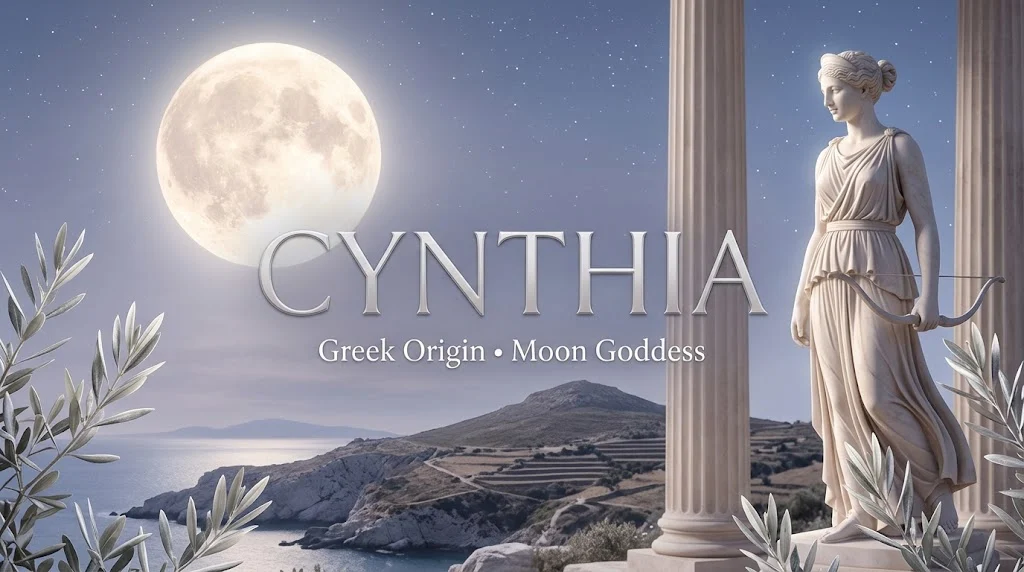
Cynthia is a beautiful feminine name of ancient Greek origin that traditionally means “woman from Mount Cynthus.” The name is closely associated with Artemis, the Greek goddess of the moon and the hunt, who was believed to have been born on Mount Cynthus on the island of Delos. Because of this mythological connection, Cynthia is also associated with the moon, femininity, beauty, and nature.
Cynthia is a feminine given name with roots in ancient Greek mythology. It comes from the Greek name Kynthia, meaning “woman from Cynthus.” Cynthus, also called Mount Cynthus, is a mountain on the Greek island of Delos.
The name is especially connected with Artemis, the Greek goddess associated with the moon, hunting, wilderness, and protection. According to Greek mythology, Artemis and her twin brother Apollo were born on the island of Delos. Cynthia became one of the poetic titles used for Artemis because of her connection with Mount Cynthus.
Over time, Cynthia developed from a mythological title into a personal name used in different languages and cultures. Today, it is recognized as a classic feminine name with a graceful sound and a strong connection to ancient Greek history.
Cynthia Name Meaning
The traditional Cynthia name meaning is “woman from Cynthus” or “woman from Mount Cynthus.” Its meaning comes from the geographical connection between the Greek goddess Artemis and the mountain on the island of Delos.
Cynthia also has a figurative association with the moon because Artemis was connected with lunar symbolism in later Greek and Roman traditions.
The name carries several interesting interpretations:
- Woman from Cynthus: Its direct geographical meaning.
- Moon goddess: A symbolic association through Artemis.
- Celestial beauty: A modern interpretation connected with the moon.
- Grace and femininity: Qualities often associated with its traditional feminine use.
- Nature and independence: Associations inspired by Artemis’s connection with wilderness and the natural world.
It is important to distinguish the literal meaning from the symbolic interpretation. Cynthia does not directly translate to “moon goddess.” Its original meaning refers to a woman from Cynthus, while the lunar association comes from its connection with Artemis.
Cynthia Name Origin and Etymology
Cynthia has an ancient Greek origin. It developed from the Greek word Kynthia (Κυνθία), a feminine form associated with Kynthios, meaning someone connected with Mount Cynthus.
The name later entered Latin as Cynthia and became familiar in classical poetry and literature.
Its linguistic development can be understood through three important stages:
Ancient Greek: Kynthia was used as an epithet for Artemis, identifying her with Mount Cynthus.
Latin: Cynthia became the Latinized form of the Greek name and appeared in classical literary traditions.
English: Cynthia eventually became an established feminine given name in English-speaking communities, particularly from the Renaissance onward.
The connection between the name and Mount Cynthus gives Cynthia a geographical foundation, while its association with Artemis adds a rich mythological background.
Cynthia in Greek Mythology
Cynthia has a special place in Greek mythology because of its association with Artemis.
Artemis was one of the most important goddesses in ancient Greek religion. She was the daughter of Zeus and Leto and the twin sister of Apollo.
She was associated with several aspects of the ancient Greek world, including:
- The moon in later traditions
- Hunting and wild animals
- Forests and wilderness
- Nature and the outdoors
- Protection of young people
- Independence and strength
Mount Cynthus on Delos was connected with the birth of Artemis and Apollo. Because of this location, Artemis was sometimes called Kynthia, which later became Cynthia in Latin.
The name therefore carries a connection with an ancient mythological figure rather than simply being a modern invention.
Cynthia and Artemis
The relationship between Cynthia and Artemis is one of the most important parts of the name’s history.
Artemis is commonly associated with the moon in later Greco-Roman traditions. Her Roman counterpart was Diana, who also became strongly connected with lunar imagery.
This connection helped Cynthia develop a poetic identity associated with moonlight, nature, and feminine symbolism.
For parents who enjoy mythology-inspired names, Cynthia offers a meaningful connection to one of the most recognizable goddesses of the ancient world.
History and Cultural Significance of Cynthia
Cynthia has a history that stretches from ancient Greek mythology into classical Latin literature and modern naming traditions.
Although its roots are ancient, Cynthia was not originally a common personal name. It was first used as a mythological epithet and poetic reference.
Cynthia in Classical Literature
Cynthia became particularly recognizable through classical poetry.
The Roman poet Propertius used Cynthia as the name of a woman who inspired many of his elegies. This literary use helped establish Cynthia as a recognizable poetic name associated with beauty, romance, and artistic expression.
The name also became a popular literary reference to the moon in later European writing.
Cynthia During the Renaissance
During the Renaissance, interest in ancient Greek and Roman culture encouraged writers to bring classical names and mythological references back into literature.
Cynthia became a recognizable poetic name during this period. English writers sometimes used it as a symbolic reference to the moon and classical goddess traditions.
Cynthia in Modern Naming Traditions
Cynthia gradually developed into a personal name in English-speaking communities. It became particularly common during the 19th and 20th centuries.
In the United States, Cynthia experienced a major rise in popularity during the middle of the 20th century. It reached its highest recorded position among girls in 1957, when it ranked seventh.
Although its popularity has declined since that period, Cynthia remains a recognizable traditional name with a distinctive historical identity.
How Do You Pronounce Cynthia?
Cynthia is commonly pronounced:
SIN-thee-uh
Phonetic pronunciation: SIN-thee-uh
The name has three syllables:
- SIN: The opening sound.
- thee: The middle sound.
- uh: The ending sound.
The pronunciation is relatively straightforward for English speakers, although accents may slightly change the sound of the final syllable.
In French, the pronunciation is different and may sound closer to “sin-tya.”
Cynthia is generally easy to recognize and spell once someone becomes familiar with it.
Is Cynthia a Girl’s Name?
Cynthia is traditionally a feminine given name. Its historical connection with the goddess Artemis and its long-standing use in English-speaking communities have established it primarily as a girl’s name.
Although some historical records show occasional masculine use, this is extremely uncommon in modern American naming data.
Parents looking for a traditional girl name with Greek mythology connections may find Cynthia appealing because it combines classical history with an established feminine identity.
Cynthia Name Popularity
Cynthia was especially popular in the United States during the middle of the 20th century.
According to U.S. Social Security Administration-based baby-name records, Cynthia reached its highest popularity in 1957, ranking #7 among girls’ names.
Its popularity gradually declined in the following decades. In 2025, Cynthia ranked approximately #1,014 among girls in the United States, with 247 recorded births.
This change shows how Cynthia has moved from a highly fashionable mid-century name to a less frequently chosen traditional option.
Its declining popularity may appeal to parents who prefer recognizable names that are not currently used as often as some modern favorites.
Cynthia has several qualities that continue to make it interesting:
- A recognizable spelling
- A graceful pronunciation
- Ancient Greek roots
- A connection with mythology
- A traditional feminine identity
- An established history in English
Popularity figures can change each year, so the latest Social Security Administration records are the best source for tracking its position.
Cynthia Name Symbolism and Personality
Cynthia’s symbolism comes primarily from its connection with Artemis and the natural world.
The name is often associated with qualities such as grace, independence, strength, and beauty. These associations reflect the mythology surrounding Artemis rather than any fixed personality traits of people who carry the name.
Grace and Beauty
The name has a soft, flowing pronunciation. Its classical literary history also gives it an elegant and graceful impression.
Independence
Artemis is traditionally portrayed as an independent goddess. This has helped create an association between Cynthia and self-reliance.
Strength
Artemis was a powerful figure in Greek mythology. Her connection with protection and the wilderness gives Cynthia a symbolic association with strength.
Moon and Nature
Cynthia’s connection with the moon makes it appealing to people who enjoy celestial and nature-inspired names.
Wisdom and Confidence
Modern interpretations sometimes associate Cynthia with thoughtfulness, confidence, and determination. These are symbolic impressions, not meanings directly translated from the Greek language.
Common Nicknames for Cynthia
Cynthia has several familiar nicknames. Some are traditional shortened forms, while others offer a more casual or modern sound.
Popular nickname ideas include:
- Cindy: The most familiar traditional nickname.
- Cindi: A variation of Cindy.
- Cyndi: A modern-looking spelling.
- Cyn: A short and simple option.
- Cynth: A shortened version based on the original spelling.
- Thea: An alternative nickname that can be used creatively.
- Thia: A soft, shortened form inspired by the ending.
Cindy became especially popular as a nickname during the 20th century. Some people prefer Cynthia because it feels more formal, while others enjoy the friendly sound of Cindy.
Cynthia Name Variations
Cynthia has several international forms and spelling variations. These names are influenced by different languages and pronunciation traditions.
| Variation | Language or Region |
|---|---|
| Kynthia | Greek mythological form |
| Cintia | Spanish and Hungarian |
| Cíntia | Portuguese |
| Cinzia | Italian |
| Cinthia | Spanish-language variant |
| Sintija | Latvian |
| Sindija | Latvian |
| Cindy | English nickname |
These variations preserve a connection with the original name while adapting its spelling and pronunciation to different languages.
Cinzia, for example, has a distinctive Italian sound, while Cíntia is a familiar Portuguese form.
Names Similar to Cynthia
If you like Cynthia, you may also enjoy other names with Greek origins, classical backgrounds, elegant sounds, or mythological connections.
Here are some related baby girl names:
| Name | Origin | General Meaning |
|---|---|---|
| Diana | Latin | Divine |
| Artemis | Greek | Associated with the Greek goddess |
| Selene | Greek | Moon |
| Phoebe | Greek | Bright or radiant |
| Celeste | Latin | Heavenly |
| Cassandra | Greek | Traditional Greek name |
| Daphne | Greek | Laurel |
| Lydia | Greek | From Lydia |
| Thea | Greek | Goddess |
| Celine | French | Heavenly |
These names share some stylistic or cultural similarities with Cynthia, although their individual meanings and histories are different.
Cynthia vs. Other Moon-Inspired Names
Cynthia is especially interesting because its connection with the moon comes through mythology rather than a direct translation.
Other celestial names have different linguistic backgrounds.
| Name | Origin | Meaning or Association |
|---|---|---|
| Cynthia | Greek | Woman from Cynthus; associated with Artemis |
| Selene | Greek | Moon |
| Luna | Latin | Moon |
| Diana | Latin | Roman goddess associated with the moon |
| Aylin | Turkish | Associated with the moon’s halo |
| Chandra | Sanskrit | Moon |
Cynthia is a good option for parents who want a moon-associated name with a classical Greek background rather than a name that directly translates to moon.
Is Cynthia a Good Baby Name?
Cynthia can be a lovely choice for parents who appreciate traditional names with historical and mythological significance.
It offers a balance of familiarity and individuality. Most English speakers will recognize the name, but it is no longer as frequently chosen as it was during its mid-century popularity peak.
Some reasons parents may choose Cynthia include:
- Historical background: It has roots in ancient Greek culture.
- Mythological connection: It is associated with Artemis.
- Beautiful symbolism: It has connections with the moon and nature.
- Classic sound: Its pronunciation is graceful and recognizable.
- Nickname flexibility: Cindy, Cindi, and Cyndi offer informal alternatives.
- International variations: Related forms exist in several languages.
One consideration is that Cynthia may sound more traditional or mature to some modern parents. However, others may appreciate precisely that quality.
Ultimately, choosing a name is a personal decision. Cynthia offers a combination of cultural history, recognizable spelling, and meaningful symbolism that can make it a memorable choice.
Cynthia Name Meaning at a Glance
| Attribute | Details |
|---|---|
| Name | Cynthia |
| Gender | Feminine |
| Origin | Ancient Greek |
| Original Form | Kynthia |
| Greek Spelling | Κυνθία |
| Traditional Meaning | Woman from Cynthus |
| Mythological Connection | Artemis |
| Symbolic Meaning | Moon, nature, grace |
| Pronunciation | SIN-thee-uh |
| Syllables | Three |
| Main Nickname | Cindy |
| Variations | Cintia, Cinzia, Cíntia, Cinthia |
| Name Style | Classic, Greek, mythological |
| Popularity Peak | 1957 in the United States |
| Related Names | Diana, Selene, Phoebe, Thea |
FAQs
What does the name Cynthia mean?
Cynthia traditionally means “woman from Cynthus,” referring to Mount Cynthus on the Greek island of Delos. It is also associated with the moon goddess Artemis.
What is the origin of the name Cynthia?
Cynthia has an ancient Greek origin. It comes from Kynthia, a name associated with Mount Cynthus and the Greek goddess Artemis.
Is Cynthia a biblical name?
No. Cynthia is not a biblical name. It comes from Greek mythology and has a historical connection with the goddess Artemis.
Is Cynthia a girl’s name?
Yes. Cynthia is traditionally a feminine name and has been widely used as a girl’s name in English-speaking countries.
How do you pronounce Cynthia?
Cynthia is pronounced SIN-thee-uh. It has three syllables and a soft, graceful sound.
Conclusion
The Cynthia name meaning comes from the ancient Greek word Kynthia, traditionally interpreted as “woman from Mount Cynthus.” Its connection with Artemis, the Greek goddess associated with the moon and nature, gives the name an additional layer of mythological significance. This combination of geographical origin and classical mythology makes Cynthia a name with a fascinating historical background.
Throughout history, Cynthia has appeared in Greek mythology, Roman poetry, Renaissance literature, and modern naming traditions. Its popularity reached its height in the United States during the 1950s, but the name remains recognizable today. With familiar nicknames such as Cindy and international variations such as Cinzia and Cíntia, it also offers plenty of flexibility.
Overall, Cynthia is a meaningful choice for parents who appreciate Greek heritage, classical names, and celestial symbolism. Its graceful sound, connection with Artemis, and long cultural history give it a distinctive identity. Whether you prefer its traditional form or a shorter nickname, Cynthia carries a timeless connection to mythology, nature, and ancient history.
Discover More Related Articles:
- Walter Name Meaning | Origin, History, Popularity & Symbolism In 2026
- Paige Name Meaning | Origin, History, Popularity & Symbolism In 2026
