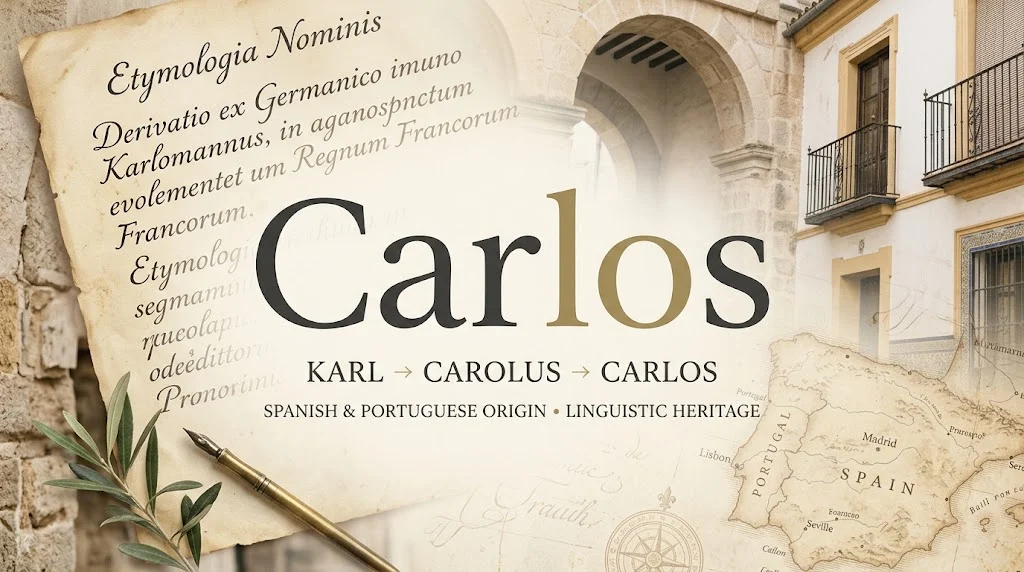
The Carlos name meaning is traditionally given as “free man,” and Carlos is the Spanish and Portuguese form of Charles. Its deeper roots reach back through Latin Carolus to the Germanic name Karl. Today, Carlos is a well-established masculine given name associated with Spanish and Portuguese naming traditions and widely recognized internationally.
Beyond its simple definition, the name has a long linguistic and cultural history. It has appeared in royal families, historical records, religious traditions, and modern Spanish-speaking communities. In this guide, you’ll learn what Carlos means, where the name comes from, how to pronounce it, its variations and nicknames, and how popular it is today.
What Is the Carlos Name?
Carlos is a masculine given name and the Spanish and Portuguese form of Charles. It ultimately belongs to the same family of names as Carl, Karl, Carlo, and Charles. The name is particularly familiar in Spain, Portugal, Latin America, and communities around the world with Spanish- or Portuguese-speaking heritage.
Although Carlos looks distinctly Spanish to many English speakers, its linguistic ancestry is considerably older than the Spanish language itself. The name developed through several languages before reaching its modern form.
At a basic level:
- Name: Carlos
- Gender: Traditionally masculine
- Main usage: Spanish and Portuguese
- Related English name: Charles
- Related Germanic form: Karl
- Italian form: Carlo
- Common traditional meaning: “Free man”
- Spanish pronunciation: roughly KAR-los, with a tapped Spanish “r”
- Common Spanish diminutives: Carlito and Carlitos
Carlos is therefore both a culturally recognizable Spanish name and part of a much broader European naming family.
Carlos Name Meaning
The most commonly cited Carlos name meaning is “free man.” This meaning comes from the Germanic root associated with Karl, a word historically connected with “man” and, in some etymological explanations, a free man.
The meaning is worth understanding in historical context. Modern readers may see “free man” as an abstract quality representing independence, confidence, or personal freedom. Historically, however, the underlying Germanic vocabulary referred more directly to a person’s social status and the idea of a man or free person.
Some sources emphasize “man” or “husband” as the more literal historical sense of the Germanic root, while the familiar name-dictionary interpretation is “free man.” That is why you may encounter slightly different definitions when researching Carlos or its related forms.
What Does Carlos Mean Symbolically?
If you are choosing a baby name based on meaning, Carlos can suggest qualities such as:
- Freedom
- Independence
- Strength
- Maturity
- Tradition
- Confidence
- Heritage
These are modern symbolic associations, rather than additional literal dictionary meanings. The historical meaning should remain the primary reference point.
Carlos Name Origin and Etymology
The Carlos name origin is Spanish and Portuguese, but its ultimate linguistic roots are Germanic.
The name belongs to a chain of related forms:
Germanic Karl → Latin Carolus → Spanish/Portuguese Carlos
Carlos is documented as the Spanish and Portuguese form of Charles. The related name Charles developed through French and Medieval Latin forms from the Germanic Karl.
The Germanic Root
The oldest part of the name’s history is connected with the Germanic root represented by Karl. Historical linguistic sources connect this root with words meaning “man,” while the traditional interpretation of the personal name is often expressed as “free man.”
The Latin Form
As Germanic names were adopted and adapted into Latin-speaking Europe, Carolus became an important written form. From this Latin form, related versions developed across different European languages.
This explains why names that look quite different today can actually belong to the same family.
For example:
- Carlos — Spanish and Portuguese
- Charles — English and French
- Carlo — Italian
- Karl — German and several Northern European languages
- Carl — English and Scandinavian usage
- Carles — Catalan
- Karel — Czech and Dutch-related usage
- Karol — Polish and several Central/Eastern European languages
The different spellings reflect language development rather than completely unrelated names.
History and Cultural Context of Carlos
Carlos has a particularly strong connection with the history of the Iberian Peninsula and the wider Spanish-speaking world.
One reason the name became culturally significant is its use among European royalty and historical figures. Various Spanish and Portuguese monarchs carried forms of the name, helping reinforce its association with traditional and formal naming. Historical figures such as Carlos I of Spain, also known as Emperor Charles V, illustrate the name’s place in European political history.
The name also became established through religious and cultural traditions. Saints and other notable historical figures carrying related forms of Charles helped maintain the name family across European Christian communities.
Over time, Carlos moved beyond royal and formal settings. Spanish colonization and migration contributed to the spread of Spanish naming traditions throughout the Americas, where Carlos became a familiar given name across many countries and communities.
Today, Carlos is not limited to one country. It is recognizable throughout:
- Spain
- Mexico
- Central America
- South America
- The Caribbean
- Portugal
- Spanish-speaking communities in the United States
- Portuguese-speaking communities internationally
The cultural identity attached to the name can therefore vary depending on family background and country.
How Do You Pronounce Carlos?
The pronunciation of Carlos changes slightly depending on the language and region.
In Spanish, the name is approximately:
KAR-los
The Spanish pronunciation uses a light, tapped r, which differs from the stronger English “r” sound.
According to name references, the Spanish pronunciation is represented approximately as /ˈkaɾ.los/. European Portuguese and Brazilian Portuguese have their own pronunciation differences.
English speakers may pronounce Carlos somewhat differently, often using an English-style “r.” Neither pronunciation should automatically be treated as universal because pronunciation naturally follows the speaker’s language and regional accent.
Is Carlos Easy to Pronounce in English?
Generally, yes. Carlos is widely recognizable in English-speaking countries, and its two-syllable structure makes it relatively straightforward for English speakers.
If someone introduces themselves as Carlos, the most respectful approach is simply to follow their preferred pronunciation.
Carlos Nicknames and Diminutives
Carlos has several affectionate forms, especially in Spanish and Portuguese.
Common examples include:
- Carlito
- Carlitos
- Carlito can function as an affectionate diminutive
- Carlinhos is a Portuguese diminutive form
In Spanish, the ending -ito commonly appears in affectionate or diminutive forms. Therefore, Carlito can sound more familiar or endearing than the formal Carlos.
Nicknames, however, are personal. Not every person named Carlos uses a nickname, and some may prefer their full name.
Carlos Name Variations in Other Languages
Because Carlos belongs to a large European name family, there are many related forms.
| Name | Language or Tradition | Relationship |
|---|---|---|
| Carlos | Spanish, Portuguese | Main form discussed here |
| Charles | English, French | Closely related form |
| Carlo | Italian | Related form |
| Karl | German and other European languages | Older Germanic form |
| Carl | English and Scandinavian languages | Related form |
| Carles | Catalan | Regional form |
| Karel | Czech and related languages | Related form |
| Karol | Polish and other European languages | Related form |
| Carla | Spanish, Portuguese, Italian and others | Feminine-related form |
| Carolina | Multiple European languages | Feminine form related to the same name family |
These variations demonstrate how one historical name can develop different spellings and pronunciations as it moves between languages.
Carlos vs. Charles vs. Carlo
Carlos is often compared with Charles and Carlo because all three belong to the same historical name family.
| Name | Main Association | Key Difference |
|---|---|---|
| Carlos | Spanish and Portuguese | Iberian form |
| Charles | English and French | English/French form |
| Carlo | Italian | Italian form |
| Karl | Germanic/European | More directly reflects the Germanic form |
| Carl | English/Scandinavian | Anglicized and Scandinavian-related form |
The names share historical ancestry, but their pronunciation, spelling, and cultural associations differ.
Choosing between them can therefore be less about meaning and more about language, family heritage, pronunciation, and personal preference.
Is Carlos a Traditional Name?
Yes. Carlos has a long-established history and is not a newly invented or modern trend name.
Its connection with Charles and Karl gives it centuries of European linguistic history, while its continued use in Spanish- and Portuguese-speaking communities has kept it recognizable across generations.
For parents looking for a name that feels:
- Traditional
- International
- Strong
- Familiar
- Culturally connected
- Easy to recognize
Carlos can fit naturally into those categories.
At the same time, the name does not have to be used only in a traditional family. Modern parents may choose Carlos simply because they like its sound, meaning, cultural associations, or connection to Spanish or Portuguese heritage.
Carlos Name Popularity in the United States
Carlos remains a recognizable and established boys’ name in the United States.
According to U.S. Social Security Administration-based name data compiled by Behind the Name, Carlos ranked #150 for boys in the United States in 2025, with about 0.132% of male births receiving the name. It ranked #135 in 2024 and #139 in 2023.
The recent figures show that Carlos is not among the very highest-ranked American baby names, but it remains widely established.
For perspective, the name’s recent U.S. ranking was:
| Year | U.S. Rank |
|---|---|
| 2021 | #151 |
| 2022 | #147 |
| 2023 | #139 |
| 2024 | #135 |
| 2025 | #150 |
These figures show normal year-to-year movement rather than a disappearance from use.
Popularity can also differ significantly by region and community. A national ranking does not necessarily reflect how common the name feels within a particular city, state, family, or cultural community.
Is Carlos a Spanish Name?
Carlos is a Spanish name, but it is not exclusively Spanish.
It is also the Portuguese form of Charles.
This distinction is important because names often cross linguistic boundaries. Calling Carlos simply “Spanish” is accurate in many contexts, but its use in Portuguese-speaking cultures is also well established.
If you are considering Carlos for a baby, family heritage can therefore include either Spanish or Portuguese naming traditions, depending on your family’s background.
What Is the Feminine Form of Carlos?
Several feminine names are related to the Carlos/Charles family.
Common related feminine forms include:
- Carla
- Carolina
- Carlota
The exact form and usage depend on language and regional naming tradition. Behind the Name lists Carla and Carolina as feminine forms associated with Carlos in Spanish and Portuguese usage.
These names are related linguistically, but they should not be treated as interchangeable versions of Carlos.
Carlos as a Baby Name
Carlos can work especially well for parents who want a name with both cultural heritage and international familiarity.
Some reasons parents may consider it include:
Strong historical roots
The name connects to a much older European naming tradition through Karl, Carolus, and Charles.
Familiar pronunciation
Carlos is recognizable in many countries, even though pronunciation can vary.
Spanish and Portuguese heritage
The name has a clear place in both Spanish and Portuguese naming traditions.
Established rather than invented
Carlos has a documented history and long-standing use rather than being a newly created spelling.
Flexible internationally
The related forms Charles, Carlo, Carl, and Karl make the name part of a recognizable international family.
Ultimately, a good name choice depends on personal circumstances. Meaning and history are useful, but family connection, pronunciation, cultural identity, and how the name sounds with the surname can matter just as much.
Names Similar to Carlos
If you like Carlos but want alternatives, several names have a similar cultural or linguistic connection.
Carlo
Carlo is the Italian form of the same broader Charles/Karl name family.
Charles
Charles is the English and French form and offers a more traditional English-language presentation of the same name family.
Carl
Carl is a shorter form used in English and Scandinavian contexts.
Karl
Karl stays closer to the Germanic form and has a distinctly European sound.
Carles
Carles is a Catalan form and may appeal to families looking for a regional Spanish-language variant.
These names are especially useful to compare when family heritage or multilingual naming is important.
Is Carlos a Good Name?
Carlos is a strong choice for someone looking for a traditional masculine name with Spanish or Portuguese roots and a long European history.
Its traditional “free man” interpretation gives it a positive association with independence, while its connection to Charles and Karl gives it substantial historical depth.
The name also has an advantage that many parents appreciate: it is culturally specific without being difficult to recognize internationally.
Whether it feels classic, modern, formal, or familiar can depend heavily on the country and community where it is used.
Carlos Name Meaning at a Glance
| Attribute | Carlos |
|---|---|
| Meaning | Traditionally “free man” |
| Gender | Masculine |
| Origin | Spanish and Portuguese |
| Deeper root | Germanic Karl |
| Latin form | Carolus |
| Related English name | Charles |
| Related Italian name | Carlo |
| Spanish pronunciation | Approximately KAR-los |
| Common diminutives | Carlito, Carlitos |
| Feminine-related forms | Carla, Carolina, Carlota |
| Style | Traditional, international, established |
| U.S. boys’ rank in 2025 | #150 |
The meaning and language information is based on established name and etymological references, while the U.S. ranking reflects recent Social Security Administration-based data.
FAQs
What does the name Carlos mean?
Carlos traditionally means “free man.” It is the Spanish and Portuguese form of Charles and ultimately traces back to the Germanic name Karl. Some etymological sources emphasize the older sense of “man” or “husband,” so wording can vary between references.
What is the origin of the name Carlos?
Carlos has Spanish and Portuguese usage, while its deeper linguistic origin is Germanic. The name developed through forms including Latin Carolus and the Germanic Karl.
Is Carlos a Spanish name?
Yes. Carlos is a standard Spanish given name. It is also used as the Portuguese form of Charles, so it is not exclusive to Spanish-speaking cultures.
Is Carlos a biblical name?
Carlos is not a biblical name in the sense of being a personal name found in the Bible. It belongs to the Charles/Karl European naming family and developed from Germanic linguistic roots.
How do you pronounce Carlos?
In Spanish, Carlos is approximately pronounced KAR-los, with a light tapped “r.” Portuguese pronunciation differs depending on the variety of Portuguese.
What is the nickname for Carlos?
Common affectionate Spanish forms include Carlito and Carlitos. Portuguese also has forms such as Carlinhos.
Is Carlos a good name for a baby boy?
Carlos can be a strong option for parents looking for a traditional, internationally recognizable masculine name with Spanish or Portuguese cultural connections and a long historical background.
Conclusion
The Carlos name meaning is traditionally “free man” or “freeman,” and the name has roots that extend back to the Germanic name Karl. Over centuries, this name family developed into different forms across Europe, including Charles, Carlo, and Carlos. The Spanish and Portuguese form has become especially well established and recognizable.
Carlos has a rich cultural history without belonging to just one country or community. It is strongly associated with Spanish-speaking cultures, while also having an important place in Portuguese naming traditions. Its historical connection to European names such as Charles and Karl gives it a broader linguistic story than its modern Spanish appearance might initially suggest.
For parents considering Carlos, the name offers a combination of traditional meaning, cultural identity, international familiarity, and historical depth. Whether chosen because of family heritage, personal preference, or its classic sound, Carlos remains a distinctive and enduring masculine name with a clear place in the international family of Charles-related names.
