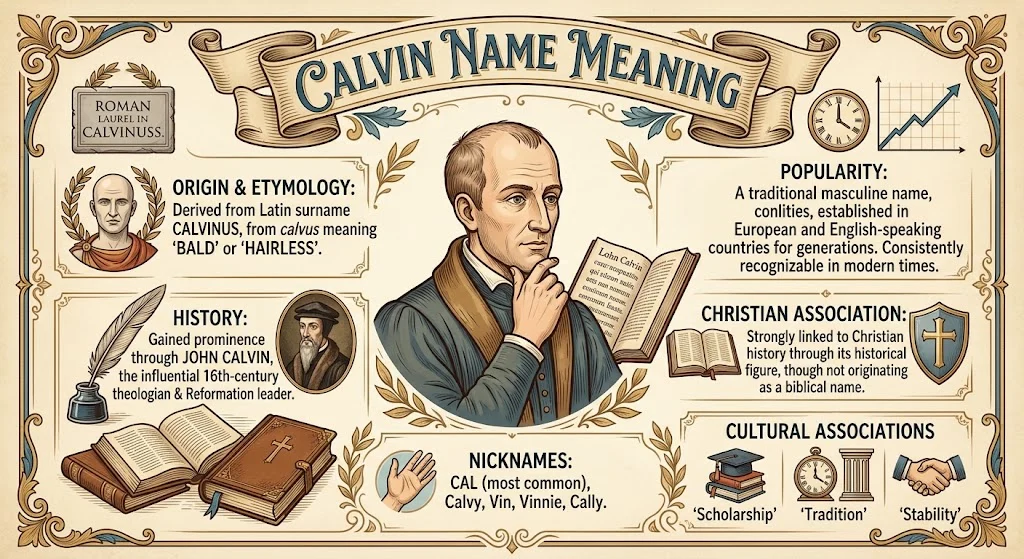
The Calvin name meaning is traditionally connected to the Latin word calvus, meaning “bald” or “hairless.” Calvin developed from the Latin surname Calvinus, a name formed from calvus. Although its literal origin refers to a physical characteristic, the name’s cultural history has given it a much broader identity. Calvin is now recognized as a classic masculine given name with Latin roots and strong historical associations.
The name became particularly notable in European history through John Calvin, the 16th-century French theologian and reformer associated with the Protestant Reformation. That connection helped establish Calvin as a recognizable name in religious and historical contexts.
Today, Calvin has a distinctly classic sound. It can appeal to parents looking for a traditional boy’s name that is familiar, easy to pronounce, and supported by centuries of history. This guide explores the Calvin name meaning, origin, etymology, history, pronunciation, popularity, symbolism, nicknames, variations, and related names.
What Is the Calvin Name?
Calvin is a traditional masculine given name that originated from a Latin surname. The name is ultimately connected with the Latin calvus, meaning “bald” or “hairless.”
Unlike some names that began directly as biblical or religious names, Calvin has a different linguistic path. It developed from a Roman-era Latin naming form and later became established as a personal name in European cultures.
The name is particularly associated with:
- Latin heritage
- European history
- John Calvin
- Protestant history
- Traditional naming
- Classic masculine names
The literal etymology and the cultural associations of Calvin should be kept separate. Its original linguistic meaning refers to “bald” or “hairless,” while qualities such as intelligence, discipline, leadership, or faith are associations people may connect with the name because of its history.
Calvin Name Meaning
The traditional Calvin name meaning is “bald” or “hairless.”
This meaning comes from the Latin adjective calvus, which referred to being bald or lacking hair. The Latin personal-name form Calvinus was derived from this root.
While the literal meaning may sound unusual by modern naming standards, many traditional names originated from physical characteristics, occupations, places, family relationships, or personal qualities.
It is also important not to interpret “bald” as a description of everyone who carries the name. Modern use of Calvin is based on its established identity as a personal name, not on a literal expectation about appearance.
Literal Meaning
The direct etymological association is:
Calvin → Calvinus → Latin calvus → “bald” or “hairless.”
Cultural Meaning
Through its historical use, Calvin has acquired associations with:
- Tradition
- Scholarship
- Religious history
- Seriousness
- Intellectual heritage
- European culture
These are cultural associations rather than translations of the name.
Modern Meaning
For a modern family, Calvin may simply represent a classic, established boy’s name with a distinctive historical background. Parents may choose it because they like its sound, heritage, or association with historical figures.
Calvin Name Origin and Etymology
Calvin has Latin origins.
The name is generally traced to the Latin Calvinus, which was derived from calvus, meaning “bald” or “hairless.” Calvinus functioned as a Latin name or cognomen in the Roman naming tradition.
This gives Calvin an interesting linguistic history because its modern form is not simply an English invention. It developed from an older Latin naming structure before becoming established as a personal name in later European languages.
The basic etymological pathway can be summarized as:
Latin calvus → Calvinus → Calvin
Over the centuries, the name moved through different European cultural and linguistic environments. Its later history was particularly influenced by French and English usage.
Because names often travel between languages, the exact historical development of a personal name can be more complicated than a single direct translation. However, the connection between Calvin and the Latin root calvus is the standard explanation of its origin.
History and Cultural Context of Calvin
Calvin’s historical significance extends well beyond its original Latin meaning.
One of the most important figures associated with the name is John Calvin, the 16th-century French theologian and reformer. He became one of the major figures of the Protestant Reformation, and his writings and theological ideas had a lasting influence on Protestant Christianity.
Because of John Calvin, the name became strongly recognizable in religious and intellectual history.
The association does not mean that Calvin is itself a biblical name. Instead, it became culturally prominent through a historical figure whose influence was connected to Christianity and the Reformation.
Over time, Calvin developed into a personal name used independently of its original historical association.
The name has appeared in English-speaking naming traditions for generations and is particularly recognizable in the United States, Canada, Britain, and other countries influenced by European naming traditions.
Is Calvin a Biblical Name?
No, Calvin is not a biblical name.
Calvin does not originate as a personal name in the Bible. Its roots are Latin rather than Hebrew, Greek, or biblical Aramaic.
However, Calvin has an important Christian historical association because of John Calvin and the Protestant Reformation.
This distinction matters:
- Biblical name: A personal name that appears in the Bible.
- Christian-associated name: A name connected to Christian history or culture.
- Calvin: A Latin-origin name that became strongly associated with Christian history through John Calvin.
Therefore, someone looking for a Christian or historical name may consider Calvin, but it should not be described as a biblical name.
How Do You Pronounce Calvin?
Calvin is commonly pronounced:
KAL-vin
It has two syllables.
The first syllable sounds similar to “cal”, followed by “vin.”
The pronunciation is relatively straightforward for English speakers, which is one reason Calvin works well as an everyday given name.
Is Calvin Easy to Pronounce?
Yes. Calvin is generally easy to pronounce and spell in English.
Its spelling is familiar, and there are few pronunciation surprises. This can be useful for parents who want a traditional name without frequent corrections.
Calvin Name Popularity
Calvin has remained a recognizable boys’ name in the United States for many generations.
According to U.S. Social Security Administration baby-name data, Calvin ranked #153 among boys in 2025, with 2,293 recorded births. The name has maintained a substantial presence in American naming over time rather than appearing as a short-lived trend.
Its long-term recognition gives Calvin an interesting position between traditional and contemporary naming styles.
Calvin is familiar enough that most people recognize it immediately, but it is not generally among the very most frequently chosen boys’ names.
For parents, this can make it appealing if they want a name that feels:
- Established
- Familiar
- Classic
- Masculine
- Easy to spell
- Distinct without being unusual
Popularity can change over time, so current Social Security Administration data are the best source for checking the latest U.S. ranking.
Calvin Name Symbolism
The literal meaning of Calvin does not directly describe personality. Still, the name has accumulated symbolic associations through its historical use.
Intellectual Heritage
The name’s association with John Calvin gives it a connection with theology, scholarship, and written intellectual traditions.
Tradition
Calvin has been used across multiple generations, giving it a classic rather than newly invented character.
Strength and Stability
Its short, firm sound can give the name a strong and grounded impression. This is a stylistic association rather than a historical meaning.
Historical Depth
Calvin connects a modern given name with Latin linguistic history and European cultural history.
These symbolic qualities are subjective. A name cannot predict a person’s personality, intelligence, beliefs, or future.
Calvin and John Calvin
When people encounter the name Calvin in historical contexts, John Calvin is often the first major association.
John Calvin was a French theologian and reformer who lived from 1509 to 1564. He became one of the most influential figures of the Protestant Reformation.
His theological writings had a major impact on Protestant thought, particularly in traditions that later became associated with Reformed theology.
This historical connection helped Calvin become recognizable as more than an ordinary Latin-derived name.
However, parents choosing Calvin today do not necessarily choose it because of John Calvin. Many people simply appreciate the name’s traditional sound and established history.
Common Nicknames for Calvin
Calvin is already a relatively short name, so many people use it in its complete form.
Still, possible nicknames include:
- Cal
- Calvy
- Vin
- Vinnie
- Cally — a less common informal option
Of these, Cal is the most natural and widely recognizable short form.
Nicknames are personal and can develop differently within families, so there is no single required nickname for Calvin.
Calvin Name Variations
Calvin has fewer obvious spelling variations than some traditional names.
The historical Latin form Calvinus is important for understanding its origin, while Calvin is the established modern English form.
In different linguistic traditions, names derived from the same historical roots may take different forms, but not every similar-looking name should be considered a direct variant of Calvin.
For practical modern naming purposes, Calvin is the dominant English-language form.
Famous People and Characters Named Calvin
The name Calvin has appeared in historical, literary, entertainment, and cultural contexts.
The most historically significant association is John Calvin, the French theologian and reformer.
Another well-known cultural association is Calvin, the imaginative young character from the comic strip Calvin and Hobbes. The character helped make the name familiar to generations of readers, although the character is fictional.
These associations give Calvin an interesting combination of historical seriousness and modern cultural familiarity.
Names Similar to Calvin
If you like Calvin, you may also be interested in traditional names with a similar classic sound or historical character.
| Name | Origin | General Style | How It Relates to Calvin |
|---|---|---|---|
| Calvin | Latin | Classic and traditional | Core name |
| Caleb | Hebrew | Biblical and familiar | Similar initial sound |
| Colin | Gaelic/European | Traditional | Similar two-syllable rhythm |
| Clive | English | Vintage | Similar classic character |
| Arthur | Celtic/English tradition | Classic | Strong historical identity |
| Edwin | Old English | Traditional | Similar established feel |
| Julian | Latin | Classic | Shares Latin heritage |
| Martin | Latin | Traditional | Long-standing European use |
These names are not necessarily etymological relatives of Calvin. They are included because they may appeal to parents looking for a similar naming style.
Calvin vs. Similar Names
Calvin can sometimes be confused stylistically with names such as Caleb, Colin, or Callum because of their sounds. Their origins and meanings, however, are different.
| Name | Meaning / Origin | Main Difference |
|---|---|---|
| Calvin | Latin; traditionally “bald” or “hairless” | Latin-origin name with strong historical associations |
| Caleb | Hebrew; traditionally associated with biblical Caleb | Biblical Hebrew name |
| Colin | A European form related to Nicholas | Different linguistic history |
| Callum | Scottish form of Columba | Scottish name with a different origin |
| Julian | Latin, related to Julius | Another Latin-origin classic name |
This distinction is useful when choosing a name based on meaning rather than sound alone.
Is Calvin a Good Baby Name?
Calvin can be a strong choice for parents who want a traditional boy’s name that is familiar but not overly elaborate.
Its advantages include:
- Easy pronunciation
- Straightforward spelling
- Long historical use
- Latin roots
- Strong cultural recognition
- Several possible nickname options
- A classic but approachable sound
The name’s literal meaning, “bald” or “hairless,” may be surprising to some parents. However, most modern name choices are not interpreted literally, and the historical meaning does not define the identity of someone named Calvin.
Its association with John Calvin may also appeal to families interested in religious or intellectual history.
What Does Calvin Symbolize?
Calvin can symbolically represent tradition, historical depth, scholarship, and stability.
These associations come primarily from the name’s long history and famous bearers rather than from its literal Latin meaning.
For example, its connection with John Calvin gives it an intellectual and religious historical dimension. Its continued use as a given name gives it a sense of familiarity and continuity.
Parents may therefore see Calvin as a name that bridges classical heritage and modern practicality.
Calvin Name Meaning at a Glance
| Attribute | Details |
|---|---|
| Name | Calvin |
| Gender | Traditionally masculine |
| Origin | Latin |
| Root | Latin calvus |
| Traditional meaning | “Bald” or “hairless” |
| Historical Latin form | Calvinus |
| Common pronunciation | KAL-vin |
| Syllables | 2 |
| Famous historical association | John Calvin |
| Biblical? | No |
| Religious association | Strong historical Christian association |
| Common nickname | Cal |
| Style | Classic, traditional, established |
| U.S. 2025 rank | #153 for boys |
FAQs
What does the name Calvin mean?
Calvin is traditionally derived from the Latin calvus, meaning “bald” or “hairless.” The name developed through the Latin form Calvinus.
What is the origin of the name Calvin?
Calvin has Latin origins. It developed from the Latin name or surname form Calvinus, which is connected to calvus.
Is Calvin a biblical name?
No. Calvin is not a biblical name. It is Latin in origin, although it has a significant Christian historical association because of John Calvin.
What is the Calvin name meaning in Latin?
The traditional Latin-root meaning of Calvin is “bald” or “hairless,” from the Latin word calvus.
How do you pronounce Calvin?
Calvin is commonly pronounced KAL-vin. It has two syllables and is generally straightforward for English speakers to pronounce.
Conclusion
The Calvin name meaning comes from the Latin root calvus, traditionally interpreted as “bald” or “hairless.” The name developed through the Latin form Calvinus and eventually became an established personal name in European and English-speaking naming traditions. Although its literal meaning describes a physical characteristic, modern use of Calvin is primarily shaped by its long history and recognizable sound.
Calvin also carries an important historical association through John Calvin, the influential 16th-century French theologian and Protestant Reformation figure. This gives the name a strong connection with religious and intellectual history, even though Calvin itself is not a biblical name. Its historical background makes it particularly interesting for families who appreciate names with European, Latin, or Christian cultural connections.
As a modern baby name, Calvin offers a practical combination of familiarity and distinction. It is easy to pronounce, simple to spell, has the friendly nickname Cal, and has remained recognizable across generations. For parents looking for a classic boy name with Latin roots and substantial historical depth, Calvin is a name with a distinctive story.
