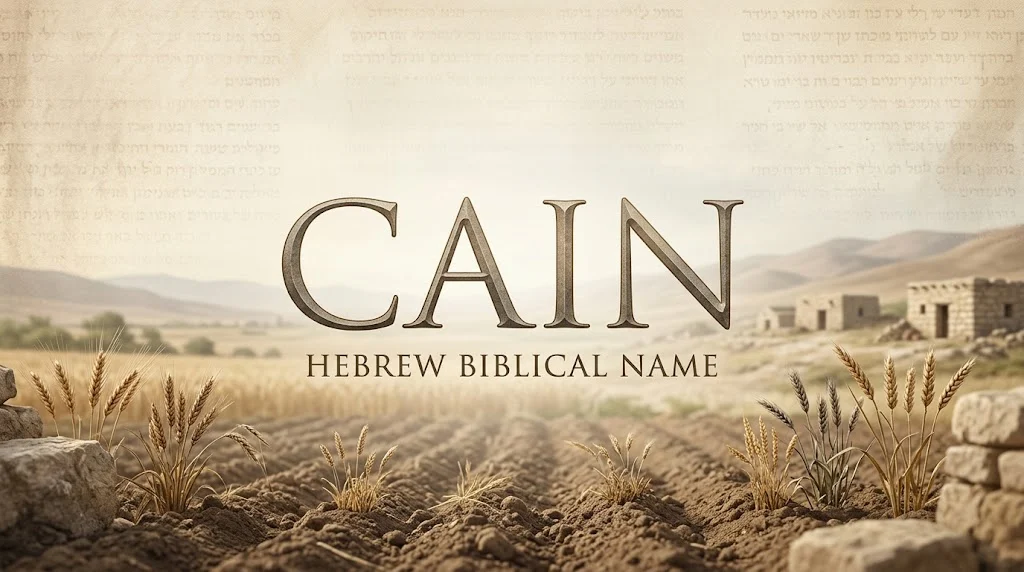
The Cain name meaning is traditionally connected with the Hebrew name Qayin, commonly written Cain in English. The name is associated with the Hebrew verb qanah, often understood as “to acquire,” “to obtain,” or “to possess.” Cain is also one of the most recognizable names in the Bible because he appears in the Book of Genesis as the first son of Adam and Eve and the older brother of Abel.
The story of Cain and Abel is one of the earliest narratives in Genesis and has had a lasting influence on Jewish, Christian, and broader Western culture. Because of that story, Cain has developed symbolic associations that go far beyond its possible linguistic meaning. The name is historically connected with themes such as family, work, jealousy, moral responsibility, and the consequences of one’s actions.
This guide explores the Cain name meaning, Hebrew origin, biblical history, pronunciation, symbolism, cultural significance, related names, nicknames, and modern naming considerations.
What Is the Cain Name?
Cain is a masculine given name with ancient Hebrew and biblical roots. In the Book of Genesis, Cain is introduced as the first son of Adam and Eve after their expulsion from the Garden of Eden.
Genesis describes Cain as a worker of the ground, while his younger brother Abel is described as a keeper of sheep. The two brothers later bring offerings to God, and the biblical narrative develops into one of the best-known stories involving sibling conflict in the Bible.
As a personal name, Cain therefore has an unusually strong connection with a specific biblical character.
The name can be understood through two different layers:
- Linguistic meaning: connected by the biblical text and traditional interpretation with acquiring or obtaining.
- Biblical symbolism: shaped by the story of Cain and Abel and its themes of jealousy, responsibility, choice, and consequences.
These two layers should not be confused. The name’s traditional etymological interpretation does not mean that every person named Cain possesses the qualities associated with the biblical character.
Cain Name Meaning
The traditional Cain name meaning is often explained as “acquired,” “possession,” or “one acquired.” This interpretation comes from the relationship between Cain’s name and Eve’s statement when she gives birth to him.
In Genesis, Eve says that she has acquired a man with the help of the Lord. This creates a word association between Cain’s name and the Hebrew verb qanah, generally translated in contexts as acquiring, obtaining, or possessing.
What Does Cain Mean in Hebrew?
The Hebrew form of Cain is commonly represented as Qayin or Qayyin, written קַיִן.
The precise etymological history of the name has been discussed by scholars, and the biblical narrative itself provides a wordplay-based explanation. For a general name guide, “acquired,” “possession,” or “one acquired” are commonly used explanations.
It is therefore more accurate to describe these as traditional interpretations rather than claiming that one English word provides an absolutely definitive translation.
Biblical Meaning of Cain
The biblical story gives Cain a much more complicated cultural meaning than the literal interpretation of his name.
Because Cain is involved in the story of Abel, the name can evoke themes including:
- Sibling relationships
- Jealousy
- Moral choice
- Personal responsibility
- Consequences
- Work and livelihood
- Human conflict
- Repentance and divine judgment
These are associations created by the biblical narrative rather than direct translations of the Hebrew name.
Cain Name Origin and Etymology
Cain originates from the ancient Hebrew naming tradition found in the Hebrew Bible.
The name is written קַיִן in Hebrew and is commonly transliterated as Qayin or Kayin. The English form Cain developed through the transmission and translation of biblical texts into other languages.
The Book of Genesis itself connects the name with the Hebrew verb qanah, which has meanings related to acquiring or obtaining. This wordplay is part of the biblical explanation for why Eve gives her first son the name Cain.
However, scholars have also examined the possibility that the name may have an older or more complex etymological background. Because of these discussions, responsible name references generally distinguish between the biblical wordplay and claims about a complete historical etymology.
For everyday name research, the most useful explanation is that Cain is an ancient Hebrew biblical name traditionally associated with acquisition or possession.
Cain in the Bible
Cain’s story appears primarily in Genesis 4.
He is introduced as the first son of Adam and Eve. Cain becomes a farmer, while his brother Abel becomes a shepherd.
Both brothers bring offerings to God. The narrative says that Abel’s offering is regarded favorably, while Cain’s offering is not described in the same way. Cain becomes angry and resentful.
The story then reaches its tragic turning point when Cain kills Abel.
God subsequently confronts Cain and asks where his brother is. Cain responds with the famous question about whether he is responsible for his brother. The narrative then describes consequences placed upon Cain, including his becoming a restless wanderer.
Cain is also described as receiving a mark associated with protection from being killed by others. The biblical account does not provide a clear physical description of what this mark looked like.
Cain as a Farmer
One detail that is sometimes overlooked is Cain’s occupation.
Genesis describes Cain as a worker of the ground, while Abel is associated with keeping sheep. This contrast introduces two different forms of livelihood within the story.
The agricultural setting is important because the narrative takes place within an ancient world where farming, herding, family relationships, and land were central parts of everyday life.
Cain and Abel
The names Cain and Abel are inseparable in biblical storytelling because their relationship forms the central focus of Genesis 4.
Abel’s name is generally associated with the Hebrew word hevel, which can carry meanings such as “breath,” “vapor,” or “vanity” depending on context and translation. Cain and Abel therefore have distinct linguistic backgrounds even though their stories are closely connected.
The phrase Cain and Abel has also entered broader cultural language as a reference to intense sibling conflict.
Cain and Abel: What Is the Story About?
The story of Cain and Abel is more than a simple account of two brothers. It raises questions about human emotions, responsibility, violence, justice, and the choices people make when experiencing anger or disappointment.
Cain becomes angry after his offering is not regarded favorably. Before the conflict with Abel occurs, God warns Cain about the danger of allowing sin to control him.
The narrative therefore places emphasis on choice and responsibility.
This is one reason the name Cain carries a complex cultural history. The biblical character is not simply remembered as a villain; the story also explores Cain’s emotions, God’s questioning of him, the consequences he receives, and the protection that is later associated with the mark placed upon him.
History and Cultural Context of the Name Cain
Cain belongs to one of the oldest layers of biblical naming tradition. Because Genesis is foundational to Jewish and Christian scripture, Cain has remained recognizable across many centuries.
The story was transmitted through Hebrew scripture and later translated into Greek, Latin, and many other languages. The English form Cain became established through the history of English Bible translation.
The name also became deeply embedded in literature, art, theology, and popular culture. Writers and artists have repeatedly returned to the Cain and Abel story because it presents themes that are easy to recognize across different societies: sibling rivalry, resentment, violence, guilt, responsibility, and consequences.
This cultural history makes Cain different from a name whose meaning is understood only through a dictionary definition.
How Do You Pronounce Cain?
In standard English, Cain is usually pronounced:
KAYN
It is a single-syllable name and rhymes with words such as:
- Rain
- Main
- Train
- Lane
The pronunciation is generally straightforward for English speakers because the spelling closely corresponds to the common pronunciation.
In other languages, the pronunciation may vary depending on local spelling and transliteration traditions.
Is Cain a Boy’s Name?
Cain is traditionally a masculine given name.
Its biblical origin makes it part of the broader category of biblical boy names. Although biblical names can sometimes develop different patterns of usage over time, Cain has historically been associated with males because of the biblical character.
Parents considering Cain today may view it as a short, distinctive biblical name with a strong historical identity.
Cain Name Symbolism
Cain has some of the most complex symbolism of any biblical name.
Family
Cain’s story begins within the first family described after the creation narrative. His relationship with Abel is central to the biblical account.
Responsibility
God’s questioning of Cain emphasizes the theme of responsibility for one’s actions.
Consequences
The narrative presents serious consequences following Cain’s actions against Abel.
Work
Cain’s identity as a worker of the ground gives the story an agricultural dimension.
Human Emotion
Cain’s anger and jealousy are important elements of the narrative and make the story a discussion of how emotions can influence behavior.
Because these themes are complex, Cain is not generally associated with only positive or only negative symbolism. Its cultural meaning depends heavily on the context in which the name is discussed.
Is Cain a Negative Name?
Cain has a complicated reputation because of the biblical story involving Abel.
Some people may immediately associate the name with the biblical account of violence between the brothers. Others may focus more on the name’s ancient Hebrew origin, its literary importance, or its connection to one of the earliest narratives in Genesis.
For this reason, the name can carry different impressions depending on a person’s religious background, familiarity with the Bible, and cultural context.
It would be inaccurate to say that the name itself means something negative. The traditional linguistic interpretation is related to acquiring or obtaining, while the darker associations come from the biblical character’s actions.
Cain Name Popularity
Cain has remained recognizable in English-speaking naming culture, although its popularity has varied over time.
Its use is influenced by its strong biblical identity and by the fact that it is short and easy to pronounce. At the same time, its association with the story of Cain and Abel may make it less appealing to parents who want a biblical name with predominantly positive associations.
When evaluating the popularity of Cain, current official naming data should be consulted because rankings and birth counts change each year.
Unlike some highly popular biblical names, Cain generally has a more distinctive and historically complex image.
Common Nicknames for Cain
Because Cain is already only one syllable, it does not naturally require a shortened form.
Possible informal variations include:
- C
- Cay
- Caine
- Cai
Some of these forms are better understood as spelling or stylistic alternatives rather than traditional nicknames.
For many people named Cain, the full name is likely to remain the most natural everyday form.
Cain Name Variations
Cain has several related spellings and forms that may appear in different naming or linguistic contexts.
Caine
Caine is a spelling variant that preserves essentially the same pronunciation in English.
Kayin
Kayin can appear as a transliteration or alternate representation in some contexts.
Qayin
Qayin is a scholarly-style transliteration used to represent the Hebrew form more closely.
These forms should not automatically be treated as completely separate names. They can represent different ways of writing or transliterating the same ancient name.
Names Similar to Cain
Parents who like Cain may also be interested in other short biblical or Hebrew names.
| Name | Origin | General Character | Relationship to Cain |
|---|---|---|---|
| Abel | Hebrew | Biblical and classic | Cain’s brother in Genesis |
| Seth | Hebrew | Short and biblical | Another early Genesis name |
| Noah | Hebrew | Familiar and biblical | Another major Genesis figure |
| Enoch | Hebrew | Ancient and distinctive | Early biblical name |
| Adam | Hebrew | Classic biblical | Cain’s father |
| Asher | Hebrew | Traditional and modern | Hebrew biblical name |
| Levi | Hebrew | Short and established | Another biblical Hebrew name |
| Jude | Hebrew/Greek | Short and traditional | Biblical style with a modern feel |
Among these, Abel is the closest historical comparison because Cain and Abel are brothers in the same biblical narrative.
Cain vs. Abel
Cain and Abel are often discussed together, but the two names have different traditional meanings and different cultural associations.
| Name | Traditional Meaning | Biblical Association | General Impression |
|---|---|---|---|
| Cain | Acquired / possession | Older brother of Abel | Complex and historically intense |
| Abel | Breath / vapor | Younger brother of Cain | Short and traditional |
The contrast is especially interesting because both names come from the same ancient narrative but have developed very different cultural associations.
Is Cain a Good Baby Name?
Whether Cain is a suitable baby name depends on personal preference and how important biblical associations are to the family.
Cain may appeal to parents who want:
- A short name
- An ancient Hebrew origin
- A clearly biblical identity
- Easy pronunciation
- A distinctive sound
- A name with significant historical depth
However, the biblical association deserves consideration. People familiar with Genesis may immediately think of the Cain and Abel story.
For families who appreciate biblical history and do not mind the complicated symbolism, that history can make the name especially memorable. Families who prefer names with exclusively positive biblical associations may choose a different biblical name.
What Does Cain Symbolize?
Cain’s symbolism is best understood as complex rather than simply positive or negative.
The name can evoke:
- Family relationships
- Human emotion
- Responsibility
- Choice
- Consequences
- Work
- Jealousy
- Moral conflict
- Protection and judgment
These associations come from the biblical narrative rather than the literal Hebrew meaning of the name.
This distinction is important when researching biblical names. A name’s etymology tells us about its linguistic history, while a famous person’s story can give the name additional cultural meaning over time.
Cain Name Meaning at a Glance
| Attribute | Details |
|---|---|
| Name | Cain |
| Gender | Traditionally masculine |
| Origin | Hebrew |
| Language | Hebrew |
| Hebrew form | קַיִן |
| Traditional meaning | Acquired / possession |
| Biblical figure | Cain, son of Adam and Eve |
| Biblical book | Genesis |
| Sibling | Abel |
| Occupation in Genesis | Worker of the ground |
| Pronunciation | KAYN |
| Syllables | One |
| Related spelling | Caine |
| Style | Biblical, ancient, distinctive |
| Main symbolism | Responsibility, family, conflict, consequences |
FAQs
What does the name Cain mean?
Cain is traditionally associated with “acquired,” “possession,” or “one acquired.” The explanation comes from the connection between Cain’s name and the Hebrew verb associated with acquiring or obtaining in the Book of Genesis.
What is the origin of the name Cain?
Cain is an ancient Hebrew name of biblical origin. It is best known as the name of Adam and Eve’s first son in the Book of Genesis.
What does Cain mean in Hebrew?
The Hebrew form of Cain is קַיִן, commonly transliterated as Qayin. The biblical narrative connects the name with a Hebrew word associated with acquiring or obtaining.
Is Cain a biblical name?
Yes. Cain is one of the earliest personal names presented in the Bible. He appears in Genesis as the first son of Adam and Eve and the older brother of Abel.
How do you pronounce Cain?
Cain is normally pronounced KAYN in English. It has one syllable and rhymes with words such as “rain” and “main.”
Conclusion
The Cain name meaning is traditionally connected with the ideas of “acquired,” “possession,” or “one acquired,” based on the Hebrew name and the wordplay presented in Genesis. Cain is one of the oldest and most recognizable biblical names, and its Hebrew roots give it a strong connection to the ancient biblical naming tradition.
The name is also inseparable from the story of Cain and Abel, which gives it a much more complex cultural identity. Cain’s biblical story explores sibling relationships, jealousy, personal responsibility, moral choices, consequences, work, and divine judgment. These themes have influenced how the name has been understood in literature and culture for centuries.
For modern parents, Cain is a short, memorable, and distinctly biblical choice with an ancient Hebrew background. Its straightforward pronunciation and compact spelling make it easy to use, while its biblical association gives it considerable historical depth. At the same time, its connection with the Cain and Abel story means that families considering the name should be comfortable with its complex symbolism and well-known biblical history.
Discover More Related Articles:
- Elaya Name Meaning | Origin, History, Pronunciation & Significance In 2026
- Tiffany Name Meaning | Origin, History & Symbolism In 2026
