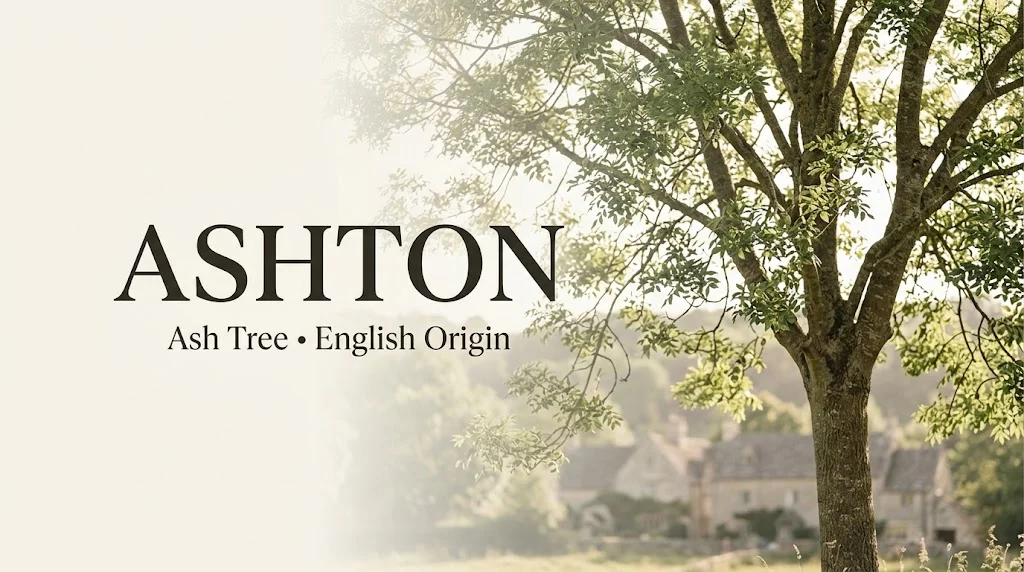
The Ashton name meaning is commonly interpreted as “ash tree town” or “settlement by ash trees.” The name comes from Old English elements associated with an ash tree and a settlement or town. Originally used as an English place name and surname, Ashton gradually became a first name and is now used primarily for boys, although it can also be given to girls.
Ashton has a modern, confident sound while retaining a connection to English history and nature. Its association with ash trees gives it a natural and grounded feel, while its use as a surname-turned-first-name makes it fit comfortably alongside contemporary names such as Mason, Easton, and Hudson.
Whether you are choosing a name for a baby, researching your family history, or exploring the meaning behind your own name, this guide covers Ashton’s origin, pronunciation, history, popularity, nicknames, variations, and cultural significance.
What Is the Ashton Name?
Ashton is a given name of English origin derived from a place name that also became an English surname. Its traditional meaning is connected with a settlement where ash trees grew.
The name is an example of a place-based name. In England, many surnames developed from the names of towns, villages, landscapes, or locations where families lived. Ashton followed this naming pattern before becoming established as a personal name.
Today, Ashton is used primarily as a masculine first name in English-speaking countries, although it is also used as a feminine or unisex name.
Several characteristics make Ashton appealing:
- English heritage: It has a long history as a place name and surname.
- Nature connection: Its meaning refers to the ash tree.
- Modern sound: It fits well with contemporary English-language names.
- Versatility: It works as both a first name and a surname.
- Flexible usage: Although more commonly masculine today, it is not exclusively used for boys.
These characteristics give Ashton a balance of historical depth and modern familiarity.
Ashton Name Meaning
The traditional Ashton name meaning is “ash tree town” or “settlement by ash trees.” The interpretation comes from the Old English elements æsc, meaning “ash tree,” and tūn, meaning an enclosure, homestead, or settlement.
This is primarily a geographical meaning rather than a description of a person’s character.
The Meaning of Ash Tree
The ash tree is a type of deciduous tree found across parts of Europe and other regions. It has a long presence in European landscapes and appears in various cultural traditions.
Because Ashton contains the word element associated with the ash tree, the name can appeal to people who appreciate nature-inspired names.
The Meaning of Town or Settlement
The second element, tūn, referred historically to an enclosure, homestead, or settlement. Its meaning developed over time and is related to the modern English word “town.”
Together, the elements describe a place associated with ash trees.
Modern Symbolic Meaning
Although the historical meaning is geographical, modern parents may associate Ashton with:
- Nature and the outdoors
- Stability and groundedness
- Growth and renewal
- Strength and resilience
- A connection to English heritage
These are modern symbolic interpretations rather than literal translations of the name.
Ashton Name Origin and Etymology
Ashton originated in England and developed from Old English place-name elements.
The first element, æsc, means “ash tree.” The second, tūn, refers to an enclosure, yard, homestead, or settlement. The combination produced place names associated with ash trees or settlements where ash trees were prominent.
Several English locations bear the name Ashton. Over generations, people associated with these places could acquire Ashton as a surname. The surname eventually became established as a first name.
This development follows a familiar pattern in English naming history:
- A location receives a descriptive name.
- People identify themselves by their connection to that location.
- The location name becomes a family surname.
- The surname later gains use as a given name.
Not every place named Ashton necessarily has an identical historical explanation. Some place names have developed through different local histories or have been influenced by other personal names. Nevertheless, the ash-tree settlement interpretation is the widely accepted explanation for the name.
History and Cultural Context of Ashton
Ashton has a strong connection to English geographical and family naming traditions.
Ashton as an English Place Name
England contains multiple settlements called Ashton. One well-known example is Ashton-under-Lyne in Greater Manchester.
Place names were important in historical communities because they helped identify locations and distinguish people from different areas. When surnames developed, a person might be identified by the settlement where they lived or where their family originated.
This helps explain why Ashton became a surname before gaining broader use as a first name.
Ashton as a Surname
Ashton has been used as an English surname for generations. Like many surnames derived from places, it could identify a family’s geographical association rather than a particular occupation or personal characteristic.
Over time, English surnames began to be used as first names, especially in communities where family surnames were preserved as given names.
Ashton as a Modern First Name
Ashton became more familiar as a first name during the late twentieth century. It developed into a recognizable choice for boys and also experienced periods of use for girls in the United States.
The name’s modern visibility has been influenced by popular culture, including actor Ashton Kutcher. However, the name existed long before contemporary celebrities helped bring it to public attention.
Today, Ashton combines an established English background with the style of a modern surname-derived first name.
How Do You Pronounce Ashton?
Ashton is commonly pronounced ASH-tən, often represented as “ASH-tun.”
The name has two syllables:
- ASH: The first syllable sounds like the English word “ash.”
- TUN: The second syllable has a relaxed, unstressed vowel.
The pronunciation is generally straightforward for English speakers.
Although accents can create slight differences in the second syllable, the first syllable remains the main source of emphasis.
Is Ashton Easy to Spell?
Yes. Ashton has six letters and a familiar spelling pattern. Most English speakers can recognize the name after hearing it, although they may occasionally confuse it with similar spellings such as Ashtyn or Ashtin.
The standard spelling, Ashton, is generally the most recognizable form.
Is Ashton a Boy’s or Girl’s Name?
Ashton is used for both boys and girls, making it a unisex name. However, its contemporary usage in the United States is predominantly masculine.
Its history as a first name is particularly interesting because its gender pattern has changed over time. Research into American naming history notes that Ashton became more frequently used for girls during part of the late twentieth century, before becoming more strongly associated with boys again.
Today, parents may choose Ashton for a boy because of its confident, modern sound or for a girl because of its surname-inspired style.
The name does not have a different literal meaning depending on gender. Its traditional English etymology remains the same.
Ashton Name Popularity
Ashton is a recognizable name in the United States and has appeared among popular boys’ names in recent decades.
The U.S. Social Security Administration publishes annual baby-name rankings based on Social Security card application data. Its records allow parents and name researchers to compare the popularity of names across years.
Ashton has been especially familiar to American families since the late twentieth and early twenty-first centuries. Its rise reflects broader naming trends that favor surnames as first names and names ending in the sound “-ton.”
The name also benefits from being familiar without being as timelessly dominant as names such as James or William.
Popularity can vary by country, state, and year, so a specific ranking should always be checked against the relevant official dataset. The fact that Ashton is recognizable does not mean it has the same popularity everywhere.
Ashton Name Symbolism and Personality Associations
The historical meaning of Ashton describes a place associated with ash trees. Its symbolic associations come from the natural imagery and the name’s modern cultural character.
Nature and Growth
The ash tree connection makes Ashton suitable for parents who like nature-inspired names but prefer something that sounds contemporary rather than overtly botanical.
Stability and Groundedness
The word “settlement” suggests a place where people live and build communities. Symbolically, this can bring to mind stability, belonging, and a sense of home.
Strength and Resilience
Some parents associate trees with endurance and resilience. These qualities can become personal symbolic meanings attached to Ashton, although they are not literal translations.
Modern Confidence
Ashton has a clear, two-syllable rhythm and a familiar English spelling. This gives it a confident and contemporary impression for many people.
These associations can make a name feel meaningful to a family, but they should not be treated as evidence of a child’s personality or future traits.
Common Nicknames for Ashton
Ashton is short enough to use in full, but several nicknames can work naturally in family or social settings.
- Ash: A simple, direct shortening of Ashton.
- Ashy: An affectionate nickname that may suit a young child.
- Ashie: A playful spelling of a similar nickname.
- A: A very short informal nickname that may develop within a family.
- Ashton: Some people prefer the full name because it is already concise.
Ash is the most straightforward nickname because it comes directly from the beginning of the name. Nicknames are personal, so the best choice depends on what the individual likes.
Ashton Name Variations
Ashton has several spelling variations, although they are not all equally common.
| Variation | Description |
|---|---|
| Ashton | The standard and widely recognized spelling |
| Ashtyn | A modern spelling variation |
| Ashtin | An alternative spelling with the same general pronunciation |
| Ashten | A less common variation |
These forms generally preserve the sound of the original name while changing the spelling.
Parents considering a variation may want to think about ease of spelling, pronunciation, and how often the child might need to clarify the name. Ashton remains the most established spelling.
Names Similar to Ashton
If you like Ashton, you may also appreciate names with English origins, surname-style structures, nature associations, or a similar modern sound.
| Name | General Style | Connection to Ashton |
|---|---|---|
| Easton | Modern and surname-inspired | Similar ending and rhythm |
| Mason | Familiar and contemporary | Shares a two-syllable structure |
| Hudson | Strong and modern | English surname-derived style |
| Parker | Casual and classic | Another surname used as a first name |
| Sawyer | Contemporary and distinctive | Shares the surname-first-name trend |
| Austin | Familiar and versatile | Similar sound and English-language use |
| Alden | Traditional and understated | Shares an English historical feel |
| Ash | Short and nature-inspired | Connects directly to Ashton’s first syllable |
| Archer | Strong and traditional | Shares a clear, modern masculine style |
| Rowan | Nature-inspired and versatile | Appeals to people who like natural imagery |
These names are stylistically related, but their origins and meanings are different. For example, Easton and Hudson have their own place-name histories, while Mason developed from an occupational surname.
Ashton vs. Similar Names
Ashton can be distinguished from other modern names by its combination of English place-name heritage and ash-tree imagery.
| Name | General Origin or Meaning | Main Difference |
|---|---|---|
| Ashton | English; “ash tree settlement” | Connects a settlement with ash trees |
| Easton | English place name, often associated with an eastern settlement | Emphasizes geographical direction |
| Mason | English occupational surname meaning a stoneworker | Connects with a historical occupation |
| Hudson | English surname meaning “son of Hudde” | Developed through a family-name tradition |
| Ash | English word for the ash tree, also used as a name | A shorter name with a more direct nature connection |
The comparison shows that Ashton belongs to a wider naming tradition in which words, places, and family surnames become personal names.
Is Ashton a Good Baby Name?
Ashton may be a good choice for parents who want a familiar but distinctive name with an English background.
Its main advantages include:
- A relatively simple spelling
- An easy-to-recognize pronunciation
- A connection to nature
- A long history as a place name and surname
- Use for both boys and girls
- A contemporary sound that works well with many middle names
Ashton may be particularly appealing if you like names such as Easton, Mason, Hudson, or Parker but want a name with a direct association with trees and the natural landscape.
One consideration is that Ashton has been used for several decades, so it may not feel completely unusual. Its popularity also varies between communities.
Ultimately, whether Ashton is right for a baby depends on your personal taste, family traditions, and how well it works with the child’s surname and any middle names.
Ashton in Modern Naming Culture
Ashton reflects a broader pattern in English-language baby naming: the transformation of place names and surnames into given names.
Parents often choose these names because they feel established without sounding overly formal. They can also work well across different stages of life, from childhood through adulthood.
Ashton has a particularly versatile quality because it combines a recognizable spelling with a nature-related historical meaning. Its use for different genders also gives families flexibility.
The name is not limited to one cultural or religious tradition. Its origin is English, and its meaning comes from historical language and place naming rather than a specific religious text.
For parents looking for a modern English name with a traceable historical background, Ashton offers a straightforward combination of heritage, natural imagery, and contemporary style.
Ashton Name Meaning at a Glance
| Attribute | Details |
|---|---|
| Name | Ashton |
| Origin | English |
| Language roots | Old English |
| Traditional meaning | “Ash tree town” or “settlement by ash trees” |
| Gender | Unisex; predominantly masculine in contemporary U.S. usage |
| Pronunciation | ASH-tən |
| Syllables | Two |
| Name type | Given name derived from a surname and place name |
| Nature connection | Ash tree |
| Common nickname | Ash |
| Variations | Ashtyn, Ashtin, Ashten |
| Style | Modern, English, nature-inspired |
| Religious association | No inherent religious meaning |
FAQs
What does the name Ashton mean?
Ashton traditionally means “ash tree town” or “settlement by ash trees.” It comes from Old English elements associated with an ash tree and a settlement.
What is the origin of the name Ashton?
Ashton is of English origin. It developed from an Old English place name and was later used as a surname and given name.
Is Ashton a boy’s or girl’s name?
Ashton is a unisex name, although it is predominantly used for boys in contemporary American naming.
How do you pronounce Ashton?
Ashton is pronounced ASH-tən, usually written as “ASH-tun.” It has two syllables, with emphasis on the first.
What is the meaning of Ashton in English?
In English, Ashton is traditionally interpreted as “ash tree town” or “settlement by ash trees,” reflecting its Old English roots.
Conclusion
The Ashton name meaning is traditionally understood as “ash tree town” or “settlement by ash trees.” Its roots lie in Old English, where the elements behind the name described a place associated with ash trees. Originally used as a place name and surname, Ashton eventually developed into a first name with a distinctive blend of historical heritage and modern appeal.
Ashton is a versatile choice for parents who appreciate nature-inspired names but prefer something that feels contemporary and familiar. Its pronunciation is straightforward, its spelling is widely recognizable, and nicknames such as Ash provide an easy informal alternative. Although it is used for both boys and girls, it is more commonly associated with boys in contemporary American naming culture.
Ultimately, Ashton offers a meaningful connection to English history and the natural world without being overly complicated. Whether you choose it for its ash-tree meaning, its modern sound, or its surname heritage, Ashton can be a memorable name for a child and a useful example of how historical place names continue to shape modern naming traditions.
Discover More Related Articles:
- Jamie Name Meaning | Origin, History & Popularity In 2026
- Lenora Name Meaning | Origin, History & Symbolism In 2026
